


CASE FILES - Justice League's "War World"

Updated: Jul 11
NOTE: This article obviously contains SPOILERS. Proceed at your own risk!

Episode Details
Writer: Stan Berkowitz
Director: Butch Lukic
Animation Studio: CNK International (formerly Koko Enterprises Ltd.)
Original Airdate: February 24, 2002 (Part One); March 3, 2002 (Part Two)
Official Summary
When Superman is apprehended by intergalactic slave traders, he is taken to a savage planet called War World and forced to fight in endless gladiatorial games staged for the amusement of Mongul, the planet’s ruthless conqueror (qtd. in Davis).
My Summary
Superman and J’onn J’onzz are abducted by slave traders and taken to War World, a dangerous, troubled planet ruled by the despotic Mongul. While Green Lantern and Hawkgirl search for their friends—and try not to kill each other while doing so—Superman is forced to fight in the arena against Mongul’s champion, the dreaded gladiator Draaga.
Voice Cast
George Newburn as Superman
Phil LaMarr as Green Lantern, Alien Gladiator (Uncredited)
Maria Canals-Barrera as Hawkgirl, Elderly Alien (Uncredited)
Carl Lumbly as J’onn J’onzz
Eric Roberts as Mongul
William Smith as Draaga
Ian James Corlett as Thug, Pilot (Uncredited)
David Paymer as Chancellor
Phil Proctor as First Humanoid, Alien Gladiator (Uncredited)

Background
Often cited as the worst episode of Justice League, “War World” suffered due to a trifecta of budget cuts at Warner Bros. Animation, the ongoing issues related to the weakened, Season One Superman; and a disagreement between the writers and Producer Bruce Timm in regard to how they should approach the material. In a May 2021 interview with the Watchtower Database, Producer and Story Editor Rich Fogel discussed the “painful birthing process” (qtd. in “ZETA”) they experienced during production:
There’s a lot I like about “War World,” but it’s a disappointing episode because Bruce and I were never able to get on the same page of the type of story that we were trying to tell. What [writer] Stan [Berkowitz] and I were hoping to do was something that, in tone, was more like Thor: Ragnarok. We thought that would have been a lot of fun, [but] Bruce was very focused on, “We’re going to be serious; we’re going to logic everything out.” We kept bumping into walls along the way, and having to work around them, and [we] ended up with this thing that wasn’t fun for anybody.
[…] In retrospect, either we shouldn’t have done that story—even though I believed in it—or I needed to find the language to convince Bruce that there was a reason to do it this way and not that way. And I learned that a lot along the way in the second season. (qtd. in “ZETA,” 00:15:47-00:16:50)
(Part of this disconnect among the creative team may have stemmed from an ongoing issue where Timm was reluctant to spotlight Superman in Justice League stories, as he had already had his own series. In the aforementioned Watchtower Database video, Fogel discussed a similar disagreement he had with him over the production of the equally Superman-centric episode “Twilight”; 00:11:06-00:12:03)

Of course, during the episode’s initial promotion back in 2002, the commentary was more positive. With the Academy Award-winning film Gladiator debuting two years prior, the creative team was eager to dust off a notable 1989 Superman story arc where, during a period of self-imposed exile from Earth, the Man of Steel found himself a prisoner fighting in gladiatorial combat for the amusement of Mongul in his first Post-Crisis appearance. Obviously, the creative team made comparisons to Russell Crowe’s wildly popular film, as well as to a more contemporary equivalent, as Bruce Timm stated in a February 23, 2002 interview with Anime Superhero (formerly Toon Zone), “there’s a fair amount of intense hand-to-hand combat scenes—pretty brutal at times. Kinda like a weird cross between Gladiator and [WWE SmackDown] in an interstellar setting!” (qtd. in Harvey, “Bruce Timm Talks”). The excitement would continue the same day in an interview with Comics Continuum, with Rich Fogel also praising the episode, saying how “I thought it would be fun to throw Superman into the gladiator’s ring on an alien world. […] Director Butch Lukic did a stellar job staging the brutal fights in the arena” and “[l]uckily, writer Stan Berkowitz is a [WWE] fan, and he captured the tone perfectly” (qtd. in Allstetter, “New”). However, Timm would pull back slightly months later, admitting in the Part One episode introduction on the 2003 Justice League: Paradise Lost DVD that, while “fun to watch,” the premise was low-hanging fruit:
“War World” is one of those basic ideas that animated series’ have a tendency to do every now and then, where you basically take a real simple kind of idea. It’s like, “Okay, it’s Superman as a gladiator in space.” It is fun to watch; it’s not necessarily as dramatic, you know, as some of our other episodes—it doesn’t have quite as strong a character development as some of the other episodes. Like I said, it’s a very basic kind of an idea—it’s fun to just put Superman in the gladiator arena and watch him go. The two guest star characters [are] Draaga—the alien gladiator, played by William Smith—and Mongul—king of War World, played by Eric Roberts. They, to me, are what really make the episode […] fun to watch; both of them were a joy to work with. (qtd. in “Episode Introduction to ‘War World, Part 1,’” 00:00:00-00:00:46)

The primary villain of this episode, Mongul is a Bronze Age Superman villain who—due to his design, characterization, and reliance on the “super-powered despot” trope—is frequently compared to the similar (and much more popular) Darkseid. Considered a second-tier adversary for the Man of Steel, he is notable primarily for appearing in the classic Alan Moore story, “For the Man Who Has Everything,” published in Superman Annual #11 (September 1985). In a 2003 DVD special feature called “Draw the Dark Side,” Bruce Timm discussed how the creative team adapted Mongul’s visual for Justice League:
The Mongul character, again, appeared in the comics originally, and he was always kind of a second-string villain, I thought. From the very moment they started using him in the DC Comics, he was a second-rate Darkseid, I thought. He’s a big, burly guy who, in fact, in the comics, he’s probably twice as wide as he is in the cartoon. I mean, he’s really, really thick. We had to reduce his bulk a little bit just so he could fit on the screen and, also—just aesthetically—I just think it looks a little bit better to animate a character not quite so blocky, and so we slimmed him down a bit.
I was never very happy with the design of the character in the comics. His costume is very, very basic—it’s very supervillany—it’s boots and shorts and a tunic, and there’s not really anything terribly interesting about his costume in the comics. We had to find a way to kind of jazz him up—to give him a little more production value; to make him look a little bit cooler than he did in the comics. His basic color scheme in the comics is purple and yellow and really pale blue so, looking at the comics, I thought, “Well, okay, instead of making it pale blue, what if all those things that are pale blue in the comics were metallic parts of his costume?” So, we tricked him out a little bit with little silvery things, you know, here and there on his costume, and that helped a lot. We put Mongul in long pants; that helped automatically—you can take him a little bit more seriously if the villain’s not walking around in Bermuda shorts. It’s interesting; I think it’s still very true to the way the character feels in the comics, but the details are different.
When we talked about using him in the Justice League show, again, he was not one of our favorite bad guys, but we thought that might actually make him an interesting villain: the fact that he’s not Darkseid. We already have Darkseid, so why do we need another one? We don’t need, you know, a clone of him. So, we decided to make him more of a Darkseid wannabe; we wanted to make him somebody who wants to be the baddest guy in the universe, but he’s never gonna get there. (qtd. in “Draw,” 00:01:48-00:03:37)
To voice the villain, the creative team tapped veteran actor Eric Roberts, best known for his roles in King of the Gypsies (1978), The Pope of Greenwich Village (1984), and—of particular interest to DC film fans—as crime boss Sal Maroni in The Dark Knight (2008). However, despite his pedigree, there was some initial concern, as Timm laid out in the aforementioned DVD Part One episode introduction:
Honestly, Eric Roberts kind of made us nervous a little bit because he had so many different ideas on how to play this character, and we recorded every single one of them. He’s not consistent through the episode—he doesn’t, you know, sound like the same guy from the beginning to the end. And there are times when he’s real suave, and there are other times when he’s really brutish, and we thought, “Man, we don’t know if this is going to cut together—if this is going to make a consistent character—or what.”
But fortunately, the storyboard artists really focused in on the acting that he had provided in the vocal tracks and played up all these different facets of his personality in the show. And so, when we got the show back, we thought, “Wow, this is great. This is better than if he was just the mean, bad guy.” I mean, he’s vain, he’s arrogant, he’s petty—I think that makes him an interesting character and, fortunately, that’s exactly what Eric brought out in his performance. (qtd. in “Episode Introduction to ‘War World, Part 1,’” 00:01:15-00:02:10)
In his capable hands, Roberts portrayed Mongul with the petty vindictiveness of a third world dictator and the exuberant showmanship of a reality show television host. Timm would later add that “Eric Roberts brought Mongul to life in a way that none of us expected. It’s a very off-beat performance—flamboyant, but menacing—definitely not a ‘poor man’s Darkseid’” (qtd. in Harvey, “Bruce Timm Talks”), while Voice Director Andrea Romano added that “I thought Eric Roberts was terrific as Mongul. I loved it. I wouldn’t say that I felt that was typecasting, because the characters of Eric’s I’m familiar with are much more subtle, odd, and strange, but not nearly as overtly villainous” (qtd. in Rossen 48, 50). As they had done so many times in the past, the creative team was able to take a stock DC villain and make him powerful and threatening in a distinctive, original way.

That said, compared to the small, but significant, adjustments to the episode’s primary villain, “War World’s” secondary villain required a more extensive overhaul. First appearing in Action Comics Annual #2 (June 1989), Draaga was a minor Superman antagonist who only lasted for about three years before his death in Superman: The Man of Steel #10 (April 1992) during the Panic in the Sky event. Believing that the Man of Steel’s refusal to take his life after losing to him in combat was an insult to his honor, the alien warrior eventually made his way to Earth seeking a rematch, wearing the familiar “S” shield as a symbol of his torment. Considering the presence of more notable Superman villains like Brainiac, Maxima, and Doomsday during this time period, Draaga became a historical footnote. Fortunately for him, his origins during the Exile story arc made him a candidate for Justice League, and with that adaption came a full makeover.

Left to right: one panel from Superman #32 (June 1989) and two panels from Action Comics #674 (February 1992). Please note that the black-and-gray Superman in the top right panel is actually the Matrix Supergirl in disguise.
Despite his formidable presence, Draaga—much like other members of Superman’s Rogues’ Gallery—was a victim of poor costuming, with his first outfit (above left) resembling a cross between a gladiator uniform and a hazmat suit from Breaking Bad, and his second one (above right) a DIY Superman outfit that made Bizarro look good. Fortunately, the creative team revitalized the character by taking a page from the Superman: The Animated Series (STAS) playbook, as explained by Timm in an October 1998 interview with The Jack Kirby Collector:
A lot of the Superman villains aren’t nearly as interesting as the Batman villains. Batman has the best rogues’ gallery in comics and the Superman rogues’ gallery is pretty dull. We would take characters like Brainiac and Parasite—that are pretty dull-looking in the comics—and go, “If [Jack] Kirby were designing them, what would he do to them?” So, we would put Kirby-type costumes and Kirby touches on them to make them more interesting. (qtd. in Khoury and Khoury III 18-19)
Seeking to make Draaga more visually compelling, the character designers changed his skin tone from green to gray and dressed him in an outfit that would not look out of place on Apokolips. This redesign was paired with an equally distinctive voice actor, as the creative team hired actor and stunt performer William Smith, best known for his roles in Any Which Way You Can (1980), Conan the Barbarian (1982), Rumble Fish (1983), and Red Dawn (1984). In the aforementioned February 23, 2002 interview with Comics Continuum, Rich Fogel discussed how Smith’s distinctive voice changed the character further:
I thought Draaga could be an interesting character to explore with his warrior’s sense of honor. [William] Smith played in so many B [movie] biker films, but [he] is probably best known for his brawl with Clint Eastwood in Any Which Way You Can. His voice was so wonderfully tough and grizzled, we actually altered the model and made Draaga older. Now Draaga looks like he’s survived years of battle in the arena. He’s a complex and compelling character. (qtd. in Allstetter, “New”)
Timm would also laud the performance in the aforementioned interview with Anime Superhero (formerly Toon Zone):
William Smith is just freakin’ wonderful as Draaga. I’ve been a fan of his work for years; it was great fun having him in the show. You won’t believe the sound of his voice. It sounds like chunks of granite being scraped together. And that’s his actual speaking voice; he’s not putting it on! I even had to go back and make the character design more savage after the recording. The visual didn’t do his voice justice! It’s not just the quality of his voice; his delivery was spot-on as well … scary, but soulful. (qtd. in Harvey, “Bruce Timm Talks”)
And Timm would later continue, in the aforementioned DVD Part One episode introduction:
William Smith, you know, it’s like I remember him from Rich Man, Poor Man [1976], and he was the main bad guy. But he is a terrific actor and, you know, has a real deep, scary presence to his voice; he was exactly what we were looking for for the part of Draaga. He’s also got that innate nobility to him, even though he sounds like a savage, he’s got like this real rigid code of honor, which is, of course, what the character is all about. (qtd. in “Episode Introduction to ‘War World, Part 1,’” 00:00:46-00:01:06)
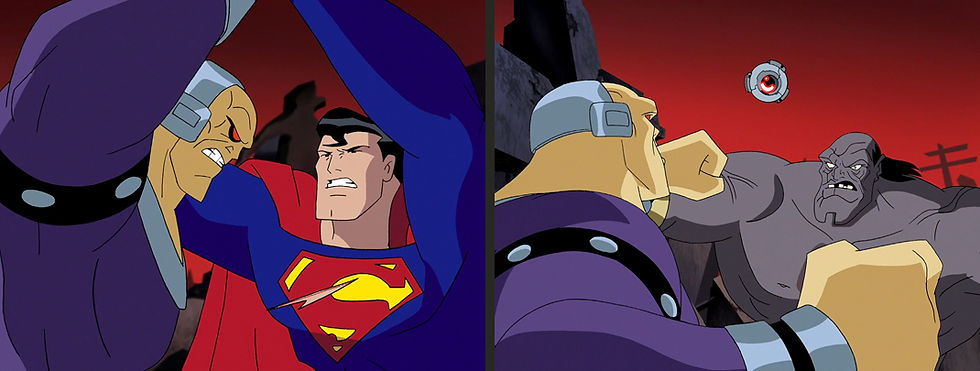
Unfortunately, despite the ingredients added to the pot, the resulting stew was not satisfying to the fan base, with particularly vocal viewers criticizing it for its deficient storytelling, contrived plot devices, and poorly used characters (see “Commentary” below). In a September 24, 2002 interview with The World’s Finest, Timm admitted that, while the episode “had [its] moments,” “War World” was “noticeably below-par” (qtd. in Harvey, “Bruce Timm: Return”), and he would later expand on this observation in a 2004 interview with RetroVision CD-ROM Magazine:
Most people consider this the weakest Justice League [episode] of all the ones we’ve done. I would pretty much have to agree. It’s a basic story that almost every fantasy adventure / science fiction show has to get around to at some point or another, whether it’s the original Star Trek or Angel, there’s always going to be that show where the character has to go fight in an arena. Obviously, we were coming on the heels of Gladiator, which had come out just a year or two before that. I thought it was a story worth doing, I just wish it had developed in a way different way than it actually had. I think having J’onn J’onzz there and conveniently powerless just really drags the story down. [Also, Superman falls into the] whole big cliché of the hero who says, “I won’t fight for your entertainment,” and then [he] ends up fighting for your entertainment.
The big problem with it is that the story is structured in such a way that you really want Superman to clean Mongul’s clock by the end of the story. Unfortunately, the way Draaga’s story goes, you want him to clean Mongul’s clock by the end of the story as well. In the first draft of the script, Draaga was a character who had nothing to do, and you wondered why you went through the trouble of setting him up. So, then we were stuck in a situation in which both Superman and Draaga kind of have to take on Mongul. We were kind of between a rock and a hard place. I admit we dropped the ball on that one, but that’s just the way it goes. (qtd. in Gross 11-12)
If there was an advantage to be had from this incident, it would be the changes made to developing and writing the scripts as, in his aforementioned interview with the Watchtower Database, Rich Fogel spoke of how, “[b]ecause we were so short-handed, we decided—in the second season—that we would do some writer’s room things with Bruce and James [Tucker] and Stan, and that helped us get on the same page more so that we didn’t have things like ‘War World’ happen to us” (qtd. in “ZETA,” 00:15:31-00:15:46).

Commentary
As stated above, it has been established by both the creative team and fans that “War World” was bad, but was it really as bad as people made it out to be? I mean, sure, the Roman Colosseum / professional wrestling / ultimate fighting angle was a little trendy at the time (and still is, actually), and the Justice League creative team was still getting a handle on New Supes, but the episode did deliver with the “wonderfully eccentric” takes on both Mongul and Draaga (Harvey, “Bruce Timm: Return”), and it also gave us the beginning of the long-term, star-crossed relationship between Green Lantern and Hawkgirl. Of course, as alluded to above, there was more at play than one episode being a stinker, as it was largely a victim of timing, considering the series’ protracted growing pains.
Flashback, if you will, to development and production of Season One, and consider the state that the creative team found themselves in. They had just moved to Cartoon Network after decade of working in children’s programming for both Fox and the WB Network, with the latter being marred towards the end by executive mandates and interference. They just completed the order of 52 episodes for Batman Beyond, which they often worked on while simultaneously working on STAS and The New Batman Adventures (TNBA; Avila), as well as Batman Beyond: Return of the Joker, which underwent extensive retooling following public outcry over violence in children’s media (Allstetter, “Batman”; Archie). After finding further work at Kids’ WB! untenable, they made the jump to basic cable, but—along the way—they lost two of their senior producers, Alan Burnett and Paul Dini, two of the creators who, along with Timm, were often credited with making Batman: The Animated Series (BTAS) the institution that it became. Add to that massive budget cuts at Warner Bros. Animation, along with an ethos stating that “good was good enough” when it now came to their product (“ZETA,” 00:13:23-00:13:51), and Justice League began its life in a very precarious spot.
Possibly due to their experiences with the darker Batman Beyond, and the subsequent fights with Broadcast Standards & Practices, the creative team elected to make Justice League less so, at least at first, as Bruce Timm discussed in a January 2000 interview with Starlog:
There’s an ongoing internal debate with us: how adult do we want the show to be? The first three-parter aside, we’ve made a strong effort to tone down some of the more adult-themed stuff. Batman Beyond is as far as we want to go within the superhero genre, in terms of making things really dark and intense. There have been situations in the scripts where I’ve felt we were being too ironic or cynical, a bit too adult. (qtd. in Jankiewicz 33)
However, Timm later admitted—in an April 2003 interview with the now-defunct website The Pulse—that their attempted course correction did not have the effect that was intended:
Don’t get me wrong, I think we did a lot of really good shows the first season, but there was an overall kind of blandness about it. There was maybe a little too much reliance on “been there, done that” clichés, particularly in terms of the [dialogue]. […] That was the thing, we literally made a conscious effort in the first year to see if we could make the show entertaining and maybe not as dark as some shows we’ve done in the past. The only problem is, when we took out the dark edge, we didn’t really replace it with anything comparable. Again, we were trying to make the show maybe a little bit more family-friendly, but it just got a little bit bland. It was a good show, but there were some things that kept it from being great.
[… The criticism] is not just from the Internet fans, I’ve got to point this out. It’s also from people I just talk to, people I know in the industry. A lot of people were saying, “Yeah, Justice League is a good show, but it’s not quite as good as the shows you’ve done before.” I heard that from a number of people—Alex Ross read me the riot act for almost an hour. (qtd. in MacDonald)
In retrospect, Timm wrote off Season One as a “shakedown cruise” (qtd. in MacDonald; qtd. in “Inside,” 00:08:08-00:08:10), adding “[w]e were working really hard, and it was a hard show to do but, on the other hand, I think just the enormity of the project was kind of daunting, and we kind of let it cow us a little bit. We kind of let it intimidate us to the point where we made mistakes based on fear” (qtd. in “Inside,” 00:08:10-00:08:24). Committing himself to making a good show even better, Season Two brought many changes to their storytelling, as well as how that storytelling was hammered out by the creative team (see “Background” above). During the DVD commentary for “Twilight, Part 2,” Timm explained the show’s new mandate compared to what came before:
Season One we had a tendency—because we had so many things to do in the show because this show is just huge. There’s just so much involved in doing the series—design work and everything—that, you know, we knew we weren’t gonna be able to win every battle, so we would get things to a certain point and say, “Okay, that’s good enough; it’s approved. Let’s move on.” And, for Season Two, we kept saying, “You know what? Good enough isn’t good enough.” You know, […] if I’m seeing a background, and it looks good, what can we do to make it great? And so, I did that all throughout Season Two—just cracking the whip over all the artists, just like, “Okay, it looks good; make it great.” […] It’s not necessarily dark, but it’s intense. It’s edgy, you know? The show doesn’t necessarily have to be dark, but it has to be intense. You have to be in the moment, and in Season One you were rarely in the moment (qtd. in “Commentary,” 00:03:45-00:04:47)

Following the logic of this narrative, “War World’s” problem wasn’t that it was bad necessarily—it was merely good enough, considering the circumstances it was developed in, which begs the question: could it have been better? What if the episode was produced during Season Two rather than Season One? What follows is a thought experiment where “War World” was made in a working environment where the creative team learned the mistakes of Season One and—more importantly—had the advantage of the newly-hired, full-time writer and Story Editor Dwayne McDuffie to help out.
Assisting me in this essay, albeit from over two decades in the past, is Jay Allman, also known as Maxie Zeus on the Anime Superhero (formerly Toon Zone) message boards. A seasoned animation scholar, reporter, and creator of The Animated Batman website (currently accessible on the Internet Archive), I have referenced his work before and—on March 5, 2002—he wrote two message board posts laying out what went wrong with “War World,” as well as his thoughts on how it could have been fixed. With his help, and the benefit of hindsight, I intend to build the Man of Steel a better colosseum.
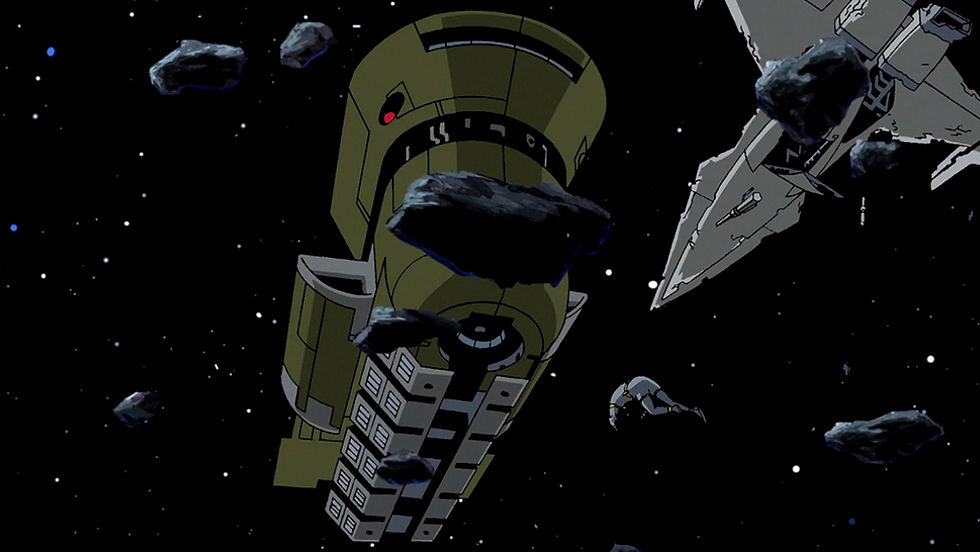
To summarize, Allman laid out a partial rewrite of the episode, removing unnecessary coincidences, lapses in character, and—most importantly—J’onn J’onzz, who did little to nothing to contribute to the action, as “something” about War World’s atmosphere weakened him (as stated above, even Bruce Timm later acknowledged that he was unnecessary to the plot; Gross 11-12). To begin, rather than have the League accidentally blow themselves up, allowing a slaver ship just happening to pass through the solar system the opportunity to harvest the survivors, the new script would feature Mongul taking a more active role in the proceedings:
[L]et it not be an accident that strands Superman but an ambush, perpetrated by Mongul in order to capture him. So, Superman is out investigating a derelict spaceship. The reactor fluctuates, and it explodes with him inside (a ploy to cover up the intentional nature of the trap). Immediately after, a ship decloaks and scoops up Superman. On the bridge, the captain receives a transmission from Mongul: “Have you retrieved that package I sent you to pick up?” “Yes, m’lord,” he replies. “The Kryptonian is now your prisoner and awaits your pleasure on War World.” At one stroke, the incident is no longer due to Supes’ idiocy but the cunning of an adversary. Second, the coincidence is eliminated; the slaver was waiting for him. As a dividend, Mongul is immediately set up as a smart, ballsy, and ruthless adversary, and one (we may expect) with a trick or two up his sleeve he can use to keep Superman trapped and off-balance. (Maxie Zeus)

This premise works much better when you consider Superman’s off-planet activities, both on STAS (“The Main Man,” “Warrior Queen,” “Absolute Power”) and on Justice League in episodes like “In Blackest Night” (before anyone brings up the detail that the creative team wanted to break from the continuity of previous shows at first [“Unlimited”], let me remind you that “War World” is taking place in Season Two here). Even in a galaxy as vast as ours, word would get out that an altruistic Kryptonian was sighted on an inhabited planet in the Orion-Cygnus Arm, and Mongul—seeking newer and more powerful fresh meat for his arena—would be eager to add him to the roster. Simply put, a Mongul who actively does his homework and sets a trap to obtain the big score comes off as impressive in the eyes of the audience, while one who passively happens to fall bass-awkwards into one doesn’t.

Due to League members being tied up on other missions, only Green Lantern and Hawkgirl are available to investigate Superman’s disappearance … which is a good thing, as these are the only two that have had extensive off-planet experience (aside from J’onn J’onzz, but he probably spent all of his stuck on Mars). Now, of their pairing, Allman was largely positive, saying how “[a]lthough some scenes could have been sharpened—even here, there’s too much ‘placeholder’ dialogue—there isn’t a single scene involving them that didn’t work” (Maxie Zeus). Looking back, it is easy to see how these two intergalactic military officers would hit it off, as “when paired they come off as a cranky married couple who have lived together for so long that they’ve picked up each other’s habits” (Maxie Zeus). Coming through in the end to destroy Mongul’s doomsday weapon and provide necessary backup, the majority of their screen time would feature their search for Superman as it transforms into a buddy cop / screwball comedy caper. Hopefully though, in this version, Green Lantern would either charge his ring or bring his power battery along to avoid the forced plot point of him potentially running out of energy mid-mission.
Meanwhile, Superman wakes up in a War World prison and, despite Mongul’s best efforts, he manages to escape his cell. As he is currently unaware of Mongul and his intentions, the Man of Steel attempts to find answers directly, rather than sneak around the prison inviting scenes where he has to fight robot guards. Allman described how this would play out:
Now, the plot requires that the hero be put in jeopardy. There are basically two ways to do that. First, you can make your character so weak that he can be overwhelmed by whatever you have on hand to hit him with (in this case, robots with lasers) or you put him in a situation in which, despite his best and truest efforts, he is consistently wrong-footed. […] Supes should break free and march right up to the guards, hotly demanding to know what the hell and why the hell (or words to that effect; no cursing in the cartoon, you know). He should demand to be taken to whoever is in charge. They should gladly accede and lead him to the platform that takes him to the arena. When it arises, he is surprised to suddenly find himself faced by the mob. He should be astonished to hear Mongul’s speech. And he should be outraged when he is suddenly transported to War World and attacked by Draaga. In short, he should be kept off-balance and unprepared until it is too late.
[…] Supes, confused, refuses to fight back until Draaga actually slashes his chest with the blade, drawing blood. Supes, stung into seriousness, glowers back, “All right, let’s make this quick.” He heat-visions the blade, melting it in Draaga’s hand. Draaga quickly grabs a boulder and tosses it at Supes, who demolishes it with one punch; a big fragment lands on Draaga, knocking him on his back. Supes steps forward and extends a hand to help him up. Draaga grabs it, pulls Supes down; they roll across the ground, then stagger up. Draaga clutches Supes on the shoulder and pulls his fist back to land a haymaker. Behind him, the background suddenly drops away. Draaga pauses, looks around, and down. A long shot shows him and Supes hanging 100 feet in the air. Superman smiles nastily at Draaga and firmly pushes him away. Draaga falls to the ground and lays still.
Back in the arena, the crowd moans. Mongul watches impassively.
Back on War World, Supes looks down and smiles. He looks up, and his face falls. Point-of-view shot: the ruins of War World stretch into the horizon, over which suddenly looms the lip of a rising red sun. Superman whirls and looks behind him. The golden orb of a yellow sun is disappearing below the opposite horizon.
In the arena, Mongul grins.
On War World, Draaga staggers up, picks up a huge boulder, and tosses it at Supes, still air borne. Supes grimaces and charges, landing body blow after body blow, plainly desperate to knock out Draaga while he has the strength. Draaga falls back but never stumbles. [Then] Supes pauses, winded, and Draaga swings back, and lands body blow after body blow. (Maxie Zeus)

Allman does not end the scene, but let’s say that, for the sake of argument, it mirrors the original fight in Part One: Superman knocks out Draaga and then refuses to kill him when Mongul demands it. Enraged, the despot orders his robots to kill Superman. Now, in the original episode, this is where J’onn J’onzz—having been dead weight in the script so far—rallies the crowd to cheer for Superman, forcing Mongul to stay his hand. However, in his version, Allman offers a different option that validates his decision to bench the Martian:
[W]hy does a hero have to be on hand to lead a chant that saves Superman’s life? If the people themselves spontaneously rise, it puts Mongul in a more dangerous position. It makes clear the extent to which these people are not under his control, and [it] gives him a reason to be a lot more ruthless because he looks a lot more desperate. That sharpens the conflict. (Maxie Zeus)

Here, much like Maximus in Gladiator, Superman begins to win the populace away from Mongul, who—despite his general contempt and indifference for them—wants the crowd to love him as much as they fear him (after all, why else would he grandstand in the arena?). Consider the words of Senator Gracchus, from Gladiator: “Rome is the mob. Conjure magic for them, and they’ll be distracted. Take away their freedom, and still they’ll roar. The beating heart of Rome is not the marble of the Senate; it’s the sand of the Colosseum. He’ll bring them death … and they will love him for it” (01:05:42-01:06:05). In many ways, Mongul is very similar to the film’s Emperor Commodus—barely statesmen, they thrive on conflict and spectacle, and they also recognize that they can maintain their grip on power as long as they possess the loyalty of the mob. And Mongul does … until Superman.
Over the course of several days or weeks, Mongul maintains enough power over Superman to keep him imprisoned and fighting but, gradually over time, more and more of the crowd gravitates towards him. Incensed, Mongul exhausts his store of gladiators, sending bigger and crazier opponents to face off against him, trying to put him in a position where it’s either kill or be killed. This would be great opportunity to plunder Who’s Who to pull some deep-cut cameos. Fatality. Ultra the Multi-Alien. Ferrin Colos, of the Darkstars. Warriors from the Daxamite and Khund species. Members of the Omega Men and L.E.G.I.O.N. teams. Superman defeats them all, and he further angers Mongul by refusing to kill them once defeated. The mob begins to applaud him specifically for his mercy. Meanwhile, Draaga, having been spared by Superman, rots in prison, his demands for a rematch falling on deaf ears. Eventually, he escapes, seeking another way to regain his honor by killing, or by getting killed, by Superman.
Finally, Mongul has had enough. He elects to fight Superman directly in exchange for his freedom, and Superman—intending to depose Mongul and free War World—agrees. By this time, his costume is shredded, forcing him to wear a more gladiator-themed outfit like the one from the comics, using the remains of his red cape as part of a toga. Meanwhile, Draaga plans to insert himself into their conflict, and Green Lantern and Hawkgirl successfully track Superman to War World via an unlikely source: Space Cabbie (hey, why not?). These factions coalesce in time for the big Superman / Mongul showdown, but the warlord still has an ace to play with his kingdom hanging in the balance.
Much like Jay Allman twenty-four years ago, I’m going to stop here, fully confident that the creative team would be able to complete this story with the same creativity and flair that they completed episodes like “Maid of Honor,” “The Terror Beyond,” and “Hereafter” with. Still, I think I’ve proven my point—while the end result was not ideal, the story definitely had potential and, had circumstance been different, I’m convinced that “War World” would have floored audiences for reasons other than its banality.

Stray Observations
The title of this episode, “War World,” is obviously a reference to the location of Mongul’s empire. While merely the name of a planet in the Justice League animated series, in the comics, however, it is a Death Star-like, mobile artificial world that Mongul used for both military aggression and gladiatorial games.

As stated above, the episode’s story is based upon a segment of the 1989 Superman story arc Exile, where Superman—experiencing PTSD and fearing that he was too dangerous to remain on Earth—leaves his adopted homeworld for a sojourn through space. The specific issues featuring Mongul, Draaga, and War World include Adventures of Superman #454 (May 1989), Action Comics Annual #2 (June 1989), Superman #32 (June 1989), and Adventures of Superman #455 (June 1989).
Also, as stated above, the 2000 release of the film Gladiator no doubt stimulated the creative team’s interest in adapting the aforementioned story during early production.


The episode begins with Superman, Hawkgirl, and J’onn J’onzz preparing to blow up an asteroid that—based on context clues—may be preparing to collide with Earth. Of course, it doesn’t help that the action occurs around Saturn, a location known for its rocky debris. Despite the fact that Hawkgirl describes the asteroid as “three and a half miles across” (the debris in Saturn’s rings are much smaller), it does kind of look like it originates from out of one of the planet’s ringlets rather than just passing through the area.
It’s also worth mentioning that, while an asteroid that size wouldn’t necessarily destroy the planet (that would necessitate a rock about seven to eight miles wide; Brain and Gleim), it certainly would be devastating to our civilization (for information about historical asteroid impacts for comparison, check out this article, by Tereza Pultarova).
Since this article already heavily features comparison to contemporaneous blockbuster movies, it is worth noting that two films featuring celestial bodies threatening to collide with Earth—Armageddon (1998) and Deep Impact (1998)—were both freshly out on home video when this episode was written.

Apparently one of the trio failed to fully analyze the asteroid before setting the detonators, as the bomb ignited some “hydrogen pockets” that made the explosion bigger than they anticipated. By the way, considering where Superman, J’onn, and the Javelin-7 were situated compared to the asteroid, were they really far enough away to begin with? For that matter, the asteroid was moving, presumably continuing its orbit around the sun, while the Javelin-7 was technically parked. How does that work?
For that matter, why blow it up? Couldn’t they just redirect it before it approached Earth? Or push the thing into orbit around Saturn, or just let it crash into the planet and let its atmospheric conditions take care of it? I guess the creative team really wanted to start the episode with a bang.


Considering the vastness of space, what an amazing coincidence that a slaver ship just happened along to scoop up the last Kryptonian and the last Martian when it did! I mean, does our solar system cross any trade routes, or is it located near any galactic landmarks that would increase traffic? Imagine walking the entire shoreline of New Jersey and, at one point, just stopping at random to dig a hole in one spot only to find a diamond ring and a ruby earring in the same hole. Rewatching this episode twenty years later, I really wish it was Mongul setting a trap for them.

With two of the Justice League’s powerhouses missing, only Green Lantern bothers to report in, and his concern manifests as low-key accusing Hawkgirl of screwing up. The look of frustration on Shayera’s face implies that John has been venting for a while.


Superman wakes up in chains, finding himself in the gallows of a ship surrounded by a host of background charact—I mean, imprisoned aliens. With his captors in his line of sight, all he has to hear from their conversation is how he’s “a rare specimen” who will “do well on War World” to understand what’s about to go down.

Located somewhere in the Milky Way Galaxy, War World appears to be a planet inhabited by a non-homogeneous civilization that is largely impoverished. Orbiting it is an unnamed moon that appears to be inhabitable, but some sort of unknown calamity destroyed its infrastructure, leaving nothing but semi-demolished buildings and other ruins. Apparently uninterested in rebuilding it, Mongul instead uses it as a staging area for his gladiatorial fights, teleporting warriors over and watching them battle in the apocalyptic surroundings. Essentially, it’s Gladiator with a healthy dose of The Running Man (1987) thrown in.
Just like with “In Blackest Night,” during the various crowd scenes in the colosseum, please recognize the reuse of background character models from the two-part STAS episode “The Main Man.”

Standing proudly on the stage is Draaga, War World’s gladiator champion. As stated above, he first appeared in Action Comics Annual #2 (June 1989) as a minor Superman character who saw the Man of Steel’s refusal to slay him in battle as an insult to his honor.
Again, Draaga is voiced by actor William Smith, a man possessing a voice that, as described by Bruce Timm, sounds like “chunks of granite being scraped together” (qtd. in Harvey, “Bruce Timm Talks”). I don’t know about the rest of you, but I half-expected him to grab a guitar and break into a rendition of Motörhead’s classic, “Ace of Spades.”
Apparently the episode’s writer, Stan Berkowitz, had met Smith prior as—according to the February 6, 2024 installment of the Justice League Revisited podcast—he had previously interviewed him as a journalist for the L.A. Times, but “he had no idea who I was when he showed up to do the episode. Didn’t remember the article; didn’t remember anything” (qtd. in Eisenberg and Enstall, 00:14:20-00:14:32).
Also, during the podcast, Berkowitz gave his thoughts about the performance, including the detail that Smith apparently arrived to the recording session in a state of inebriation:
A woman he was with—I think it might have been his wife—explained that he’d had terrible back pain. Smith was an athlete, an obvious bodybuilder for a long time, and it gets to you. He had terrible back pain, so he was medicating it inexpensively with a bit of alcohol. But in watching the show, there’s no sense that he was incapacitated at all. I thought he did a great job.
Yeah, he did a great job. I mean, he was—I didn’t even recognize him; he had aged so much. He was in his late 60s and, somehow, went on to live another twenty years after that. But his work really stood out. A great, raspy voice, and I think it was Andrea who told me that when they called his agent because they wanted William Smith, the agent said, “Are you sure? Are you sure you don’t want Will Smith from Fresh Prince?” “No, we want William Smith. We want that raspy voice.” And he was terrific. (qtd. in Eisenberg and Enstall, 00:14:40-00:15:36)
The following is Cartoon Network’s profile for Draaga: “Superman defeated Draaga, a disgraced intergalactic gladiator, in the arena but refused to kill him, depriving Draaga of an honorable death. Now, Draaga must live with his disgrace, and his honor cannot be restored until he kills Superman or dies trying. As a symbol of his shame, he wears Superman’s shield on his chest” (qtd. in Allstetter, “Justice League Characters”).

Making his debut in DC Comics Presents #27 (November 1980), Mongul is—in a nutshell—all of the power of Superman but none of the humanity. Frequently used as a Superman villain, he has also increasingly become a foe of characters in the Green Lantern comics, particularly Hal Jordan and Sinestro.
Critics of Mongul are technically incorrect when they say he is merely a copy of Darkseid, as he is—in fact—a copy of a copy. Darkseid first appeared in Superman’s Pal Jimmy Olsen #134 (December 1970) and, after debuting Thanos in Iron Man #55 (February 1973), creator Jim Starlin was allegedly prompted by Editor Roy Thomas to borrow the look of the New God for his character (Cronin). Later, when he shifted over to DC Comics, Starlin co-created Mongul with writer Len Wein. In a November 2024 interview with Comic Book Historians, he admitted that “when I went over to DC after I left Marvel the first time, I […] created Mongul, and he was definitely supposed to be Thanos over in the DC Universe” (qtd. in “Jim,” 00:42:37-00:42:47).

Originally a member of an undetermined race, after DC Rebirth Mongul has been identified as being of the Warzoon, who were originally a separate, red-skinned species Pre-Crisis.
The following is Cartoon Network’s profile for Mongul: “The ruthless ruler of a vast intergalactic empire, Mongul amuses himself with endless gladiatorial games staged on a barren planet called War World” (qtd. in Allstetter, “Justice League Characters”).

Draaga’s challenger, Krodar the Terrible, is an original creation for the episode. At best, the use of an abstract, tentacled creature was previously done with the shoggoth, in the STAS episode “The Last Son of Krypton, Part 1.”
Krodar’s use in this scene was a shrewd move on behalf of the creative team, as Broadcast Standards & Practices is less likely to object to the slaying of a nonhuman entity bleeding black ichor rather than biped with traditional red blood.

The fight between Draaga and Krodar the Terrible was necessary to the plot for 1) showcasing Draaga’s skill in the arena, and 2) breaking up the largely dialogue-heavy scenes we’ve had so far in this episode.

During the fight, there is an animation error when Krodar, who is anchoring itself by wrapping its tentacles to pipes on the underside of a structure, is shown wrapping its tentacles around a pipe that is actually a foot or so to its left (above left). This error is corrected in a later scene (above right).

Following Krodar’s less than stellar debut on the battlefield, Mongul calls up his slavers to threaten them and, in response, the captain informs him about their capture of a Kryptonian. Based on his lack of reaction—and his ignorance of Krypton’s destruction in Part Two—I don’t think Mongul has heard of them.
Come to think of it, the slavers knew of the Kryptonian race, but they expressed no familiarity with the Martians, as they also obtained J’onn J’onzz, a being of similar, formidable power. Now, according to comic book issues such as Superman Adventures #3 (January 1997; DCAU tie-in) and Action Comics #14 (January 2013; Post-New 52), the planet Krypton was located twenty-seven light years from Earth, implying that its destruction occurred sometime in the past thirty years or so. However, by my estimate (according to “Secret Origins”), the destruction of the Martian civilization occurred anywhere from 500 to 1,000 years ago. Considering the time frame, it stands to reason that Kryptonians are still remembered in the DCAU, while the Martians are a distant memory.

Green Lantern and Hawkgirl travel to Saturn to inspect the wreckage of the Javelin-7. Man, Batman’s gonna be pissed.

Using his ring, John Stewart is able to locate the ion trail of a passing ship, presumably the one that may or may not have abducted Superman and J’onn, and they elect to follow the trail to its source. I sure hope the ring can figure out whether the ions are “fresher” one way as compared to the other, otherwise they’ve got a 50/50 chance of tracking the trail the wrong way.


Coming to in Mongul’s dungeon, Superman has a less than friendly encounter with Draaga before breaking out of his chains. He showed incredible restraint here; I could very easily see most of the rest of the Justice League taking him down then and there.

In a confusing sequence, Superman makes a great show of loudly breaking down the dungeon door, and then he peeks around the corner, as if he’s trying not to alert the two guys dragging Krodar the Terrible’s remains to the croc pond. And the two goons apparently don’t hear that loud, metal door crashing against the next wall. Gee, how invested are they in their expository dialogue that they don’t register Superman’s escape? Okay, first, should have used your heat vision, Superman. Second, those guys are either dumb, or they don’t care.
And another thing: the two alien guys—gray guy with skull necklace and reptile guy with metal left arm—weren’t they a part of the slave ship’s recent delivery (see pic above)? Why are they out and about while Superman and the other guys are still in chains? Man, they must have taken to slavery real quick.

Tracking the two goons to the holding area of a giant, alien crocodile, the Man of Steel has to grapple with the beast to save a weakened J’onn J’onzz.

Attempting to escape from Mongul’s stronghold, the duo run afoul of his robotic sentries. Please note that these are reused models of Brainiac’s sentries, from the STAS episode “Stolen Memories.”

During Superman and J’onn’s escape attempt, the Martian reveals that “something in the atmosphere is sapping [his] strength,” which serves as an excuse, of sorts, for his poor showing in this episode (in one of his posts, Jay Allman referred to this MacGuffin as “plot gas”). Now—going back to my rewrite attempt (see “Commentary” above)—if Mongul had technology that could disrupt the abilities of shapeshifters to protect himself and his rule, well, that would be a different thing entirely.
Fortunately for J’onn, whatever is sapping his strength in the atmosphere also apparently makes him immune to the building’s forcefield, effectively splitting him from Superman for the episode’s duration (above left). How convenient.
Okay, let me get this straight: through some form of hand-wavy plot device, J’onn J’onzz is weaker, thus preventing him from helping Superman or fighting in the arena. He lacks super-strength, he can't fly (he regains this ability after Green Lantern transports him to War World’s moon in Part Two), but he can phase and shapeshift for brief periods (and when his shapeshifting fails, he reverts back to his Martian Manhunter form rather than his native Martian form). What a convoluted mess.
Considering his “weakness” and his general uselessness in the plot, I’m starting to think that the only reason J’onn J’onzz was included in this story is because he appeared alongside Superman in Mongul’s first appearance (above right).

Please forgive the political commentary here, but in this scene—where the chancellor is attempting to alert an indifferent Mongul to the potential threat of a rebellion over shortages—I’m getting strong Donald Trump vibes from Mongul. Considering the ongoing issues in the United States regarding the costs of food, health care, and energy, I find it hard not to see parallels as our president focuses his attention instead on the upcoming Olympics, the FIFA World Cup, and his recently-announced plans for a “Patriot Games” in preparation of the United States’ 250th anniversary.

I also can’t help but see what a lazy slacker Mongul is. The slavers have already told him that they got him a Kryptonian, and dummy here apparently didn’t bother to do his homework on how to properly keep him contained:
CHANCELLOR: Sir, shouldn’t we get some red solar generators? Or kryptonite? I can send a ship to the Rao star system and—
MONGUL: Nah. Let’s just toss him to Draaga and whatever happens happens.
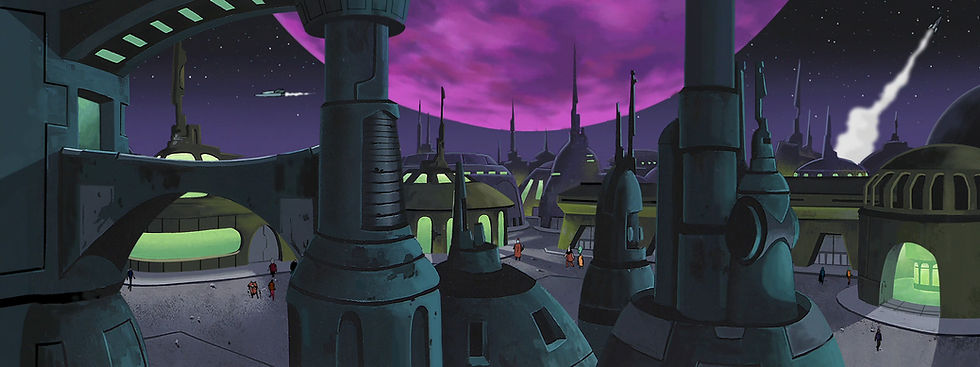
Tracking the slaver ship to what Green Lantern describes as a “refueling port” (what, like an intergalactic truck stop?), both he and Hawkgirl drop in to lean on some of the locals for information.

I can’t help but notice that John Stewart furrows his brow when the alien he’s questioning mentions slave trading. Either he suspects that that’s what happened to Superman and J’onn, or it is merely an unfortunate reminder of American history.

Considering how they handled themselves, Green Lantern and Hawkgirl establish themselves with a strong “good cop / bad cop” vibe. All I need is now John muttering how he’s getting “too old for this shit.”

After finding an informant who admits that he heard someone talking about a Kryptonian being taken to War World, Green Lantern and Hawkgirl “negotiate” transportation to that planet.
It is worth noting that, despite the fact that Hawkgirl has had multiple scenes in this episode, this is the first time that the audience sees her wielding her Nth metal mace. Apparently, much like Wonder Woman’s lasso, Hawkgirl has the capacity to pull the item out of hammerspace when needed.


Watching this episode twenty-five years later, I wish there was a little more background on War World and its history. As a Superman-level character in terms of strength, did he just show up one day and start murdering people until they made him ruler (that seems to have been his plan in “For the Man Who Has Everything,” at any rate). Was the population always this bloodthirsty, or did Mongul help them develop a taste for it? I mean, in terms of humanity, we’re not too far off from the days when public executions were considered a legitimate form of entertainment, and we often seem to be one reality television show away from backsliding into Survivor: Roman Colosseum Edition ourselves.
Also, are Mongul’s War World death matches a daily occurrence? It does not seem like much time has passed. I’m guessing that Superman’s been in their custody for about forty-eight hours max.
Watching Mongul and Draaga grandstand in front of the crowds, I can see why the creative team kept referencing WWE (formerly WWF) wrestling as a marker (as Rich Fogel said in 2002, they wanted to make the episode “over the top, just like [WWE] wrestling”; qtd. in Allstetter, “New”). In that context, Mongul here was obviously patterned after Vince McMahon, while Draaga serves as his Undertaker.

Sneaking into the stadium is J’onn J’onzz, who apparently has enough control to transform into a different type of alien. What was the point of this? Considering the crowd, was he really that noticeable in his “Martian Manhunter” form? Why not just revert back to his regular Martian form if he wanted to disguise himself? Also, did he steal that cloak, or is it part of him?

While entering the arena, J’onn befriends an older, alien woman voiced by Maria Canals-Barrera and, through their dialogue, we learn a bit more about the population of War World, specifically the massive unemployment and overreliance on “the games” as a way to pass the time. I can literally picture War World’s decline: once in power, Mongul cut all funding for resources, including education, and—over time—you have a wasted generation of unemployed and unemployable people reliant on cheap entertainment. Meanwhile, Mongul hoards all the resources, minus a pittance that he uses to provide “bread and circuses.” Am I missing anything?

Framed to the masses by Mongul as “The Man from Krypton,” Superman quickly establishes his protest. As stated above by Bruce Timm in a 2004 interview with RetroVision CD-ROM Magazine, he falls into the “whole big cliché of the hero who says, ‘I won’t fight for your entertainment,’ and then [he] ends up fighting for your entertainment” (qtd. in Gross 11).
If Superman can break that axe over his knee like that, then why did he bother with the pretense of keeping those manacles on his wrists, when he could have broken them off or head-visioned them? Is Superman intentionally playing to the crowd as well—a face to Mongul and Draaga’s heel?


Fight scene! Not much to say here, save that this battle shows some of the differences between broadcast standards on Cartoon Network versus Fox or Kids’ WB! Blows to the face, visual blood—all forbidden in traditional “children’s programming.”
Speaking of which, the fact that Draaga has green blood is an interesting detail.

When Superman refuses to kill Draaga in the ring, as per Mongul’s demand following the gladiator’s loss, the tyrant attempts to kill the Man of Steel. I’ll say it: Mongul’s a dick.

After an episode of being redundant (at best) or useless (at worst), J’onn starts the chant that begins to sway the mob in Superman’s favor. Maybe J’onn’s been watching pro wrestling too?
After rewatching this scene, I have to agree with Jay Allman—it would have been better had J’onn not been there and the swell of support originated from the people themselves. In this alternate take, the crowd is naturally swayed by the inherent decency of a powerful man who shows mercy. Here, however, the sheep are either 1) following the leader or 2) trying to get on the Jumbotron.

I will say this about the creative team, however: they have severely upped the quality in terms of their crowd scenes. Compare a crowd from “War World” (above left) to what passed as a gathering in “In Blackest Night” (above right).

Forced to acquiesce to the demands of the crowd, Mongul returns Superman and Draaga to the cells, where the Man of Steel receives a warm welcome for defying Mongul. “Yay! You challenged the guy who keeps killing us!”

Recognizing that Mongul will stop at nothing to kill Superman now, the prisoners attempt to help him escape in a garbage scow. Refusing to leave without J’onn, he elects to remain and gives his spot to Draaga, who is now marked for death for his failure. This feels less of a mercy thing and more of a “go away, kid, ya bother me” kinda thing.
Forget J’onn J’onzz for a moment—shouldn’t Superman remain on War World because he intends to depose Mongul and liberate the people? That seems like a Superman thing to do. The idea that the Man of Steel just wants to grab his Martian buddy and run seems beneath him.

Superman has run into this scenario before: in the STAS episode “Absolute Power,” the Man of Steel discovers a world that has been conquered by Phantom Zone criminals Jax-Ur and Mala. Initially intending to let them remain in power (under the pretense that attempts to liberate their stolen world would cause massive destruction and bloodshed). He is turned, however, when he realizes that—despite their earlier claims—the Kryptonians intend to use their new empire to invade Earth. In the end, Superman comes around, and he is reminded of a line often attributed to philosopher Edmund Burke: “evil triumphs when good men do nothing.” In that context, Superman should also want to liberate War World as well.

Although, to Superman’s credit, this lesson may have been soured by his experience in the STAS episode “Legacy,” where he attempted to depose Darkseid, only to find that the citizens he brutalized remain devoted to him. Unfortunately, he learned here that—as a future Orion told him in the Kingdom Come hardcover (May 1997)—“to the lowlies ground under Darkseid’s heel since Apokolips was young, liberty was every bit as paralyzing as fascism” (Waid 104).

Shifting back to Green Lantern and Hawkgirl, they are now cramped in the back seat of a space ship by their hostage—err, I mean, their pilot—as he flies them to War World. The pretense for this scene is that they need the pilot’s navigational computer to find it because “the galaxy’s a big place.”
This plot point was obviously thrown in to force them into this situation because, on its face, it’s bullshit because, otherwise, the Green Lantern ring is useless. The rings must possess star charts and other data about the galaxy, and their location therein, in order to simply function as peacekeepers. Without them, Green Lanterns would immediately get lost after leaving Oa, their worlds of origin, or literally anywhere else. Without a galactic GPS of some sort, they would all need to rely on space ships for transportation, rather than flying aided only by the ring, as they do both in the comics and in this series. Ideally, John Stewart would either just 1) look up War World (or its corresponding star system) on his ring or 2) look at a map and put it into his ring.

In classic screwball comedy formula, the duo—stuck in a farcical situation—begin to bicker, giving the pilot the opportunity to knock them out with gas. It’s funny, but it makes both Green Lantern and Hawkgirl look like idiots.
Their verbal sparring would continue throughout Justice League until “Wild Cards,” when they finally surrendered and entered into a relationship. Even the pilot, with his “do you want a little privacy?” line, knew what was going on, meaning that John and Shayera were literally the last people in the series to recognize their chemistry.
That said, check out Stewart’s face in panel two above—he’s enjoying their little back-and-forth.
In the “Stray Observations” for “Secret Origins,” I noted how whenever John Stewart succumbs to a gas attack or something similar, it is often colored yellow, a reference to Green Lantern’s Silver Age weakness. I’d say that the pilot’s knock-out gas qualifies.
Wait, couldn’t Stewart create some kind of gas mask with his ring? Either the gas affected him too quickly, or he either did not know how to make a respirator or didn’t have time to work through the details.

While Stewart goes down quickly, Hawkgirl holds on for a few seconds longer, attempting to break the glass. This is most likely because Thanagarians have greater lung capacity, as Adam Strange acknowledged in Saga of the Swamp Thing #58 (March 1987).
Normal humans also don’t scratch glass like that either. Thanagarians must have talon-strength fingernails.

Meanwhile, Draaga gets dumped on what appears to be a garbage world, presumably somewhere near War World itself. By my estimate, I suspect that this location is probably within War World’s star system (would Mongul bother to pay to have his garbage transported somewhere further away?).
Note the damage compared to War World’s moon—the ruins are similar, but notice how the sky here is purple, compared to War World’s red. If this is within War World’s planetary system, one can imagine that, like War World’s moon, it was decimated during Mongul’s invasion and—rather than repair it—he elected to abandon it, turning it into a junk world.


Enraged by his treatment at the hands of the Kryptonian, Draaga sears the mark of Superman upon his chest as a symbol of his shame. Considering how, in the comics, he basically wore a Superman T-shirt, the fact that, here, he literally brands himself with the “S” symbol is metal as fuck.

Superman mania takes over on War World, though the episode is vague on why. In the realm of the episode, Mongul’s chancellor suggests that the people love Superman because he is fearless, even of Mongul. Is there more going on here that the story isn’t telling us? After all, Part One mentioned the anger amongst the population over resource shortages and the threat of rebellion. Do the people of War World seek their freedom from a tyrant, or are they sick of Mongul and simply seeking to hand over power to another strong man?

Hawkgirl and Green Lantern wake up on gray desert sands under a somewhat familiar, purplish night sky. Dumped there by their pilot, they briefly wrestle with the idea that, without Green Lantern’s power battery or knowledge of where they are, they could be marooned there.
Fortunately for them, the pilot they hijacked elected to dump them without relieving them of their mace and power ring. He may have stranded them, but at least he didn’t rob them.
Let me reiterate: the idea of a Green Lantern being stuck somewhere in the galaxy not knowing where they are is preposterous. Considering the immensity of the galaxy, and the fact that it is constantly rotating, every Green Lantern would be lost all the time if this was the case.

For that matter, didn’t the episode “Hearts and Minds” establish that most Green Lanterns choose to hide their power batteries in a hidden pocket dimension, and didn’t the Static Shock episode “Fallen Hero” kind of imply that the pocket dimension could be accessed anywhere? Seems to me that this was either a changed premise to the series, or the writer threw this in to add artificial stakes.

To reiterate, discovering the value of the Green Lantern and Hawkgirl pairing was worth the price of admission to “War World,” and it paid dividends throughout both this series and Justice League Unlimited. So taken was Jay Allman by their scenes that he declared how he wished “the story had been about Superman’s mysterious disappearance and had entirely focused on GL and Hawkgirl quarreling with each other as they tried to track him down” (Maxie Zeus). As for Bruce Timm, he touched upon his thoughts about the duo in the Part Two episode introduction on the 2003 Justice League: Paradise Lost DVD:
From the very beginning, we thought that Green Lantern and Hawkgirl would be interesting to pair up because, on the face of it, they’re both very similar, in that they’re both real no-nonsense, warrior types. You know, GL having a military background and Hawkgirl coming from a very warlike planet. They’re both very, very strong and forceful characters, so we thought it would be interesting to put them together and, you know, watch the sparks fly, and this is like the first time you get kind of a hint of that. They’re alike, but they’re so un-alike, so they’re attracted to each other, but they’re also repelled by each other. So, it’s interesting—their scenes together on the show are, again, one of the things, I think, really, really kind of sells this episode. Some of the most enjoyable moments in the show are the scenes where they’re stranded together on an alien planet and realize that they have to work together to get off it. (qtd. in “Episode Introduction to ‘War World, Part 2,’” 00:00:26-00:01:14)


Locating a settlement, Green Lantern and Hawkgirl investigate an area strewn with random fires and piles of trash. Didn’t the audience just view an area similar to this a few scenes ago?
In the aforementioned installment of the Justice League Revisited podcast, Stan Berkowitz admitted that Hawkgirl’s line, “what a dump,” is a reference to Bette Davis’ famous line from the 1949 film noir, Beyond the Forest (00:10:08-00:11:10).

And here’s another thing that the creative team couldn’t allude to on either Fox or Kids’ WB! Aside from rebellion from their former networks, the only reason I could think of for the creative team to place an alien pin-up calendar in this scene is to foreshadow John Stewart’s openness regarding dating women outside of his species.

We would later learn of his past relationship with the Korugarian Katma Tui in “Hearts and Minds,” and—of course—he would later move forward, albeit briefly, with the Thanagarian Shayera Hol beginning in “Wild Cards.”


Not happy with visitors entering their camp, John and Shayera are attacked by the site’s residents. Fortunately, they make short work of them.
I would just like to mention here that these alien designs are a definite step up from many of the ones used previously on this series.

Two of our three storylines converge when they encounter Draaga, who offers to take them to War World. Based on their luck so far, I’m certain that he’ll be a trustworthy source and ally for them—


Oh. As soon as they arrive on War World, Draaga cold-cocks Green Lantern and escapes. Sounds about right.

Before moving back to Superman and Mongul, check out the two pics of War World’s skyline for a moment. The picture above left is the capital city in Part Two; note how the primary colors are beige and the tops of the building are often rounded off at the top. Meanwhile, back in Part One (above right), the buildings are more futuristic, with more sharp edges, and their colors are more blues and greens. Why the change-up?

Following a tense exchange, Mongul reveals that, like Superman, Draaga originally wanted to uplift the people of War World, but he changed his mind … when the tyrant threatened to blow up Draaga’s planet if he didn’t comply. And then Mongul, apparently still uninterested in studying his foe, threatens to do the same to Krypton. In response, Superman—without thinking—tells him that Krypton is already gone. Seriously, dude? DON’T HELP THE SUPERVILLAIN! This scene would have been so much better had he maintained that same snarky energy from moments before (“That wasn’t your name they were chanting out there”). Imagine if this scene played out like this:
MONGUL: Its power can decimate a planet, and that’s exactly what I would have done to Draaga’s if he hadn’t cooperated. I can do the same to your world.
SUPERMAN: Decimate Krypton. [DARK CHUCKLE.] Good luck with that.
CHANCELLOR: Sire, our records show that Krypton was destroyed decades ago.
MONGUL: No matter. Any planet will do…

Hitting Superman’s weak spot (protecting the innocent), Mongul offers him a deal that apparently plays out like this: in exchange for not blowing up Draaga’s planet, Superman will allow Mongul to beat him to death to the delight of the crowds. When the Man of Steel does not respond, Mongul takes that as a sign of compliance. However, fortunately for him…

…War World’s atmosphere has not made J’onn J’onzz’s power set completely useless. With Superman busy in the arena, J’onn resolves to stop the cannon.


The following day (?), Superman and Mongul square off on War World's moon, with the Last Son of Krypton reminded that, to save an inhabited world, he must allow himself to be murdered. Seriously, did Superman have a plan here? Was he going to rally and knock out Mongul to prevent him from ordering the weapon used, or was he really going to let the tyrant beat him to death? Unfortunately, the episode never really dwelled on this question, as the one-on-one match was soon interrupted…

…by a familiar face who found a way to acquire transport.
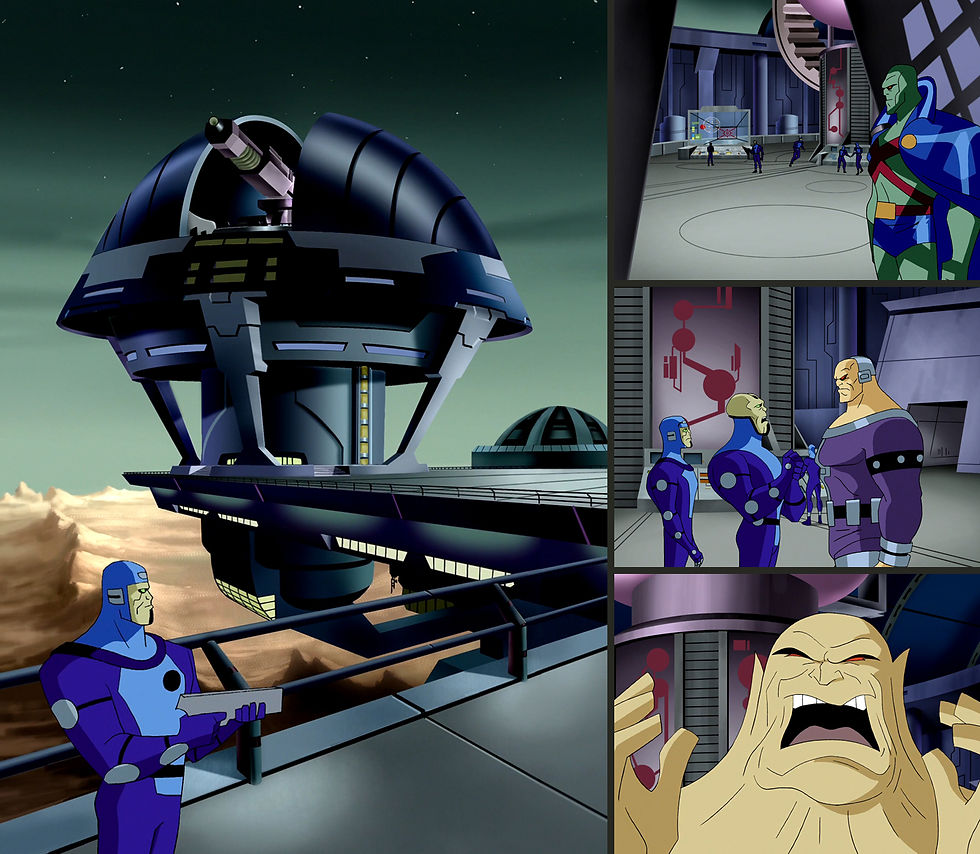
Meanwhile, at the planetary death ray, J’onn J’onzz learns that Mongul intends to blow up Draaga’s homeworld anyway because 1) it heightens the tension in the third act and 2) as I have said previously, Mongul’s a dick.
Unfortunately, J’onn’s attempt to impersonate Mongul to stop the countdown is thwarted by plot device, which means that he couldn’t even end the episode strong.

Intent on being the one to kill the Man from Krypton, Draaga temporarily knocks out Mongul to get his turn, creating War World’s version of an impromptu tag team match.

Before attacking Superman, Draaga sheds his cloak, unknowingly mimicking the Man of Steel’s iconic transformation.
Eager to slay Superman, he relents when the Kryptonian reveals that he is attempting to save Draaga’s native planet. Even though he values his honor, remember that this is what got him tied to Mongul in the first place.

And, just like that, Draaga is out, and Mongul is tagged back in!

Through sheer coincidence, Green Lantern and Hawkgirl stumble upon where J’onn is about to be killed by security forces, and they stop the cannon. Better luck next episode, pal.

In an improbable feat, Hawkgirl causes the whole death ray to explode just by swinging her mace. Remember in “Starcrossed,” when Batman volunteers to disable the hyperspace bypass, and the Flash deadpans, “What are you gonna do, throw a Batarang at it?,” to which the Dark Knight replies, “Something like that?” This is the Hawkgirl equivalent.
The only way I can justify this working is that, somehow, the Nth metal the mace is made of reacted with the energy, causing it to either disperse, be redirected, or both. It might also explain why the device blowing up didn’t take half of War World with it.
If you look closely in the above fourth image (far right), there is an animation error where a second Hawkgirl appears in the energy of the explosion.

Please note that, during their escape from the explosion, J’onn J’onzz is being carried using Green Lantern’s power ring, as he cannot fly thanks to War World’s atmosphere. However, in the next scene, he’s flying normal again, as they are now on War World’s moon.


Knocked around by Mongul, Superman is “defeated,” lying prone and ready for the tyrant to make the killing blow (still waiting to see that plan to save War World and yourself, Supes). Fortunately for him, the cavalry has arrived.

Okay, Supes. This is your moment. The Internet’s been calling you “super-wimp” for months now, and this is the time to put that to rest. Look at him. Mongul’s enslaved you, forced you to fight for his amusement, and just now he nearly killed you even though he was going to renege on his promise and blow up Draaga’s home world anyway. C’mon, Supes, stop being the boy scout for a moment and be the badass that nearly destroyed Darkseid once and for all. [PAUSE.] Wait, what are you two looking at…?

Goddamn it.
While acknowledging how unsatisfying the climax to “War World” is, the creative team defended their decision to make the final battle between Draaga and Mongul. In the aforementioned 2006 DVD special feature “Inside Justice League,” Rich Fogel admitted how the “[p]roblem with ‘War World’ all comes down to the end of it. […] At one time, we had Superman kicking everybody’s butt. [Bruce Timm] came in and said, ‘We’ve seen Superman kick people’s butt before. Let’s do something different’” (qtd. in “Inside,” 00:07:09-00:07:23). This sentiment was backed up by Butch Lukic in a November 2005 interview with ToyFare Magazine, adding how “[d]uring the synopsis stage, I think we realized Draaga needed something at the end to justify him getting back what he lost. How many times before have you seen Superman basically punch everyone out at the end and win it all? He needed to step aside” (qtd. in Rossen 50). Finally, Bruce Timm—in the aforementioned Part Two episode introduction on the 2003 Justice League: Paradise Lost DVD—added his take:
The one criticism of this episode that I’ve gotten a lot from reading the Internet—and I kind of have to agree with it, in retrospect—was that the show is mostly about Superman, and it’s about Superman fighting in the gladiator arena and going toe-to-toe with this Mongul character, and the biggest problem is that Superman doesn’t get to clean Mongul’s clock at the end of the show. It’s unfortunate, because you really want that—you want that nice closure, you want Superman just to sock him a good one and, you know, teach him a lesson at the end, but the problem is we’ve got this Draaga character on the show, you know, and half the story is about him, about his lost honor. When we got to the ending of this story, I think that the way the script originally ended was that Superman did finish off Mongul and, unfortunately, that left Draaga’s story unresolved, so, you know, we went back and forth and tried to find a way to resolve, you know, the two storylines, and this is what we came up with. (qtd. in “Episode Introduction to ‘War World, Part 2,’” 00:01:14-00:02:12)


As loathe as I am to admit it—seeing how it exacerbated Superman’s appearance of weakness in Season One—Draaga did deserve the win. After all, he won’t be back next week.
Wait, next week is “The Brave and the Bold,” an episode that Superman doesn’t appear in. FUCK!!!
In a moment of humility, Draaga offers Superman Mongul’s crown, but Superman—having learned of the warrior’s character through conversations with the slaves and with Mongul himself—tells him that he himself is fit to rule.


Well into the episode’s dénouement following a somewhat anticlimactic climax, the Green Lantern creates his “let’s go home” energy bubble … but they’re returning to War World’s surface. And they’re leaving Draaga stranded up there … with an unconscious, but unrestrained, Mongul. Uhh, guys?
It is worth noting that, in the original comics, Draaga is also offered War World’s crown, which he refuses to continue with his vendetta against Superman. Fortunately, for this Man of Steel, this Draaga knows when to call it a day.
It’s also worth mentioning how War World is still a financially-strapped, chaotic mess. Even Stan Berkowitz acknowledged this in the aforementioned installment of the Justice League Revisited podcast, when he said that, at the end of the episode, “our heroes leave the planet in complete anarchy. Their leader’s gone. They have no—what do we do now?” (qtd. in Eisenberg and Enstall, 00:18:09-00:18:20). Since we never return to War World nor see Draaga again, we can only hope that he was able to turn it around.

On the other hand, Mongul would later return—with a much better design and costume, if I may add—in the aforementioned JLU episode “For the Man Who Has Everything,” where the Man from Krypton gets his rematch with the Warzoon Warlord. And as for Green Lantern and Hawkgirl, their pairing would soon blossom into the long-lasting “will-they-or-won’t-they” trope that will run the entire length of Justice League and Justice League Unlimited … and beyond.
Works Cited
Allstetter, Rob. “Batman Beyond: Return of the Joker Delayed.” Comics Continuum. 3 Oct. 2000. <http://www.comicscontinuum.com/stories/0010/03/index.htm>. Accessed 18 Dec. 2022.
---. “Justice League Characters.” Comics Continuum. 19 Oct. 2001. <http://www.comicscontinuum.com/stories/0110/19/jlindex.htm>. Accessed 22 Dec. 2022.
---. “New Justice League Episode.” Comics Continuum. 23 Feb. 2002. <http://www.comicscontinuum.com/stories/0202/23/index.htm>. Accessed 30 Dec. 2022.
Archie. “Paul Dini.” Internet Archive. 3 Jul. 2022. <https://web.archive.org/web/20220703062144/http://wba.toonzone.net/dini/>. Accessed 25 Jun. 2026.
Avila, Mike. “Batman Beyond: The Classic That Nobody Wanted.’” IGN. IGN Entertainment, Inc. 1 Jun 2021. <https://www.ign.com/articles/batman-beyond-the-classic-that-nobody-wanted-inside-stories>. Accessed 15 Jun. 2024.
Brain, Marshall and Sarah Gleim. “What If an Asteroid Hit Earth?” HowStuffWorks. n.d. <https://science.howstuffworks.com/nature/natural-disasters/asteroid-hits-earth.htm>. Accessed 12 Jan. 2026.
“Commentary on ‘Twilight—Part Two.’” Justice League: Season Two. Warner Bros. Animation, 2006.
Cronin, Brian. “Comic Book Legends Revealed # 266.” Internet Archive. 28 Jun. 2010. <https://web.archive.org/web/20100628014353/http://goodcomics.comicbookresources.com/2010/06/24/comic-book-legends-revealed-266/>. Accessed 12 Jan. 2023.
Davis, Joseph. “War World.” Internet Archive. 11 Feb. 2008. <https://web.archive.org/web/20080211141902/http://jl.toonzone.net/episode6/episode6.htm>. Accessed 14 Jun. 2026.
“Draw the Dark Side.” Justice League: Paradise Lost. Warner Bros. Animation, 2003.
Eisenberg, Susan and James Enstall, hosts. “War World.” Justice League Revisited, featuring Maria Canals-Barrera and Stan Berkowitz. Apple Podcasts, 6 Feb. 2024. <https://podcasts.apple.com/us/podcast/war-world-with-maria-canals-barrera-hawkgirl-and/id1709910091?i=1000644343494>. Accessed 6 Jan. 2026.
“Episode Introduction to ‘War World, Part 1.’” Justice League: Paradise Lost. Warner Bros. Animation, 2003.
“Episode Introduction to ‘War World, Part 2.’” Justice League: Paradise Lost. Warner Bros. Animation, 2003.
Gladiator. Directed by Ridley Scott, performances by Russell Crowe, Joaquin Phoenix, Connie Nielsen, Oliver Reed, Djimon Hounsou, and Richard Harris. DreamWorks Pictures. 2000.
Gross, Edward. “Justice League Episode Guide.” RetroVision CD-ROM Magazine. M&R Multimedia, Inc. n.d.: 8-27. PDF file.
Harvey, Jim. “Bruce Timm: Return of the Q&A, The.” The World’s Finest. 24 Sept. 2002. <https://dcanimated.com/WF/sections/backstage/interview/bt/thesequel.php>. Accessed 2 Jul. 2024.
---. “Bruce Timm Talks Justice League’s ‘War World.’” Anime Superhero. 23 Feb. 2002. <https://animesuperhero.com/forums/threads/bruce-timm-talks-justice-leagues-war-world.2927871/>. Accessed 25 Dec. 2022.
“Inside Justice League.” Justice League: Season One. Warner Bros. Animation, 2006.
Jankiewicz, Pat. “Justice League: Superman, Batman & Their Super Friends Get Animated for the 21st Century.” Starlog. Jan. 2002: 28-33. Print.
“Jim Starlin Biographical Interview 2024 part 1 by Alex Grand.” YouTube. Uploaded by Comic Book Historians. <https://www.youtube.com/watch?v=3dOFRxg-p6Y&t=2575s>. Accessed 12 Jan. 2026.
Khoury, George and Pedro Khoury III. “Bruce Timm Interviewed.” The Jack Kirby Collector. Oct. 1998: 17-22. Print.
MacDonald, Heidi. “Timm on the League’s New Attitude.” Internet Archive. 23 Apr. 2003. <https://web.archive.org/web/20060623022635/http://www.comicon.com/cgi-bin/ultimatebb.cgi?ubb=get_topic;f=36;t=000941;p=1>. Accessed 3 Jan. 2023.
Maxie Zeus. Comment on “Justice League “War World, Parts 1 & 2” Talkback (Spoilers).” Anime Superhero. 5 Mar. 2002. <https://animesuperhero.com/forums/threads/justice-league-war-world-parts-1-2-talkback-spoilers.2929091/post-43166611>. Accessed 6 Jan. 2025.
---. Comment on “Justice League “War World, Parts 1 & 2” Talkback (Spoilers).” Anime Superhero. 5 Mar. 2002. <https://animesuperhero.com/forums/threads/justice-league-war-world-parts-1-2-talkback-spoilers.2929091/post-43166631>. Accessed 6 Jan. 2025.
Rossen, Jake. “An Extraordinary League.” ToyFare: The Toy Magazine. Nov. 2005: 46-64. Print.
“Unlimited Reserve: Exploring the Depths of the DC Universe.” Justice League: The Complete Series. Warner Bros. Animation, 2010.
Waid, Mark. Kingdom Come—Limited Hardcover Edition. Illustrated by Alex Ross. DC Comics. 1997.
“ZETA vs BATMAN and How Warner Bros. Almost Killed JUSTICE LEAGUE (Writer Rich Fogel).” YouTube. Uploaded by Watchtower Database. <https://www.youtube.com/watch?v=zvH0oq7YIjw&t=633s>. Accessed 15 Jun. 2025.
Images courtesy of Warner Bros. Discovery, Warner Bros. Home Entertainment, Warner Bros. Animation, DC Comics, DreamWorks Pictures, and Universal Pictures.


Comments