


Play with It: Remembering the Palisades' Muppet Show Action Figure Line

Updated: Jul 4
On the fiftieth anniversary of The Muppet Show, we take a fond look back at the action figure line that celebrated the show’s twenty-fifth anniversary.

As I have discussed in a previous essay, I am a huge fan of the Muppets, whether they be from The Muppet Show, Sesame Street, or Fraggle Rock (again, my definition of “Muppet” encompasses any creation that owes its origins to Jim Henson and his Creature Shop). Specifically—but not limited—to the first property mentioned, I think my appreciation stems from the improvisational, sketch comedy spirit with which they present themselves. First and foremost, they are actors, and their ability to be anything pairs nicely with the “make believe” aspect of a child’s imagination. This, coupled with their colorful, wildly diverse designs and costumes, is no doubt why they factored heavily into my formative years.
(As I have grown older, I must confess that another part of my appreciation comes from a measure of regional pride. After all, Jim Henson graduated from the University of Maryland, College Park, in 1960 [“Henson”], and—while a student there—he co-created the first Muppets with his longtime partner, Jane Nebel [whom he married in 1959], as part of Sam and Friends [1955-1961] for WRC-TV in Washington, D.C.)
As part of my burgeoning Muppet fandom, I found myself the recipient of lots of Muppet merchandise and products. I had Muppet dolls, Muppet books, and issues of Muppet Magazine. I had the Muppet films on VHS—both store-bought and recorded off of television—and I watched them over and over in that way that only children can. In fact, I was so Muppet crazy that my mother sewed me a Kermit the Frog costume (presumably the one from Vogue Patterns), which I wore multiple years for Halloween. But the ones I remember the most were The Muppet Show Players, a set of seven Muppet stick figure puppets.

Images courtesy of Muppet Wiki and the RowlfNation Etsy store.
Not truly action figures, these were a set of toys that could be “puppeted” using a stick that plugged into the characters’ backs. They had limited articulation—mostly legs, though three had posable arms—but I remember playing with them a lot. The only problem I had with them was the limited number of Muppets available. Already conditioned for collecting through the likes of He-Man and G.I. Joe, I wanted all the Muppets for my collection. I also wanted playsets, including a replica of the Electric Mayhem Bus from The Muppet Movie (1979). Unfortunately, those products did not exist.
Seeking to correct this wrong, I remember my mother helping me write a letter to the company that created the toys, Fisher-Price, requesting that they expand the line and, miraculously, I got a response weeks later: a typed letter thanking me for my interest, but how they were unable to continue. I was disappointed that my efforts did not allow me toys featuring Dr. Teeth, Crazy Harry, or the Swedish Chef (much like I am disappointed today that I did not save the letter we received). However, little did I know that, nearly twenty years later, my desire for a Muppet action figure line would actually happen, thanks in large part to another college graduate from the state of Maryland.

Master of Puppets
In 1994, Michael Horn—a 1991 graduate of Towson University (Cook 11)—founded Palisades Toys, a toy and collectibles company geared more towards the then-developing adult collectors’ market. Originally described as “a marketing firm that found shelf space for collectables produced by a variety of manufacturers,” the company eventually turned to creating their own products (Cook 11-12). Getting their start making resin statues and action figures based on the Alien, Predator, and Reservoir Dogs films—as well as the Mortal Combat and Resident Evil video games (Cook 11)—Horn eventually recognized that his company needed to broaden its portfolio. “There’s a reaction at retail that they’re having less ability to sell the really violent stuff,” said Horn in an April 2002 ToyFare interview, so “we needed something that had a little bit broader appeal” (qtd. in Root 63).

Above left: the Palisades Toys’ logo and snapshot of its website (circa 2003); from the Internet Archive. Above right: a group shot of the Palisades Toys’ staff (circa Fall 2002) at their Elkridge, MD offices.
The decision to pursue the Muppets license started during a monthly meeting (presumably sometime in 2001; Cook 12) where employees held a “brainstorming session for new toy properties” (Root 63). According to Horn, “[e]veryone thought it sounded like a good idea” (qtd. in Root 63), so they reached out to The Jim Henson Company, who at the time was owned by EM.TV, a Germany-based media company that temporarily owned both the company and its assets from 2000 to 2003 (Retsinas). “[W]e called up [the Jim Henson Company],” said Horn, “and said, ‘Hey, we’re a collectible action figure manufacturer interested in making figures for The Muppet Show.’ They said, ‘Oh, yeah, we know who you guys are’” (qtd. in Root 63). Later, in an April 2003 interview with Baltimore Magazine, Horn added how “[t]he Henson people understood that we had a vision and were paying attention to the authenticity of the characters and particularly were paying attention to detail—we weren’t trying to turn Kermit into a zombie” (qtd. in Medland). After sending them samples of their products (Cook 12), this resulted in a manufacturing contract that, over time, spanned multiple years and nine waves of figures (not counting playsets and exclusives). Initially only covering The Muppet Show (1976-1981) specifically, the contract was later expanded to include characters and designs from the then-six Muppet films (“Incoming!” 22), as well as from the short-lived ABC / Disney Channel series Muppets Tonight (1996-1998).

A snapshot of the Palisades Toys’ official message boards (circa 2004); from the Internet Archive.
From the start, it was obvious that Palisades Toys was different from the toy companies that came before, and one of the most notable ways was the level of interaction the company maintained with its customer base. Recognizing their patrons as a resource beyond their mere capital—as Horn said in a 2017 interview, “[w]e get information from our message boards … fans know the properties better than anybody” (“PCHOF ’17”)—Palisades kept Muppet fans in the loop by maintaining a presence on both their now-defunct message boards, as well as those at the Muppet Central fan site. This was mostly done through the presence of Ken Lilly, the company’s vice president and head of product development, who would answer questions and provide updates on upcoming items. By listening to their customers, accepting both praise and criticism, it kept the company honest, and it elevated the proceedings from one-way transaction to a symbiotic relationship.
It is also worth noting that, by seeking assistance from their fan base, this led to at least one of them actually finding employment with Palisades, as was the case with freelance Graphic Designer James V. Carroll, who told his story as part of a July 8, 2020 Facebook interview with The Muppet Collection Page:
I was cutting graphics for Muppet Central, during the early stages of designing their new interface, when Product Developer / Vice President of Palisades, Ken Lilly, joined the forum portion. He revealed the wave one prototypes for the Muppet figures, but many members, including me, believed it to be a hoax and ragged hard on the early designs. […] Strangely enough, that sparked interest in Ken to check out my work, and he contacted me through email. The very simplified story is that I’d insulted my way into a gig.
[…] He couldn’t figure out what was missing from the prototypes. That’s why he posted them in the first place. Ken is a workaholic and a perfectionist, you see. Any small blemish in a design will bug him until the end of time. It’s admirable. He’s not content to just acquire a brand license and put out the same old clip art, rubber-stamped schlock. Caring about those details doesn’t necessarily translate into profits, so few other executives handle with that kind of refinement. He’s a serious product artist. The work at Palisades redefined the action figure industry and the Muppet brand itself. He might disagree with that, but there, I said it, and I mean it! Then Henson Company didn’t have much cohesive reference for the monumental task he was mounting. Palisades directly patched that up and rewrote the licensing book Disney still uses today. I am proud to have been a part of that crew.
[…] My work with Palisades ranged from graphic design for accessories to initial concept drawings, and even a great deal of art direction on the sculpts, under his watchful eye, of course. They didn’t use digital modeling back [then], so Ken would send me high-definition photographs of the prototypes in over a dozen different positions. I would seamlessly Photoshop my changes onto them, realistically with light and shadow, and note the changes to send the sculptor. […] It was crazy. Ken helped me get my foot in the door and taught me so damn much! (qtd. in Muppet Collection, “Part two”)
In addition to the above, the company made itself distinct in other ways, such as producing exclusive merchandise, which they sold both at conventions or through the Palisades Toys’ Collector’s Club, a mail order service allowing fans to purchase directly from the company; this also offered the opportunity for them to create merchandise that may not have been feasible to sell at the retail level. According to Pop Culture Hall of Fame, an online fan community celebrating the works of geek icons, “about a fifth of the company’s revenue came from such items” (“PCHOF ’17). Through practices such as these, in 2002—the first full year the Muppet toy line was available—“the company [collectively] sold 1.5 million figures and saw $3.5 million in global sales, with its products on the shelves of several major retailers, including Target and Toys ‘R’ Us” (Medland). Palisades had a hit on their hands, and they were just getting started.

It’s Time to Meet the Muppets
After many years operating under the radar, landing The Muppet Show license put Palisades Toys on the map, but with that attention came a certain level of unease, as the increased visibility brought with it a desire to maintain the company’s already high-quality standards. As they catered to the adult collectors’ market, there was a certain expectation that the caliber of the figures—likeness, attention to detail, joint articulation, accessories, etc.—would surpass the level of mass market, child-oriented toy companies like Mattel or Kenner. Fortunately, Palisades was up for the challenge, and this was proven when the first wave of action figures hit shelves in Spring 2002.


Top row, left to right: Kermit the Frog, Miss Piggy, Dr. Teeth, and Dr. Bunsen Honeydew. Bottom row, left to right: Beaker with the Muppet Labs playset, Tuxedo Kermit (available exclusively through Toys “R” Us and ToyFare magazine), and Glamour Piggy (available exclusively through EB Games). Images courtesy of the Muppet Wiki page.
Series One established the template for many of the future releases: four figures, one playset with an accompanying figure, and at least one variant figure, which manifested most of the time as a repaint (in addition to the above, a repaint of Dr. Teeth was sold at the 2002 Wizard World East convention). Overall, the figures were an excellent herald of things to come, and they featured wonderful designs that successfully captured both the folds and textures of the felt, fabric, and feathers that make up the original puppets. In a 2002 interview, Ken Lilly pointed out how the Kermit the Frog figure is indicative of these design choices: “[w]hen [the puppeteer] works the head, there’s those little stretch wrinkles in the neck. They’re in the sculpt” (qtd. in Root 63). Unfortunately, due to the limitations of Kermit’s design, they could only give the action figure five points of articulation; as Lilly admitted, “[y]ou can’t put an elbow joint on a character whose arms are so thin they’ll break” (qtd. in Root 64). Fortunately, this was not a problem with Tuxedo Kermit, who was designed with 10 joints owing to the design’s thicker arms and legs (Root 64).
In addition to Kermit, other standouts from this lineup include Dr. Teeth, whose psychedelic design required roughly 200 paint applications (Root 64), and Dr. Bunsen Honeydew, with its soft, plastic lab coat layered over the figure’s body, rather than being part of the figure itself.

Left to right: concept sketch for Miss Piggy action figure (courtesy of Ken Lilly’s Instagram page), pics of a rejected Miss Piggy prototype, and pics of First Mate Piggy prototype.
Of course, there were some lessons to be learned from this wave, and this was primarily seen in the Miss Piggy figure. Unlike the other toys, this one lacked the texture seen on the original puppet’s “skin,” and the decision to have the main figure’s hair sculpted into a bun made it look like Piggy had a bob haircut, a look not common to the character. Acknowledging the difficulty in adapting the Muppet Show’s grande dame, Lilly admitted how “[s]he’s actually the most difficult one to do. Miss Piggy has changed the most in 25 years than any of the other Muppets. We had to try and find a way to make it look like Miss Piggy from today and 25 years ago” (qtd. in Root 63). Unfortunately, these growing pains can be common in developing toy lines, though it could have been worse—as seen in the above center image, an early plan to give Piggy realistic, Barbie-like hair did not go as planned. Fortunately, they learned from their mistakes when creating the First Mate Piggy figure (above right), which was released along with the Pigs in Space playset, as part of Series Six in Winter 2003.
Described by ToyFare magazine as “an aggressive launch,” the Muppet Show line began with “30 figures and five playsets […] already in the pipeline” (Root 63), and these toys began hitting retail every couple of months. According to Horn, “[w]e release new characters every three months [for the Muppet line] and have a production run of 100,000. Once they’re sold, that’s it” (qtd. in Medland). Also notable was the price point, which was low for such figures, even in the 2000s. “I don’t want to pay $10 for a figure,” admitted Lilly, adding how “I’m not ready for that yet” (qtd. in Root 66). From the perspective of a world used to a digital, Amazon-dominated marketplace, the concept of actually walking into a brick-and-mortar store to find these toys on sale for anywhere from eight to twelve dollars is almost quaint. Anyway, it was in this environment that Muppet fans lined up to buy old favorites like Fozzie Bear and the Great Gonzo while, at the same time, introduce themselves to deeper cuts like Lew Zealand, Clifford, and Marvin Suggs.

Left to right: a rejected Animal prototype from Series Two (courtesy of Ken Lilly’s Instagram page), a pic of the Mega Animal action figure, and a pic of the Sweetums prototype.
As the series progressed, the company’s methods for adapting the Muppet characters evolved, as translating soft fabric into hard plastic frequently provided new challenges. For example, when developing the Animal action figure, which was packaged with the Electric Mayhem Stage playset, their initial sculpt failed to reflect the wild, unkempt hair the character was known for possessing. Dubbed “Toilet Head” Animal by both fans and the Palisades offices (@creatusmaximus, “Photos of the first”), they went back to the drawing board, and eventually they mastered the art of sculpting whatever the wispy, scraggily fuzz the puppet is made of (ostrich feathers, according to this YouTube video). These lessons would later be applied to other Muppet figures, like Sweetums, who was available as an online exclusive in Fall 2004.

Above left: a pic of the original Uncle Deadly puppet. Above top right: an excerpt from Jim Henson’s Muppet Show Annual, No. 3 (1979), featuring the earliest, full body image of Uncle Deadly. Above bottom right: Palisades Toys’ Uncle Deadly and Muppet Ghost prototypes.
Another issue the creative team faced was the simple fact that, as their subjects were puppets, Palisades was only guaranteed that fifty percent of them would be available to sculpt. While it is true that—through the Muppet films and other available media—the principal Muppet Show cast had available, full-bodied models and templates, many of the more obscure characters literally had no available representations below the belt. “A lot of times,” Lilly revealed in a 2002 interview, “from the waist down, there isn’t anything on the puppet, so we had to flesh some of it out. But the sculptors really did a nice job of capturing the middle ground” (qtd. in Root 64). An example of this can be found in cult favorite Uncle Deadly as, prior to his comeback in The Muppets (2011) and the 2015-2016 ABC sitcom of the same name, he had limited reference material available, forcing Palisades’ researchers to dig deep into Muppet arcana for anything of use. In the aforementioned Facebook interview, James V. Carroll revealed what went into discovering the character’s lower half:
Henson didn’t provide much art for the second and third-tier characters. Again, the work done at Palisades has been heavily incorporated into subsequent licensing style guides, I’m told. I invented lots of leg looks for these guys! […] In our research, our team discovered Uncle Deadly has a tail only seen in rare drawings and an obscure children’s book. I think Warrick Brownlow-Pike figured that out. He was consulting with the company as an expert. […] No one knows the Muppets better than he does. He’s a cool guy and a wonderful performer. Uncle Deadly’s tail had never been made in puppet form at that point, but it’s there in some shots now. Check out the Muppets / OK Go video for proof! (qtd. in Muppet Collection, “Part two”)
Unfortunately, while the toy line received critical acclaim and attention from collectors, interest began to decline over time. According to longtime Muppet fan site ToughPigs, the line was not successful financially, and after Series 5 Target and Toys “R” Us stopped selling the figures (Wermuth). I myself recall picking up the first few waves of figures at Toys “R” Us, where it regularly shared pegs with the likes of Batman and Power Rangers figures, but over time I could only find them as niche collectibles at mall locations like Suncoast, Sam Goody, and the aforementioned EB Games. At any rate, originally planned to run until at least Series 14, the line ended with Series 9, leaving a number of planned figures in various stages of production, with a good number of them either released piecemeal as online exclusives or never getting released at all.


Of note among the almost-weres include action figures based upon the Muppet Babies (obviously based on their appearance in the 1984 film The Muppets Take Manhattan and not the long-running animated series; @creatusmaximus, “Early”), as well as—surprisingly—Gobo Fraggle, who was going to be released as a “test figure” in anticipation of a potential Fraggle Rock toy line (@creatusmaximus, “Photos of the [semi]”). However, all was not lost, as there was still another Jim Henson-related asset that Palisades was interested in adapting into action figure form.
Exile from Sesame Street
As the Muppets toy line experienced its life cycle, Palisades Toys had built upon their success by expanding their licenses into a literal who‘s who of adult-themed animation properties, ranging from Gen X nostalgia (Pink Panther) to early-2000s cult favorites (Adult Swim, Invader Zim, Ren & Stimpy, and The Fairly Oddparents!). However, they had not forgotten what got them started, and they planned a new toy line to continue their progress through Jim Henson‘s catalogue with Sesame Street. In a 2014 interview with the digital toy magazine littleplasticmen, Ken Lilly discussed its origin:
I recall very little about whose idea it actually was. It wasn’t something I could pinpoint to a single source. We often had group meetings sitting in Mike Horn’s office, and we would just brainstorm. I do know that it was initially a rough sell to Henson only in that we had to be sure we weren’t infringing on anyone else’s rights, because the rights to plastic toys and stuff were already secure in some fashion by other companies, and we had to sort of position it verbally as these were, naturally, aimed at a different audience. Not kids. That’s always tough to do—make products for a kids show for us older kids. (qtd. in “Can” 18)

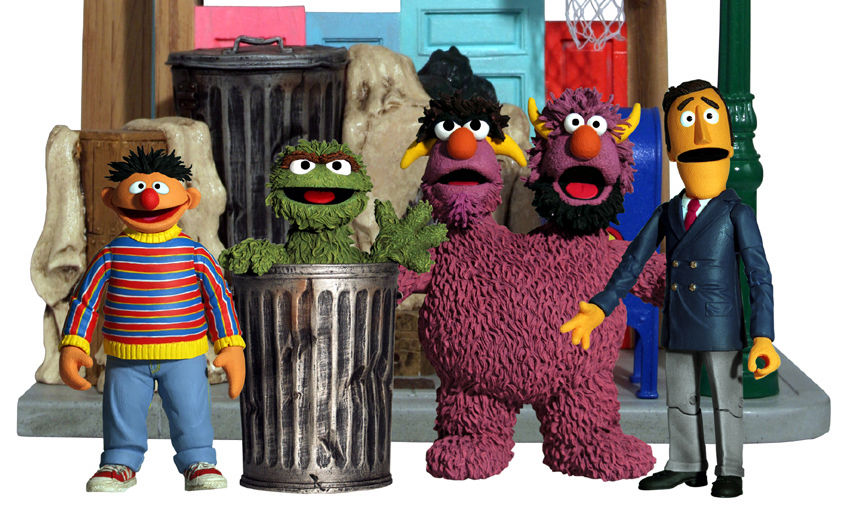
Officially announced in December 2004 (“Can” 18), the proposed toy line would offer adult collectors action figures from the long-running children’s educational program, with an emphasis on the older, “classic” cast. For example, while Series 1 was scheduled to include popular regulars Ernie and Oscar the Grouch, it would have also included semi-retired characters Guy Smiley and the Two-Headed Monster. In addition, initial plans were to sell differing versions of each wave, as revealed by Palisades Marketing Manager Travis Allen in a February 2005 ToyFare interview:
There will be one version of Series 1 that will be mass market friendly. It will carry a lower retail price and will include the figure and several character-specific accessories [including anthropomorphic Muppet letters, as shown above]. Then there will be the specialty market versions of Series 1 with a slightly higher price that will also include elements of Sesame Street. Once you collect all of the figures, you will be able to build a large-scale diorama of the world’s most famous street. (qtd. in Aclin 90).

Top left: the initial plans for the pack-in Sesame Street diorama (courtesy of Ken Lilly’s Instagram page). Above top right: Oscar the Grouch‘s Trashcan Area diorama; intended to be packed with Series 1 figures. Above bottom right: scale reference for the pack-in Muppet Letters.
Unfortunately, the ambitious street diorama proposal had to be scrapped due to projected sales numbers, according to Ken Lilly. In a February 27, 2026 post on his Instagram page, he reflected how the initial “build-a-playset” concept needed to change when “I started receiving directives to cut costs in order to make the line possibly able to be produced at the projected very low sales numbers” (@creatusmaximus, “Some images of the Oscar”). Though there were plans to shuffle the playset to the Palisades Toys’ Collector’s Club (“Can” 19), but it was not meant to be, as the entire toy line was eventually cancelled. In the aforementioned 2014 interview, Lilly revealed that the line failed due to a variety of factors:
We tried various scenarios in 2005 to see if we could reshape that line and make it appeal to mass market retailers, but we could not get them to budge. I think there were two things working against it primarily … [t]hey couldn’t see Sesame Street as anything other than a kids’ property that belonged in the kids section along with the Fisher Price toys, so why were these so expensive? And they were drawing a comparison to our own Muppets product. The problem with that is the retail buyers weren’t comparing the success of the early series of Muppets, they were comparing the waning sales of Series 7 through 9, which anyone in the business will tell you that all series have drop-off points. Any series of anything does … it’s just the nature of things. You build an audience, you gain it, you lose it. Look at most TV shows, film series, stuff like that. Buyers didn’t see this as Sesame Street Series 1. Many saw it as Muppets Series 10.

Top left: The Great Gonzo figure (from Series 5) in its clamshell packaging (courtesy of Ken Lilly’s Instagram page). Above right: the Oscar the Grouch figure (from the aborted Series 1) in its clamshell packaging (also courtesy of Ken Lilly’s Instagram page).
[…] I should have made an effort to move the packaging and presentation of the product away from the Muppets, away from that clamshell packaging look. There was a push for consistency from around 2003 or so. You can see it start to take shape with some of the lines like Pink Panther, Invader Zim, Ren & Stimpy, Muppets, etc. … starting to have the same general imprint, and it was carried over into Sesame Street. That’s what sales wanted and that is what mass market buyers wanted, and so we went that way to get higher volume for our product. It made perfect sense at the time, especially on those lines. You want that real estate at a Target or a Toys “R” Us or especially at a Wal-Mart, and if you can get it, you do what you have to do to get it. Volume equals profit … and profit means you can put out more stuff. You don’t think about that stuff as a toy collector, but the imprint of a package size is super important to the buyer, because they are planning out the entire area of space, and they know down to the inch how much space they have to work with. But, in this situation, it may have bitten us a little. By that time, we were out of those larger stores on a regular basis, that “real estate rule” no longer applied, but we hadn’t changed the packaging imprint, since we all had grown to like it, and it was still working. It was durable, and at the time petroleum-based plastic was still relatively affordable. Why change it if it wasn’t broken? Problem was that, in this case, it was broken; I just didn’t see it.

Above: the Super Grover figure, available from the Palisades Toys’ Collector’s Club and the company’s 2005 tour locations (like San Diego Comic-Con). This was the only Sesame Street character made available for sale; note the collector’s box packaging.
[…] It never occurred to me, and it should have based on the way the Super Grover was successfully presented with the Alex Ross artwork and the boxed format (though, in fairness, that was a convention exclusive, so the expectations were different) that this series of product should be designed to be different, and distanced, from a flailing Muppets series. (qtd. in “Case” 20-21)
To make matters worse, the line’s demise coincided with the bankruptcy and closure of Palisades Toys itself. In a February 1, 2006 press release, Michael Horn cited “a general trend within the toy industry, including the bankruptcy of one of Palisades’ largest customers” (qtd. in Cochran). While he did not identify which customer specifically, it was most likely Musicland Holding Corp—a company whose assets included Sam Goody, Suncoast, and Media Play—who declared bankruptcy on January 12, 2006 (“Musicland”). In the aforementioned 2014 interview, Ken Lilly elaborated on Palisades’ passing:
You can build the most amazing thing in the universe, but if you can’t sell it to retailers, you’re sunk. We had been having some success with the [d]irect to [c]onsumer model, but our Collector’s Club was still in its infancy basically, and these figures were not built around that type of production or sales model; they needed the quantity support of being in stores in order to offset the enormous cost of creating the product. Smaller retailers, the ones that had always been helpful to smaller companies like Palisades … they were fading away at the time. That hurt us a lot. Not just with Sesame Street, though the cancellation of the line was one short-term casualty. Palisades as an entity was the man casualty in the long-term, from my perspective. (qtd. in “Can” 20)
Of course, considering the time period, this decline in brick-and-mortar stores could also be tied to the rise of online markets in general and Amazon in particular. In addition, other factors could have also tied into the company’s demise, such as their dedication to niche product lines and their intentionally low prices. At any rate, in the end, Horn sold the remaining assets to Limited by CAS, Inc.—described as “another industry player” in the press release (qtd. in Cochran)—and walked away.

The Lovers, the Dreamers, and NECA
After an eleven-year run, Palisades Toys was no more, and its staff moved on to new opportunities. Michael Horn—self-styled as a “pop culture merchandise producer” on his LinkedIn page—would continue to work as a purveyor of genre merchandise, most recently as president of the U.S. branch of the Burgschneider Group, a company specializing in live-action role playing (LARPing) costumes and accessories. Ken Lilly founded Creatus Maximus, a collectables company (“Creatus”) that also offers freelance art services (according to his LinkedIn page), and he maintains a regular presence on Instagram. And James V. Carroll continues to operate as a freelance artist, including design work on the subsequent line of Muppet Show action figures produced by Diamond Select Toys, available 2016 to 2023 (Muppet Collection, “Part three”). Examples of his work can be found on his website.
As for the Muppet toy line that brought their company to a higher level of prominence, it is still fondly remembered by Muppet fans and toy collectors alike. In a March 3, 2012 ToughPigs retrospective, columnist Michael Wermuth, Jr. recalled the line fondly, stating how it was “among the best Muppet merchandise ever made, and […] certainly the best Muppet toys ever.” Likewise, on October 12, 2016, toy reviewer Michael Crawford echoed Wermuth’s praise when he said the following:
I think the love this line garnered was the result of the perfect storm of plastic goodness. They started with an adorable, cute license, oozing with nostalgic love. They created terrific sculpts in the perfect scale. They found a way to add useful articulation, and they included a great quantity of character and show-specific accessories. It wasn’t all perfect (they created a disproportionate number of variants, exclusives, and limited editions), but it was about as close as you can get without bursting into a ball of pure light. […] When a company puts people in charge of a license that truly love that license, great things happen. (Crawford)

Courtesy of the Lance Cardinal Creations page.
That said, probably the greatest praise for the toy line came not in words, but in reproduction, as—in a March 13, 2011 post—Canadian artist (and fan of the Palisades toy line) Lance Cardinal built a Muppet Show stage in-scale with the Palisades Muppet figures. Designed to resemble a real-life theatre stage (and capable of holding the Palisades playsets, allowing the Muppets to be “performing on stage”), this incredible piece of craftsmanship is a one-of-a-kind item that I would gladly pay hundreds of dollars to possess. Even former Palisades employees took notice of the post and offered their commentary in its comments section, with Michael Horn saying how the stage was “[s]tunning! I don’t get sentimental about our old company very often these days, but to see this level of creativity and passion that was spurred by our product line is pretty amazing. Congrats on the work and thanks for sharing” (Mike Horn). In addition, Ken Lilly offered his own accolades:
I am … simply an[d] utterly … blown away. AWESOME.
In my mind’s eye, this is almost exactly what I would have imagined the next playset could have looked like in my head, though admittedly I think there were some discussions about TRYING to squeeze [Statler and Waldorf’s] balcony in there if possible.
You did a fantastic job here, really first-rate. Would it have been something that we could have produced? Probably not. Some things would have to be shifted around in order to actually work from a production standpoint, but there is as much love in that homemade set as there was in any of the things we did at Palisades, and that’s what it was all about.
And, in the end, that’s all that matters.
Seriously … one of the most beautiful, most inspiring things I have ever seen anybody do with that line of figures and how to display them. ANYWHERE. (blogzilly)

Courtesy of Lance Cardinal’s Facebook page.
(It is worth noting that, this past year, Cardinal added to his collection by creating a replica of the Muppet Theatre’s box seats, allowing Statler and Waldorf to heckle the stage in comfort. According to his December 1, 2025 Facebook post, he intends to complete a replica of the entire Muppet Theatre “just in time to celebrate the 50th anniversary of ‘The Muppet Show!’” [Lance Cardinal].)

Left to right: action figures from NECA’s Sesame Street toy line, including Ernie, Bert, Count von Count, Super Grover, and Big Bird. It is worth noting that these figures are currently available for either order or pre-order on NECA’s website.
Speaking of reproduction, another example of Palisades love could be found in 2024, when the toy company National Entertainment Collectibles Association (better known as NECA) announced that they had obtained the license to create a line of Sesame Street action figures specifically for the adult collector market. At first glance, they greatly resemble the Palisades prototypes from twenty years ago—similar textures, attention to detail, and they are packaged in the type of collector’s box packaging Ken Lilly wished they had used. Also, while the figures currently available are franchise mainstays like Ernie, Bert, and Count von Count; upcoming ones are scheduled to include more obscure characters like Herry Monster, Frazzle Monster, and Sherlock Hemlock. Hell, they even come with little anthropomorphic Muppet letters and numbers, like the Palisades toys were going to. But the real kicker came in the form of a July 25, 2024 post on X (formerly Twitter) by line sculptor Paul Harding, who teased the following: “And guess what ‘vintage’ defunct line they fit in with[?]” (@HardingArt).


Top row: size comparisons between NECA’s Count von Count, Bert, and Ernie and Palisades Toys’ Koozebane Kermit and Super Grover. Bottom row left: more size comparisons with NECA’s Ernie and Bert and Palisades Toys’ Gold Tuxedo Gonzo, Fozzie Bear, Kermit the Frog, and the Swedish Chef. Bottom row right: NECA’s Count von Count and Palisades Toys’ Uncle Deadly.
As one can see from the photos above, the NECA figures pair very nicely with the Palisades ones, though I suspect that hardcore toy collectors can better suss out the differences between them. As for an expert opinion, Ken Lilly revealed in an April 16, 2025 Instagram post how “I believe wholeheartedly that NECA blows [the Palisades prototypes] out of the water” (@creatusmaximus, “A photo Bill”), later adding—in an April 20th post—that “I am so thrilled that these NECA figures are a part of my world” (@creatusmaximus, “Couple of shots”). Of course, there is one major drawback to the line, which is the cost of the figures. Compared to the Palisades’ toys, which were roughly ten bucks each, the regular NECA figures retail for $34.99, with Big Bird set to sell for $59.99. That said, considering the quality of the figures, the higher price point is probably more appropriate, and it will ensure that the toy line will be profitable enough to continue. Of course, while a pleasant surprise for an old, out-of-the-game toy collector like me, a bigger one came earlier this year at the 2026 Toy Fair, the annual toy industry trade show.
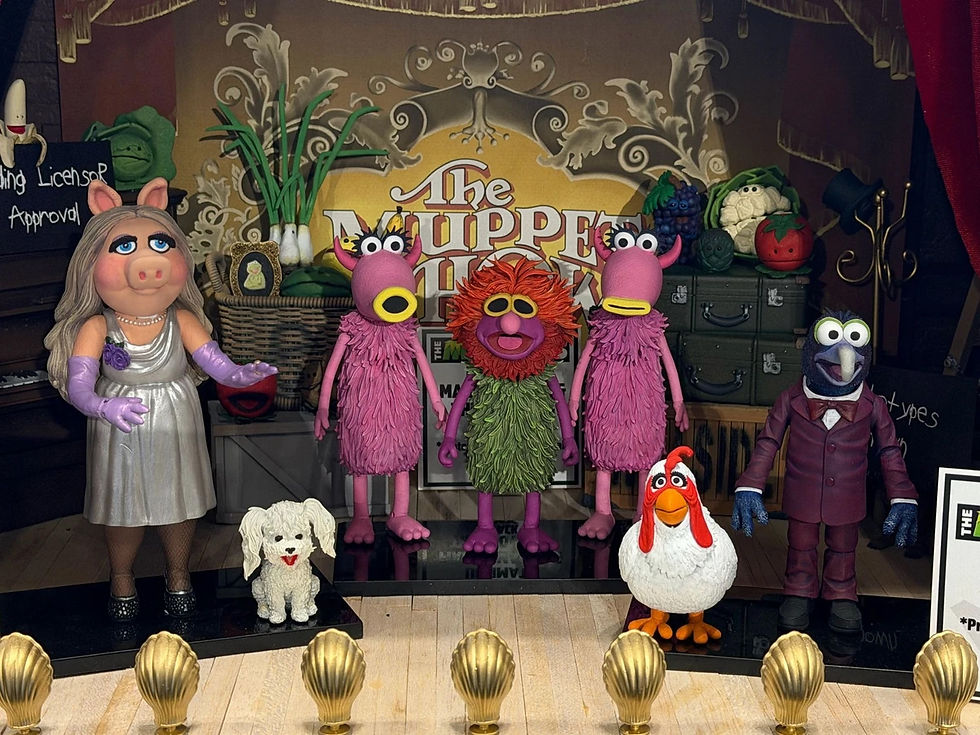
Image courtesy of the Muppet Wiki page.
Just in time for the fiftieth anniversary of The Muppet Show, NECA has also managed to acquire the license to the official Muppets, now owned by the Walt Disney Company. From the outset, it is obvious that NECA is tying their new line at least spiritually to the one from Palisades based upon the first presented figures: the Great Gonzo, a more accurate depiction of Miss Piggy (compared to the problematic Series 1 figure Palisades created), and Mahna Mahna and the Snowths (who never made to the action figure line, though they were created as part of the Mini Muppet PVCs). Regardless, I am eagerly waiting for these figures to see release.

Images courtesy of James V. Carroll’s Facebook page.
That said, it is worth noting that these are prototypes, and they will most likely change as the products evolve. Personally, I hope so—in their current form, Miss Piggy’s head is too big, and Gonzo is too tall and lacking his signature head feathers. And I’m apparently not the only fan noticing these issues, as James V. Carroll—based on his experiences working on both the Palisades and Diamond Select toy lines—offered his input (this time merely as a fan) in a February 17, 2026 Facebook post. My reposting of them here serves two purposes: first, as an example of Carroll’s skill as a digital artist, and second, to give these images better visibility, as these tweaks need to happen before they hit shelves.

This year is set to be a big one for Muppet fans. The success of Disney+ / ABC’s Muppet Show revival—drawing 7.58 million viewers during its first eight days on the streaming service—makes it look more and more likely that it will turn into a backdoor pilot for a reboot of the celebrated television series (Otterson). Roger Langridge, writer and artist of Boom! Studios’ popular Muppet Show comic book (2009-2012), returns to the franchise to create The Muppets Noir, a new series from Dynamite Entertainment (Johnston). And, later this year, I can look forward to acquiring new Muppet and Sesame Street figures for my collection … and I know just where to put them.

Mahna Mahna
In Fall 2022, after two decades working as an adjunct instructor at Towson University, I was hired full-time as an English professor (technically, I’m an assistant teaching professor, but let’s focus on the “professor” part, shall we?), and one of the perks I received was getting my own office. Unfortunately, as I already had a home office, for the first few semesters my work space was largely empty, as the four enormous bookshelves lining my office walls clearly showed. However, that changed in 2024 after the death of my father, as I inherited his extensive collection of science fiction books. Not having the shelf space at home, I relocated them to Towson and, as a bit of eccentric whimsy, I incorporated my collection of Palisades Muppet action figures into the shelves as well. What was once a generic, beige work space has evolved into a personalized area that could not be confused for any of my colleague’s offices.


They’re not all here, of course (somehow, I feel bringing over my Backstage Playset would be overkill), but they do provide a bit of needed color to my work area. Generally speaking, my students and fellow academics react positively to them, especially when I reveal that they were produced by a toy company started by an alumnus from our own English department (Medland). As I type these words, I am gratified that I can now grade my papers surrounded by decorations that not only celebrate an intellectual property intrinsic to my home state, but its very manufacture is also tied to both my alma mater and place of employment. Reflecting back on the whole affair, I can only thank Palisades Toys and its staff for making my childhood dream a reality.
Works Cited
Aclin, Justin. “How to Get to Sesame Street.” ToyFare: The Toy Magazine. Feb. 2005: 90. Print.
blogzilly. Comment on “Scratch Built Muppet Theatre Playset.” Lance Cardinal Creations. 24 Mar. 2011. <https://lancecardinal.blogspot.com/2011/03/scratch-built-palisades-muppet-theatre.html?showComment=1301020672022#c3414637325151592676>. Accessed 1 Mar. 2026.
“Can You Tell Me How to Get?” littleplasticmen: a magazine about action figures. WrightSide Media. Summer 2014: 18-21. PDF file.
Cardinal, Lance. “Scratch Built Muppet Theatre Playset.” Lance Cardinal Creations. 13 Mar. 2011. <https://lancecardinal.blogspot.com/2011/03/scratch-built-palisades-muppet-theatre.html>. Accessed 1 Mar. 2026.
Cochran, Jay. “Changes at Palisades Toy.” Toy News International. Entertainment News International. 1 Feb. 2006. <https://toynewsi.com/news.php?catid=174&itemid=8719>. Accessed 1 Mar. 2026.
Cook, Ginny. “Toy Story.” Towson: A Magazine for Towson University Alumni and Friends. Vol. 7, No. 1. Fall 2002: 10-13. Print.
Crawford, Michael. “Captain Toy Picks … the Top Ten Muppets Action Figures.” Captain Toy: Michael’s Review of the Week. 12 Oct. 2016. <http://www.mwctoys.com/FEATURE-101216.htm>. Accessed 4 Mar. 2026.
“Creatus Maximus Launches at Comic-Con.” Raving Toy Maniac. 12 Jul. 2006. <https://www.toymania.com/news/messages/8400.shtml>. Accessed 3 Mar. 2026.
@creatusmaximus. “A photo Bill Mancuso (sculptor on Muppets and Sesame)…” Instagram. 16 Apr. 2025. <https://www.instagram.com/creatusmaximus/p/DIgaQHHxfgV/>. Accessed 4 Mar. 2026.
---. “Couple of shots of the NECA Ernie figure…” Instagram. 20 Apr. 2025. <https://www.instagram.com/creatusmaximus/p/DIsA42xxTRO/>. Accessed 4 Mar. 2026.
---. “Early sculpt images of the Muppet Babies action figure…” Instagram. 25 Apr. 2025. <https://www.instagram.com/p/DI4dekexNzc/?img_index=1>. Accessed 25 Feb. 2026.
---. “Extremely early concept (using pre-existing parts) of what was a very ambitious (and possibly unrealistic) desire to create an entire Sesame Street dio / playset…” Instagram. 30 Apr. 2025. <https://www.instagram.com/creatusmaximus/p/DJCHXjmR47U/>. Accessed 1 Mar. 2026.
---. “Photos of the first paint master created for the Palisades Toys Muppets Animal action figure…” Instagram. 2 Jan. 2026. <https://www.instagram.com/p/DTBuTgpGNcT/?img_index=1>. Accessed 23 Feb. 2026.
---. “Gobo Fraggle…” Instagram. 23 Apr. 2025. <https://www.instagram.com/p/DI2GXrAxeex/?img_index=1>. Accessed 25 Feb. 2026.
---. “Some images of the Oscar the Grouch Trashcan Area Playset, from the canceled line of Sesame Street figures from Palisades Toys…” Instagram. 27 Feb. 2026. <https://www.instagram.com/creatusmaximus/p/DVRY98ejgNJ/>. Accessed 1 Mar. 2026.
@HardingArt. “And guess what ‘vintage’ defunct line they fit in with.” X. 25 Jul. 2024. 10:51 a.m. <https://x.com/HardingArt/status/1816486374645674403?fbclid=IwY2xjawEPuVZleHRuA2FlbQIxMQABHSPomDGYoDX646FIQiMNvO5bJU73VSlKToImA_k0zhd0TJmzV9Vk5B48cg_aem_X93CGrXspZbkoa-4uw6gIA>. Accessed 1 Mar. 2026.
“Henson Day.” University of Maryland. n.d. <https://innovate.umd.edu/hensonday>. Accessed 21 Feb. 2026.
“Incoming!” ToyFare: The Toy Magazine. Oct. 2002: 22-23. Print.
Johnston, Rich. “Roger Langridge Returns to the Muppets in 2026 with Muppets Noir.” Bleeding Cool. Avatar Press, Inc. 25 Nov. 2025. <https://bleedingcool.com/comics/roger-langridge-returns-to-the-muppets-in-2026-with-muppets-noir/>. Accessed 4 Mar. 2026.
Lance Cardinal. “Tansi everyone!…” Facebook. 1 Dec. 2025. <https://www.facebook.com/lance.cardinal.90/posts/pfbid0CPaJT9d5D7TgWRj7u58gCAGSbeEC5H386WFfgnbFrPb9J2hgGpU8rU7mXbFCFoCPl>. Accessed 4 Mar. 2026.
Medland, Mary. “Entrepreneurs in Toyland.” Internet Archive. 22 Jun. 2003. <https://web.archive.org/web/20030622010132/http://www.baltimoremagazine.net/monthly/2003/2003_04/baltinc/default.htm>. Accessed 22 Feb. 2026.
Mike Horn. Comment on “Scratch Built Muppet Theatre Playset.” Lance Cardinal Creations. 26 Mar. 2011. <https://lancecardinal.blogspot.com/2011/03/scratch-built-palisades-muppet-theatre.html?showComment=1301146921419#c4438176041554319498>. Accessed 1 Mar. 2026.
Muppet Collection Page, The. “Part two of my interview with James Carroll…” Facebook. 8 Jul. 2020. <https://www.facebook.com/themuppetcollectionpage/posts/pfbid0vNxLLatwwNXc4yrCbCDkU8GD34y8E7RTuzCJfzMo5i4ZwupJDbd7ZmdcDSwtHoTnl>. Accessed 22 Feb. 2026.
---. “Part three of the interview with James Carroll…” Facebook. 15 Jul. 2020. <https://www.facebook.com/themuppetcollectionpage/posts/pfbid02EKqnWGbE9F4KWcFG577H7Vuf5HPU7aaeujRNqL28JD4dm5tNiKuU9THk2kYZzBbtl>. Accessed 4 Mar. 2026.
“Musicland, Owner of Sam Goody, Files for Chapter 11 Bankruptcy.” West Central Tribute. Forum Communications Company. 12 Jan. 2006. <https://www.wctrib.com/news/musicland-owner-of-sam-goody-files-for-chapter-11-bankruptcy>. Accessed 1 Mar. 2026.
Otterson, Joe. “‘Muppet Show’ Revival Special Draws 7.58 Million Viewers in First 8 Days on Disney+, ABC.” Variety. Variety Media, LLC. 13 Feb. 2026. <https://variety.com/2026/tv/ratings/muppet-show-revival-special-viewership-1236662643/>. Accessed 4 Mar. 2026.
“PCHOF ’17 - Palisades Pioneer Mike Horn Inducted Into Hall.” Pop Culture Hall of Fame. Pop Culture Hall. 28 Aug. 2017. <https://www.popculturehall.com/blog/pchof17-palisades-pioneer-mike-horn-inducted-into-hall/>. Accessed 22 Feb. 2026.
Retsinas, Greg. “Hensons Buying Back the Muppets for $89 Million.” Internet Archive. 8 May 2003. <https://web.archive.org/web/20180104215639/http://www.nytimes.com/2003/05/08/business/hensons-buying-back-the-muppets-for-89-million.html>. Accessed 30 Dec. 2024.
Root, Tom. “It’s the Muppet Show!” ToyFare: The Toy Magazine. Apr. 2002: 62-66. Print.
Wermuth, Jr., Michael. “Ten Years of Palisades Toys Muppet Action Figures.” ToughPigs. 3 Mar. 2012. <https://www.toughpigs.com/ten-years-of-palisades-toys-muppet-action-figures/>. Accessed 25 Feb. 2026.
Images—unless otherwise indicated—courtesy of the Walt Disney Company, Fisher-Price Toys, Towson Magazine, NECA, and the company formerly known as Palisades Toys.


Comments