


Don't Call Him Super-Wimp: The Superman of Justice League, Part One

Updated: Sep 6
Before he became the foundation that Justice League and Justice League Unlimited were built upon, the Man of Steel went through an awkward phase in the first season.

In preparing the roster for the Justice League animated series, it can be argued that the only absolutely necessary character for the show would be Superman. Sure, Batman is more popular, but the DCAU had already firmly established him as a solo character in his own little corner of the world—which the creative team intentionally quarantined (Lamken 25; Kindred 33; Miller 37-38)—and, besides, they had already left him out previously when they were planning their aborted proto-Justice League / pre-Superman: The Animated Series (STAS) pitch back in 1996. Wonder Woman, despite her iconic status, was almost replaced by Big Barda due to rights issues. And, let’s be honest, there have been so many Flashes, Green Lanterns, and Hawks in DC Comics’ history that the creative team could have picked any of them and made them as interesting as what we got. Of them, only the Man of Steel was non-negotiable.
The reason for his sacred value is more than just iconic status. In the decades since Superman’s creation, his story—the immigrant from the stars who embraces his adopted world and seeks to protect and preserve it—has become a modern folktale that gains increasing significance as each generation retells it. For all the sins of the DCEU Superman, Zack Snyder got it right in the original Man of Steel teaser when he quoted this line from Grant Morrison’s influential 2005-2008 series, All-Star Superman: “You have given them an ideal to aspire to; embodied their highest aspirations. They will race, and stumble, and fall and crawl … and curse … and finally … they will join you in the sun, Kal-El” (Morrison 278).
As for the Justice League itself, the aforementioned Morrison had equally strong words in regard to Superman’s presence on the team they retooled in the ‘90s:
Superman is definitely regarded as the leader of the Justice League. I think everyone looks up to him. The JLA don’t seem to have what they had before in the way of certain rules as to who’s the leader this month. Everyone just kind of gets together and looks at Superman because he’s at the head of the table. The world loves Superman. Whenever he shows up, they say, “Thank God, we’re saved!” For Earth, the fact that Superman heads the world’s greatest superhero team is always going to bring a sigh of relief because the population has absolute trust and faith in him. (qtd. in Brick, “Leader” 37)
This connection was both acknowledged and honored by the Justice League creative team. In a May 14, 2001 interview with Comics Continuum, Associate Producer Shaun McLaughlin reflected how “[h]e’s the center of the group, I believe. He’s the one that everyone else can connect with because he’s Superman. He’s the first hero, the greatest of them, for want of a better phrase and not get too fanboy” (qtd. in Allstetter, “Justice League Animated”). In short, he is the god who would be man—the character who, using equal parts brute strength and moral character, seeks to lead others by example. He is the lynchpin upon which the entire Justice League is secured.
With that in mind, it is worth acknowledging the difficult transition from STAS to Justice League that changed the Last Son of Krypton in many unexpected—and frustratingly vague—ways. In the first of what will be a two-part essay, we will review this thorny period, look at possible reasons for his alterations, and recall how Superman overcame these difficulties to bridge the gap between series.

The Man of Yesterday
As discussed in a previous essay, Superman: The Animated Series was, in many ways, the antithesis of traditional Superman media. After decades of conventional stories featuring the Man of Steel—particularly the Christopher Reeve movies that, for better or worse, have become the default in the public imagination—the creative team made the decision to intentionally go against the grain and provide something different. In a July 1996 interview with Wizard Magazine, Producer Bruce Timm laid down his manifesto:
These characters have been around so long in the various media, and we’re trying to reinvent them to a degree to make them seem interesting again, fresh and exciting. At the same time, not do what Lois and Clark is doing and not do what the Chris Reeves movies did and not do exactly what the comics have done. Every writer that comes into the show says, “Superman’s a big boy scout, Clark’s a wimp, and Lois is a bitch.” No, no, no. That’s not what we want to do. (qtd. in Allstetter, “Men” 45-46)
Added STAS Producer Paul Dini:
We’ve had to work as hard as anybody freeing up our minds as to how we see these characters. [...] It’s so easy to fall into the trap of making Clark this dull guy and making Superman quip after he throws a punch. I said, “No quips. No gags. No jokes.” We really have to work harder to make this unique. It’s a character everybody knows, but make it cool, make it different. (qtd. in Allstetter, “Men” 46)
Draped in a costume featuring a darker color palate and mostly black shorts, the major difference between this Superman and past ones was his outward presentation. Traditionally portrayed as, yes, a boy scout, the STAS Man of Tomorrow took on more of a “mystery man” persona, as detailed by Timm: “We’re making Superman a little more mysterious. When he saves somebody, he doesn’t stand around and say, ‘No problem, Commissioner, blah, blah, blah…’ He saves somebody, and he’s off again. He’s quiet and mysterious” (qtd. in Allstetter, “Men” 45).
Of course, when it comes to animation, the look and the writing are only as good as the voice actor that brings it to life, and the creative team struck gold when they hired actor Tim Daly (best known as Joe Hackett on the NBC series Wings) to voice their Superman. Encouraged to audition for the role by the late Arleen Sorkin—the original voice of Harley Quinn—Daly found himself hired on the spot following a brief reading (Lapin-Bertone). Looking back at their hire in a November 2021 interview, Voice Director Andrea Romano had this to say about his initial showing:
[H]e gave a performance that was so natural … even though I know this isn’t specifically Tim’s personality, he has a voice—and I mean no negative thing by this—that has kind of a boy scout quality that we needed in our Clark Kent and Superman. I mean no negative thing when I say boy scout; I mean that he needs to sound like a good guy. Like a man who will always make the right ethical choice. An alien with ethics. (qtd. in Wilding)
And, in a March 2007 interview, Bruce Timm offered his recollection on Daly:
When we were first casting for Superman: The Animated Series, we were looking for somebody with a more mature, Bud Collyer / George Reeves kind of voice, and we couldn’t find anybody. We auditioned a lot of guys who had deep voices, but they all sounded like radio announcers. Their acting chops weren’t there. That’s why we ended up going with Tim Daly. Even though he wasn’t the voice we were hearing in our heads, we couldn't deny he was a really good actor, and we could see how he would fit. Over the years, I actually started to turn around. Tim Daly [was] in the Christopher Reeves mold, the more idealistic Superman. (qtd. in Fritz)

Debuting in September 1996, this incarnation of Superman would appear in a series that, despite network interference and competition from Batmen both traditional and beyond, would be notable for updating a character that had become stagnant and predictable. Under the watch of Timm and company, this was a quiet, discreet Man of Steel that tried to avoid the spotlight while, at the same time, helping as many people as possible. He largely held his tongue with the press—save for the occasional interview with The Daily Planet—and he kept his circle tight, opening up only to trusted confidents like Professor Emil Hamilton, Inspector Dan Turpin, Jimmy Olsen, and his frequent accomplice / love interest, Lois Lane. At various times, he could be intense, he could be angry, he could be funny, and even—on rare occasions—he could be downright terrifying.
Originally intended to run for 65 episodes, “lower than hoped-for numbers” led to Kids’ WB! reducing their order to what would eventually become 54 (Berkowitz 55). By this point, the creative team had already introduced the Flash, Green Lantern, and Aquaman on the series and, had they continued, they may have taken it all the way to its logical conclusion. As STAS Producer Alan Burnett revealed in a 1998 Wizard Magazine interview, “[w]e were toying with the idea of introducing all the characters that would be in the JLA one by one in Superman, then the last episode ever would be the formation of the JLA” (qtd. in Brick, “Tooned” 23). Unfortunately, the proposed series would have to take a backseat for the duration of Batman Beyond and the Kids’ WB! era.

Retempering Steel
Fortunately, following the non-cancellation cancellation of Batman Beyond, Bruce Timm successfully sold the Justice League series to Cartoon Network after a single phone call (Gross, “Justice” 2; Allstetter, “Bruce”). Tasked with developing an ensemble superhero series for the first time, Timm and the creative team began by planning both the roster and their individual personalities. Now, obviously, some adjustments were needed to make the seven characters noticeably different from each other—as Timm stated in a 2002 Starlog interview, in “the 1960s Justice League comics, the characters were all pretty interchangeable” (qtd. in Jankiewicz 29)—but unlike Batman who, aside from a few cosmetic changes over the years, largely remained the same in terms of voice and characterization for the entirety of the DCAU (the ongoing presence of his longtime voice actor, the late Kevin Conroy, certainly helped), Superman found himself extensively retooled for Justice League. Unlike his World’s Finest partner, the Man of Steel experienced a number of changes that affected his voice, his appearance, and his personality, resulting in a character very different from his STAS incarnation.
The first major change to the Man of Steel involved the recasting of his voice actor, as the original DCAU Superman, Tim Daly, was unavailable. In addition to his role in the CBS remake of The Fugitive (Dimino; Jankiewicz 33)—which primarily filmed in Washington state (Schucht)—Daly had also relocated to the East Coast, making it difficult for him to attend Andrea Romano’s weekly, group recording sessions (Gross, “Superman” 21; Pantozzi). As previously discussed, this reduced availability led to his temporary replacement by voice actor Christopher McDonald—who had performed as Superman’s father, Jor-El, on STAS—for the Batman Beyond episode “The Call,” but for Justice League a more permanent surrogate was needed. Said Romano during a 2004 interview:
[A]t the end of the [STAS] series, [Tim] moved to Rhode Island and started producing and directing more, and his availability became very limited, so we did another casting. This was right around the time of the Justice League series. We weren’t even looking for a soundalike, we were just looking for someone to play the role of Superman. Since it was a new incarnation in a new series, we thought it was fine to go ahead and recast. (qtd. in Gross, “Superman” 21)
In a January 2021 post on the Anime Superhero message boards, Bruce Timm recalled the auditions for the new Superman:
[W]hen we needed to find a new Superman for Justice League, James Tucker and I thought we’d found our guy: Gregory Harrison (Falcon Crest, Logan’s Run). At the audition, he sounded way different than Tim Daly, his voice much deeper, more “macho,” kinda like Budd Colyer from the Fleischer and Filmation cartoons—which was kinda what James and I were looking for. We’d heard lots of actors with deep, “manly” voices at the auditions, but they all tended to sound like radio announcers. Harrison had the pipes but was also a really good actor, seemed strong and dynamic, but very natural. He exited the booth, we told him he sounded awesome, and he seemed very pleased. Andrea asked him what else he had going on, and he excitedly told us he was embarking on a tour of some stage show [possibly the 2001 Broadway revival of Follies]. Uh oh. And just how long was this tour supposed to last? “Oh, I’m gonna be gone all summer,” he said cheerily. We were supposed to start recording the show in about two weeks.
Crap! Back to the drawing board. And besides Harrison, we hadn’t heard anyone we liked.
Fortunately, George Newburn was right around the corner. He might even have auditioned later that same day. We liked him right away, his audition was really solid, and we recognized that he had that same “Nice Guy Superman” quality that Tim had (and Christopher Reeve too, for that matter). Even though he wasn’t the type we’d specifically been searching for, we knew he would be a good fit continuity-wise with Tim’s version from the previous show, without sounding like an exact copy. (b.t.)

And so, the torch was passed from Daly (above left) to George Newbern (above right). Known for his roles in Adventures in Babysitting (1987) and Steve Martin’s 1991 remake of Father of the Bride, he also previously voiced the character of Ren in the cult animated series, The Pirates of Dark Water (1991-1993). Described by Timm as another Superman “in the Christopher Reeves mold” (qtd. in Fritz), Romano recounted how Newbern was “a very nice fit” and “[a] lovely actor who, coincidentally, sounds very similar to Tim Daly” (qtd. in Gross, “Superman” 21). Finally, as for any difference in performance, Dana Delaney (who performed Lois Lane on STAS, Justice League, and Justice League Unlimited [JLU]) had this to say about her leading men: “Tim was more the straight-forward hero, but George is great. To me, the difference is he’s a little goofier. It’s a different Superman, but equally viable as Tim’s” (qtd. in Freiman).

With the matter of the Man of Tomorrow’s voice settled, next came alterations to his design. While Bruce Timm was initially comfortable with reusing the original STAS designs for Superman (Davis; Jankiewicz 32), he eventually relented to Artists / Co-Producers Glen Murakami and James Tucker’s demands, who wanted “to make Superman a little bit more mature, not quite as youthful and fresh-faced, boy scout-looking” (qtd. in Allstetter, “Bruce”). In addition to bringing back the more traditional red shorts, the primary changes were made to his face, as detailed by Timm in the 2003 DVD feature, “The Look of the League”:
James Tucker took a pass over the old Superman design, and he felt that the old design was fine, but he thought that Superman could be a little more rugged, a little bit more grown-up-looking, so we gave him strong cheekbones and little, tiny dashes under his eyes, which are supposed to give him a little more of a comic book “squinty” look; makes him look a little bit older than he did in the Superman animated series. (qtd. in “Look,” 00:01:33-00:01:53)
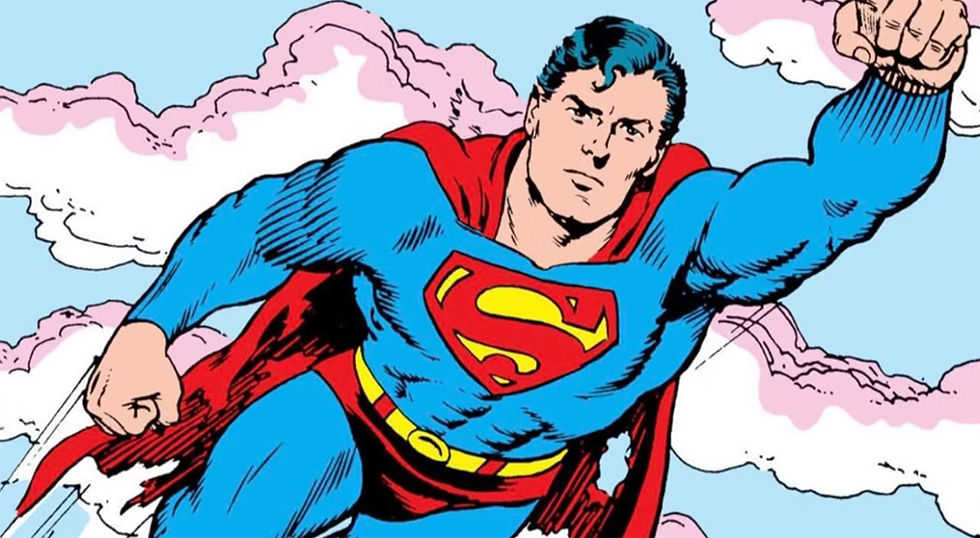
The resulting changes to his design—particularly the “squinty” lines under his eyes—made him strongly resemble Superman artist Curt Swan’s designs which, according to Timm, “wasn’t our intention” (qtd. in Jankiewicz 32):
We chiseled his features off a bit more and toned down his pompadour. Ultimately, the effect may make him look more like the Curt Swan version, but that wasn’t our intent. The grey is a highlight. We wanted to jazz up his design, so we put that comic book highlight in his hair. That doesn’t indicate he has grey hair, it’s just to give him visual oomph. We decided to change Superman and Batman for this show because we wanted their designs to be a little different from what had been seen previously. (qtd. in Jankiewicz 32-33)
Finally, there was the matter of his personality, which was a dramatic change from STAS. Rather than continue with the “quiet and mysterious” Man of Steel, which would have clashed with Batman’s modus operandi, the creative team surrendered to the “boy scout” persona. During his appearance at the Justice League panel at the 2001 San Diego Comic-Con, Bruce Timm provided a glimpse into the new Superman:
Personality-wise, if anything, he’s probably a little more of a boy scout than he was in the old show. When he was in his own show, a stand-alone kind of show, we felt that that worked against him. People would be like, “Oh, Superman’s just a boy scout.” But within the new group dynamic of the Justice League, we thought, “That’s kind of neat to have one guy who’s kind of like Dudley Do-Right.” (qtd. in Davis)
Their new Man of Steel complete, they readied him for the series premiere, which aired November 17, 2001. Prior to his debut, Cartoon Network released a new character profile for Superman, thus preparing the audience for this new incarnation:
Living up to being the legendary Superman would be a burden for most men, but Clark Kent’s shoulders are more than broad enough to carry the load. While his incredible physical strength comes from his home planet of Krypton, his moral strength comes from his simple Kansas upbringing. But he’s no longer the farm boy from Smallville. After seeing more of the universe than any of us can imagine, he maintains a firm sense of right and wrong.
But he is more complex than his reputation as a big, blue boy scout. When he talks about truth, justice, and freedom, everyone senses his deep commitment to these ideals. The natural leader of the Justice League, Superman leads by example and steadies this volatile group. With so many super-egos involved, there are often major clashes in style. And when clashes inevitably occur, he is often the peacemaker. (qtd. in Allstetter, “Justice League Characters”)
However, as the Timm and the creative team was soon to learn, their retooling of the Man of Tomorrow was far from over.

Man of Kleenex
When episodes of Season One began airing in late 2001, fans began to notice that the new Man of Steel was presented as anything but. Suddenly, the experienced, capable Superman that we watched go toe-to-toe with the most powerful villains in the universe (aka “Classic Supes”) was frequently getting knocked out in battle by way of energy blasts (“Secret Origins,” “Injustice for All,” “War World”), electrocution (“The Enemy Below,” “Legends”), or simply by an attack from a similarly-powerful foe (“Injustice for All,” “Paradise Lost,” “War World,” “Fury,” etc.). With each mission, this “New Supes” went down early with alarming regularly, requiring the other six team members to pick up the slack.

The most egregious example of this new status quo can be found in the aforementioned “Injustice for All” during the League’s first battle with the Injustice Gang. Upon arrival, New Supes found himself immediately knocked out by Star Sapphire’s energy blast and, after staggering to his feet, he was then beaten into the ground by Solomon Grundy (fortunately, Hawkgirl was able to save him). Later, after a minute of the camera focusing on the other heroes, the action returned to Superman, only to see him laid out again, this time by the Ultra-Humanite. This hero—who routinely took on the likes of Kalibak, Lobo, and Darkseid on his own series—could now barely hold his own during a fight. And he’s supposed to be the strongest member of the Justice League.

If that wasn’t enough, Superman’s indignities continued in part two of the episode, where his attempts to interrogate Copperhead were met with mockery. I mean, c’mon, he may not be the Dark Knight but compare this scene to one from the STAS episode “Where There’s Smoke,” where Classic Supes successfully questioned rogue government agents to find out where Volcana was being held. Even if they knew he wasn’t a killer, the STAS Man of Steel still knew how to evoke fear when necessary. Compared to his previous adventures, this Superman appeared lesser than his earlier incarnation.
Reaction from the fan community was swift, thanks in large part to the adoption and normalization of the Internet, and the consensus was in: Superman was now a wimp. Of the thorough and comprehensive responses to this development, the most damning came from an Anime Superhero (formerly Toon Zone) editorial written by journalist Jay Allman (aka Maxie Zeus):
Superman got the worst of it, and he got the worst of the fan criticism too. Suffice it for now, four years on, to say that he came across as tentative, inept, and burdened by a secret worry. Easy to say now why he flew about in a defensive crouch: without intending to, the show’s creative team had dropped most of their insecurities onto his very broad shoulders.
So, villains made their bona fides by beating him up; only the League could match anyone strong enough to take down Superman. A paramilitary group of superheroes, obviously, would exist uneasily alongside government authorities, so Superman groveled obsequiously to anyone with a uniform or a title. These particular heroes had not been created, as characters, to work together, so Superman diplomatically buried his own powerful ego and personality.
Above all, the new format required Kal-El to be Superman 24/7; cut off from his Clark Kent persona, he lost a lot of his warmth. He seemed lost in the crowd and often lost in the plotting. The “man” had disappeared from “Superman,” and the “super” went dangerously into eclipse. (Allman, “Farewell”)

In response to these observations, the creative team performed damage control, most of which involved an acknowledgment of fault and the learning curve in developing the new series. For example, writer Rich Fogel, in a March 20, 2003 interview with Comics Continuum, offered the following explanation:
In making these shows and approaching them, we have to put together a good chemistry for the group and make the powers so they’re not overlapping each other a lot. So, for example, we powered down Martian Manhunter a little bit, so that he was not stepping on Superman’s toes. We didn’t want two people who were doing exactly the same thing.
And, quite frankly, there are situations where Superman, if he was really on top of his game, could take care of everything by himself, and he wouldn’t need the Justice League. So, we’d be left with a Superman show, which we’ve had already. So, sometimes we’d engineer things a little bit to […] weaken him a little bit. (qtd. in Allstetter, “Justice League’s Superman”)
He would later elaborate further in a 2004 interview:
[W]e needed to get situations where the other heroes had an opportunity to show what they could do, because they hadn’t been in series before. We had to devise ways to knock Superman out of the picture so the other guys could do things. The other thing—and I don’t know how to put this delicately—is that there was a certain inattentiveness to the storyboarding in the first season. There were certain bits of business that had been successful in the past with Superman in his own series that tended to get repeated a lot. These were not written in the scripts; it was in fleshing out the action that this happened. It wasn’t until we got the footage back that we saw Superman was getting kicked around a lot. (qtd. in Gross, “Justice” 6)
Added James Tucker, in the same article:
Superman got beat up and knocked on his ass all the time on his own show. The difference was that the camera stayed on Superman because it was his show. There was no one else to come in and pick up the slack or change the focus to. Because the focus was on Superman, you waited until he got up and came back.
Well, on Justice League, Superman takes a licking, goes off screen and we don’t necessarily follow him. We stay at that point and Green Lantern or Wonder Woman comes in. The main mistake we made with that was having him get hit all the time and not showing him recovering and coming right back. We erred on the side of caution, because Superman theoretically should be able to handle all of these problems by himself. I don’t think we made him weaker; we just didn’t cover our bases as far as showing him be Superman.
[…] There’s no way to easily change directions mid-stream. It’s like a ship leaving a dock: you can’t turn around right away. You just have to make the best of what you’ve got and, if you get a pickup or another season, address them then. (qtd. in Gross, “Justice” 6)
And then there was the reaction from Bruce Timm, who shared his thoughts in an April 23, 2003 interview with the now-defunct website The Pulse:
By the time the first couple of episodes started airing, we were almost done with the pre-production on the first season. So, by the time we realized there were some problems we had, it was too late to fix them. There was almost nothing we could do.
One of the things we had gotten the most critical hits for on the first season was that, supposedly, we de-powered Superman and made him a big wimp. It wasn’t a conscious decision on our part—it was literally because we had already done his own series, and we had all these new characters to introduce and focus on. We felt Superman could take care of himself; we didn’t feel like we needed to give him any special attention. But what happened was, we fell into a rut of Superman getting knocked down, and then not getting back up. And it wasn’t something we realized was happening until we started getting the episodes back, and the fans on the Internet started saying, “Hey, wait a minute, […] Superman can’t take a punch anymore?” And we’re saying, “Oh, my God, they’re right!” But, by that time, we only had [two] or [three] episodes left on the first season. We tried to fix it as quickly as we could.
He’s a tough character. […] You don’t want him to be too powerful, but you don’t want to make him too wimpy. The trap we fell into on Justice League was, again, we have seven on these guys. Whatever villains they go up against have to be big, powerful villains. So, we used the easy trick of saying, okay, the villain walks into the scene and takes Superman down with one punch. We automatically know that he’s a bad guy, and it’s going to take the entire Justice League to take him down. We didn’t handle that with enough finesse. (qtd. in MacDonald)
While I appreciate Timm’s candor and understand where he’s coming from, I must respectfully disagree with the claim that Superman did not need “special attention.” Again, this may be true for a character like Batman, who—again—experienced minimal changes over what was now a decade of appearances, but with the Last Son of Krypton, who had just been extensively retooled from his STAS incarnation, he was practically a new character. New Supes—with his new voice actor, retooled design, and more explicit “boy scout” demeanor—was very, very different from “quiet and mysterious” Classic Supes. Furthermore, considering how the Man of Tomorrow is defined by his supporting cast, the absence of Lois and the rest of the Daily Planet staff created a further disconnect between the two (as Timm said in a special feature on the Justice League: Season One DVD: “for the first season, we made a deliberate decision to not have any other supporting characters because we didn’t have the time to play with them, and we wanted to really establish that the Justice League was its own show” [qtd. in “Inside,” 00:02:57-00:03:06]). With this in mind, it was obvious that Superman was in peril; you could literally see it in his face.

These Lines Across My Face Tell a Story
In addition to the issues listed above, another problem arose, as New Supes’ added cheekbone and eyelid lines—rather than making him look more “mature” and “rugged” as intended (Davis)—simply made him look old, tired, and—in some scenes—even sickly. In one of Timm’s many responses to the topic, he made the following comment in an April 6, 2007 post on Anime Superhero’s message boards (formerly Toon Zone):
I’m sure I’ve said this publicly before, but I’ll say it again: [Justice League] Season One Superman’s face design was not—I repeat, not—designed to look “older,” just “more rugged” or “more manly.” When drawn properly (maybe [two] or [three] scenes out of any given episode), it works great, but the cheek lines and eye details were apparently hard for the animators to draw consistently, so more often than not they actually do make him look “older” or, worse, “tired.” (b.t.)
Later, in a now-deleted January 2022 post on X (formerly Twitter; fortunately, it can still be found quoted in the above Watchtower Database video), James Tucker confirmed Timm’s earlier statements, saying how “[s]mall little details like eye wrinkles and cheekbones […] just don’t animate well going through as many hands as TV animation does” (qtd. in “What’s,” 00:17:30-00:17:38). He would also admit, in an earlier, also-deleted October 2021 post, how the “animators tended to move that little lower eyelid line lower so that it looked more like an eye bag. Another reason to be careful of every single line you put on a design” (qtd. in “What’s,” 00:09:25-00:09:35).


(Confession time: I’ve always hated Superman’s Season One cheekbone and eyelid lines [as well as Wonder Woman’s own Season One cheekbones], believing them to be unnecessary and cluttering up what should be a simple design. In fact, I disliked them so much that, both on this website and on The Justice League Watchtower, I would edit them out using Adobe Photoshop, save for specific scenes [such as his infection in “Fury,” for example]. To this day, I honestly don’t think anyone noticed.)
New Supes’ weathered appearance compounded his less-than-stellar showing on the battlefield, and—while it may not have been the intention of the creative team—it strongly implied that something was wrong with the Man of Steel. And, for long-time fans of the DCAU, it was obvious as to the cause.

A Legacy of Pain and Suffering
In February 2000, Kids’ WB! aired the two-part Superman episode “Legacy,” a show that, due to airdates, served as the series finale. In this episode, Superman responds to a distress signal from a derelict spacecraft, only to be attacked and abducted by the forces of Darkseid. Dragged back to Apokolips and brainwashed by Granny Goodness, he is reprogrammed to believe that the craft his father used to save him from the destruction of Krypton landed on Apokolips rather than Earth and, as an infant, he was adopted by Darkseid and trained to be a part of his military forces. For over a month, a mind-controlled Kal-El was used to invade an untold number of alien worlds and, later, the dark New God sent him to invade Earth itself. Normally invulnerable, here the Man of Steel was violated in ways that he never had been before, including morally, physically, spiritually, and even sexually.

While it could not be directly stated in children’s programming, it is heavily implied what type of “celebration” the Female Furies had in mind as they pulled him away from Darkseid’s presence and, later, when Superman woke from a nightmare, Lashina just happened to be in the room with him. In a May 2021 interview with the Watchtower Database, Rich Fogel discussed how the “staging of the scene in ‘Legacy’ clearly suggests that they were sleeping together” (qtd. in “Aquaman,” 00:14:30-14:00:34) but, based on the earlier scene, I think it strongly implies that the Female Furies each took turns with their “boy toy” during his conscription (note Lashina’s line to Superman in part two: “Give us a kiss?”). At the very least, it was another way for Darkseid to debase the “boy scout” further and, at worst, the lord of Apokolips would certainly welcome an opportunity to introduce Kryptonian DNA into his officer pool.
While we’re on the subject, I would be remiss to not discuss the apocryphal story about the allegedly proposed Batman Beyond pitch where Lashina bore Superman a son who would go on to kill Darkseid and conquer Apokolips. It simply isn’t true, or there is no evidence to support it. The only legitimate info I can find about this is in the aforementioned Fogel interview, where he states how “[t]o be honest, I don’t recall that ever being discussed in the room at the time. […] It’s possible that somebody had thought about it or something like that, but it never really went anywhere” (qtd. in “Aquaman,” 00:14:24-00:14:43).

(Of course, that’s not to say that it isn’t a good idea. Hell, let’s take it even further: what if each of the Female Furies bore a Kryptonian child? Fans have long complained about how General Zod never appeared in the DCAU; what if Lashina, Mad Harriet, and Stompa were the mothers of Zod, Ursa, and Non [or, as pictured above, Zod, Faora, and Quex-Ul]? But I digress.)

After freeing himself of Darkseid’s influence, the end of “Legacy” finds Superman a pariah on his adopted home world, feared and distrusted by the people he spent the entire series protecting. Sadly, his story ended there, but according to Fogel, this wasn’t their original intention:
“Legacy” had a sort of tortured ride in terms of getting to the screen. It was supposed to be much earlier in the season originally, and Paul Dini was supposed to write it. He was busy with other things, and it was not happening, so I was brought in to sort of shepherd it through and, by the time we actually got it through production, it ended up being one of the last ones.
I think that we sort of looked at that as a blessing in disguise because it gave us a whole new situation for Superman to be in and, should we have been picked up for another season, we could have told different kinds of stories. (qtd. in “Aquaman,” 00:14:52-00:15:27)
This thought was mirrored by Producer Alan Burnett, who said in a December 2, 2002 interview with Comics Continuum that “[i]n the last season, we wanted some tenseness between him and society. Society didn’t quite trust him after that episode, and he had to reprove himself. But we never got the last season, so the show sort of ends on a dark note” (qtd. in Allstetter, “Alan”).

Chronologically speaking, our next encounter with Superman was in the Justice League episode “Secret Origins,” where none of this is directly referenced at all. Again, by my estimate, the events of this show are roughly two-to-three years after STAS, but the world is back to unconditionally loving the Man of Steel, so much so that a congressman tasks him with dismantling the world’s nuclear stockpile. At one point, Batman even ribs him over having to leave to receive “another key to the city,” further implying that, as far as “Legacy” was concerned, all is forgiven, but this wasn’t always the case, as Bruce Timm revealed in a December 2001 interview with The World’s Finest:
We can’t pre-suppose that everyone who watches [Justice League] has seen every episode of our previous series; more likely, most of them haven’t. Originally, in Part One of “Secret Origins,” General Wells’ line, “We can’t entrust the world’s security to one man” ended with “…especially him!” We felt that anyone who hadn’t seen “Legacy” would be confused, wondering, “Well, why not him? Why does this guy hate Superman so much?” As it is now, it works both ways: either Wells is just being a practical military tactician, or he doesn’t trust the guy who almost conquered the world for Darkseid. Similarly, Superman’s line, “I’ve worked long and hard to earn your trust” has different meanings to long-time fans and “newbie” audiences. (qtd. in Harvey)
So, what happened? Why wasn’t this ever addressed? Unfortunately, this was by design—according to a 2010 interview on the Justice League: The Complete Series DVD, Timm revealed that “[w]hen we first started Justice League, our first self-imposed rule that we gave ourselves was that we didn’t want to rely too much on the continuity of our previous series” (qtd. in “Unlimited,” 00:05:57-00:06:06). Unfortunately, while I see his point, this was a devastating blow to Superman, as this two-to-three year “continuity hole” threw another wrench into New Supes, where there was a potential explanation for our weary, punch-drunk Man of Steel, but the creative team explicitly refused to reveal it to the audience, leaving us to indulge in fan theory to explain this mess. In addition, it raised question as to whether, considering the events of “Legacy,” a Justice League would even be possible. In an August 16, 2002 editorial on The World’s Finest website, DCAU scholar the Old Maid spelled it out for us:
Now, in a perfect world, the Justice League would have grown organically through the continuing STAS series. Traditionally, Superman has organized and led the League as an extension of his beliefs and personality (every boy scout leader needs a troupe). When STAS was cancelled, “Legacy” became the last word on that version of Superman. Oh, Supes still appears in Justice League, stoically punching a time clock and doing his duty methodically and silently (as one fan put it, “He’s not exactly having a good time”). Naturally, fans ask [if] Superman been given a post-“Legacy” personality without actually exploring the ramifications of the previous series? Could Superman have built a League with his damaged reputation? Or did the others build the Justice League and bring him into it to keep an eye on him? Tantalizing possibilities, never developed.
Unfortunately, the Justice League creative team elected to have their cake and eat it too by giving him “a post-‘Legacy’ personality without actually exploring the ramifications” (Old Maid), which is a shame, seeing as how easy it could have been to connect the two.
Consider the following, post-“Legacy” scenario: after a period of relatively positive relations with humanity, Superman is now feared and hated by the majority of the population. The United States now views him as an enemy and a traitor, so much so that the U.S. military almost executed him with a kryptonite-infused lethal injection while in custody. And, on top of this, he has to deal with the fact that his mind and body were violated by Darkseid and his henchmen. Again, despite his strength and invulnerability, he experienced real trauma and must be suffering from some form of post-traumatic stress disorder, which could result in intrusive thoughts, flashbacks, and nightmares (and it’s not like he can just go to a counselor for fear of compromising either their safety or his secret identity).
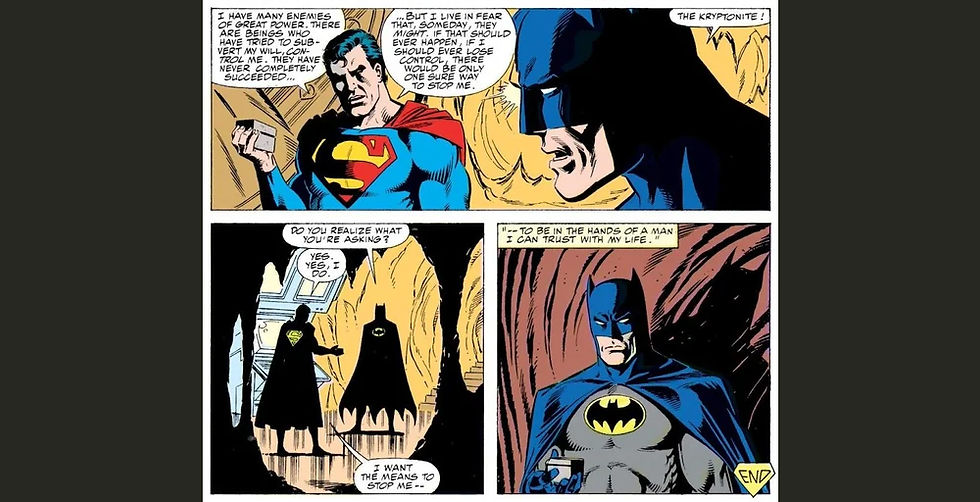
And so, to compensate for this, he throws himself into his work, redoubling his efforts to serve as Earth’s protector. Fighting every threat, answering every cry for help … laboring ceaselessly with little thought for rest or his own state of mind but, as strong as he is, even a Superman has his limits. As insurance, he goes to Batman and, assuming that he doesn’t already have some, offers him a piece of kryptonite to use should he ever lose control again (such as he did in the above scene from Action Comics #654 [June 1990]). As time passes, the fear, the stress, and the constant physical exertion takes a toll on his appearance—as James Tucker said in a now-deleted October 2021 post on X (formerly Twitter), “I always justified [his added facial lines] later by saying Superman was still feeling the aftermath of ‘Legacy,’ where Darkseid brainwashed him into conquering Earth, and the stress of having to prove himself to the world all over again wore him down until the Justice League formed” (qtd. in “What’s,” 00:19:10-00:19:25)—and, in time, these factors also affect his physical prowess.
Finally, after months of his labors, he begins to realize that while his previous “quiet and mysterious” approach to crimefighting may have worked in the past, in this new era where everybody views him with suspicion, he decides that he should now outwardly present himself as a more blatant do-gooder. Suddenly, rather than save a life and move on, he must now linger to do damage control, shaking hands and making small talk, even if he doesn‘t necessarily want to. Rather than disappear in a flash of blue and red, he now makes public appearances and accepts awards. In short, to compensate for the events of “Legacy,” Classic Supes had to force himself to become New Supes.

Fortunately, the Man of Steel—along with his longtime partner in [stopping] crime, Batman—form the Justice League, a team of like-minded heroes who could aid him in the never-ending battle. For Superman, this is a godsend, as he not only has more help defending the planet now, but he also has a first-line of defense should he ever lose control again. At first, the weary New Supes does get knocked around a bit in battle but, over time, the camaraderie helps him rally. Suddenly, he isn‘t responsible for everything all the time and, over the course of Season One, he somehow gets a bit of downtime, allowing him to recuperate, which results in a better showing in combat later in the season.
However, despite his progress, the scars of “Legacy” are still just under the surface, as we see when the lord of Apokolips returned at the start of Season Two.

How Superman Got His Groove Back
In preparation for the second season of Justice League, fixing the Man of Tomorrow was at the top of the creative team’s to-do list. They heard the constructive criticism from their fan base, and they did what they could to correct it. In a May 11, 2004 post on the Anime Superhero (formerly Toon Zone) message boards, Bruce Timm reflected on their error, saying how “I’ve admitted elsewhere that we dropped the ball with Superman’s portrayal in Season One […] not out of malice, but merely inattention. Thus, we did end up temporarily with the slightly daft, bland, cornball boy scout. When we all realized what was happening, we took steps to revitalize him in Season [Two]” (b.t.). He further outlined these changes in the aforementioned April 23, 2003 interview with The Pulse:
We just really made sure that, anytime he got knocked down, that he got back up and, whoever it was that knocked him down, Superman was eventually going to clean his clock and not have somebody else come in and clean his clock for him. We made sure we kept him at full strength—believable full strength—but [we] made sure that it left room for the other Justice League guys to have something to do. It made our jobs harder, but ultimately it works better. (qtd. in MacDonald)
In addition, this revitalization of his battle prowess was accompanied by the removal of his age lines, making him more resemble the Superman of STAS. And, while no direct correlation or explanation was made regarding these changes, it was at least good to have a healthy, youthful Big Blue back.
This return to form occurred in “Twilight,” the two-part episode that served as the premiere for Season Two, and it was intentionally designed to be not only a sequel, of sorts, to “Legacy” but also a continuation of Superman: The Animated Series itself. In a June 26, 2003 interview meant to promote the episode, Timm discussed how “[w]e didn’t really do that many Superman-centric stories the first season. So, realizing that we’d kind of dropped the ball in our handling of him, we wanted to remedy that as soon as possible, and [we] figured, what better way to erase ‘super-wimp’ than by throwing Darkseid at him?” (qtd. by Allman, “Why”).

They did more than “throw Darkseid at him,” as they also included Brainiac, references to Krypton, and even the New Gods of New Genesis, characters that were obviously intended to appear on STAS but were cut for time. After a season in quarantine, references to the previous series came back in a big way, which was necessary to connect New Supes to his past. It was also a tour de force for George Newbern, who Timm had watch “Apokolips…Now!” and “Legacy” in preparation for the recording sessions (Allman, “Why”). The producer would later praise Newbern for his performance, saying how “I think a lot of the heat he’s taken from the fans is really our fault, not his. We just didn’t give him anything to sink his teeth into in Season One. I think he gives his best performance to date in ‘Twilight,’ especially at the end” (qtd. by Allman, “Why”).

Speaking of which, the climax of “Twilight” offered up a no holds barred rematch between the Last Son of Krypton and the lord of Apokolips, allowing Superman to vent his pent-up anger over his abuse at the hands of Darkseid. This encounter was notable not only for its ferocity and brutality, but also for Superman’s promise of violence to the New God, saying how this time he wouldn’t stop “until you're just a greasy smear on my fist.” While seemingly out of character, the line was defended by Timm in a 2004 interview:
We felt we needed to draw a line in the sand and say, “This is our mission statement for Season Two, which is, ‘Goodbye Superwimp.’” We may have overcompensated in that episode; some of his dialogue is a little out there. Still, I think it’s definitely in context of him dealing with Darkseid. He’d never say it to Luthor, but he could to Darkseid. In any case, it represented a major change from Season One. (qtd. in Gross, “Justice” 6)
He would later expand on this stance, as well as Superman’s willingness to kill, in a 2021 interview with Screen Rant:
You know, it depends on the specific projects. […] And the only time we even flirted with [it] was in the Justice League episode [“Twilight”] where he’s literally coming this close to saying, “Yeah, I want to kill that guy,” but it’s really just more a matter of, as Dwayne McDuffie, God bless him, […] once put it, he gave us that great “I live in a world of cardboard” speech [from the JLU episode “Destroyer”], where it’s like Darkseid is one of the few bad guys that he can actually let loose on and not worry about him being killed and vaporized instantly.
Everybody else Superman always has to pull himself back a little bit, but with Darkseid, he could just go at it. Darkseid is psychologically … he’s the one guy who can get under Superman’s skin unlike any of the other characters, even Luthor. He’s the guy that pushes all of Superman’s buttons in the worst way. He brings out the worst in him. (qtd. in Colbert)
Following their battle, with Darkseid seemingly meeting his end in the explosion, the Man of Steel—while not fully recovered from his previous trauma—surely experienced some measure of closure from their climactic encounter. In addition, this conflict served to merge Classic Supes and New Supes into a stronger, more cohesive Superman, one who is not quite the “quiet and mysterious” hero of STAS or the boy scout of Season One but does embody the best aspects of both. And, finally, while he may have a measure of peace in regard to his fears that he could lose control again, he would soon learn that there are other ways a powerful being such as he could bring ruin to his adopted planet.
Works Cited
Allman, Jay. “Farewell to the Justice League.” Anime Superhero. 17 May 2006. <https://animesuperhero.com/farewell-to-the-justice-league/>. Accessed 6 Apr. 2022.
---. “Why is Darkseid So Very Cool? Bruce Timm Explains.” Internet Archive. 26 Jun. 2003. <https://web.archive.org/web/20060212071934/http://forums.toonzone.net/showthread.php?t=80000>. Accessed 4 Jan. 2023.
Allstetter, Rob. “Alan Burnett Talks Batwoman, Aquaman, Static Shock.” Comics Continuum. 2 Dec. 2002. <http://www.comicscontinuum.com/stories/0212/02/burnettindex.htm>. Accessed 31 Dec. 2022.
---. “Bruce Timm Talks Justice League—Part One.” Comics Continuum. 24 Apr. 2001. <http://comicscontinuum.com/stories/0104/24/jlaindex.htm>. Accessed 19 Nov. 2022.
---. “Justice League Animated Update.” Comics Continuum. 14 May 2001. <http://www.comicscontinuum.com/stories/0105/14/index.htm>. Accessed 20 Dec. 2022.
---. “Justice League Characters.” Comics Continuum. 19 Oct. 2001. <http://www.comicscontinuum.com/stories/0110/19/jlindex.htm>. Accessed 22 Dec. 2022.
---. “Justice League’s Superman.” Comics Continuum. 20 Mar. 2003. <http://www.comicscontinuum.com/stories/0303/20/index.htm>. Accessed 5 Jan. 2023.
---. “Men of Steel.” Wizard: The Guide to Comics. Jul. 1996: 44-48. Print.
“Aquaman, Creeper, and … a LADY FIREFLY? Oh My! (Writer Rich Fogel).” YouTube. Uploaded by Watchtower Database. <https://www.youtube.com/watch?v=DDoY8tCg0Ag>. Accessed 26 May 2025.
Berkowitz, Stan. “When Things Go Well … There’s Seldom a Story to Tell.” Beyond the Bat: Secrets of a Superhero Scribe. 2024: 53-68. Print.
Brick, Scott. “Leader of the Band: Grant Morrison Tells Us What the World Thinks of Superman.” Wizard JLA Special. 1998: 37. Print.
---. “Tooned Out?” Wizard JLA Special. 1998: 20-23. Print.
b.t. Comment on “Batman Beyond ‘The Call, Parts 1 & 2’ Talkback (Spoilers).” Anime Superhero. 6 Apr. 2007. <https://animesuperhero.com/forums/threads/batman-beyond-the-call-parts-1-2-talkback-spoilers.4322731/page-12#post-65962461>. Accessed 7 Oct. 2023.
---. Comment on “Sam Register of The Batman Interview.” Anime Superhero. 11 May 2004. <https://animesuperhero.com/forums/threads/sam-register-of-the-batman-interview.3616861/page-7#post-53304981>. Accessed 10 Sept. 2023.
---. Comment on “Vintage Interviews with the Makers of the DCAU.” Anime Superhero. 19 Jan. 2021. <https://animesuperhero.com/forums/threads/vintage-interviews-with-the-makers-of-the-dcau.5787503/page-4#post-87748008>. Accessed 9 Oct. 2023.
Colbert, Stephen M. “Bruce Timm Interview: Superman: The Animated Series Remaster.” Screen Rant. Valnet, Inc. 26 Oct. 2021. <https://screenrant.com/superman-animated-series-remaster-bruce-timm-interview/>. Accessed 20 Jun. 2024.
Davis, Joseph. “The Justice League Panel at 2001 San Diego Comic-Con.” Aglets Are Sinister. 26 Apr. 2025. <https://www.agletsaresinister.com/post/the-justice-league-panel-at-2ool-san-diego-comic-con>. Accessed 26 Apr. 2025.
Dimino, Russ. “The Many Faces of … Superman.” KryptonSite. KSiteTV. Oct. 2007. <http://www.kryptonsite.com/manyfacessuperman.htm>. Accessed 13 Jul. 2023.
Freiman, Barry. “Exclusive Interview with Dana Delany.” Internet Archive. 12 Jan. 2006. <https://web.archive.org/web/20060112092510/http://www.supermanhomepage.com/tv/tv.php?topic=interviews/dana-delany>. Accessed 14 Jan. 2023.
Fritz, Steve. “Bruce Timm—Doomsday and Beyond.” Internet Archive. 28 Mar. 2007. <https://web.archive.org/web/20070328174912/http://forum.newsarama.com/showthread.php?t=105799>. Accessed 4 Nov. 2023.
Gross, Edward. “Justice League: The Making of the DC Tooniverse.” RetroVision CD-ROM Magazine. M&R Multimedia, Inc. n.d.: 1-7. PDF file.
---. “Superman (George Newbern).” RetroVision CD-ROM Magazine. M&R Multimedia, Inc. n.d.: 21. PDF file.
Harvey, Jim. “The Bruce Timm Interview.” Internet Archive. 4 Dec. 2001. <https://web.archive.org/web/20020205134054/http://wf.toonzone.net/jl/btimminterview.htm>. Accessed 25 Dec. 2022.
“Inside Justice League.” Justice League: Season One. Warner Bros. Animation, 2006.
Jankiewicz, Pat. “Justice League: Superman, Batman & Their Super Friends Get Animated for the 21st Century.” Starlog. Jan. 2002: 28-33. Print.
Kindred, Christopher. “Fox Moves Batman to Saturday Morning.” Animato!: The Animation Fan’s Magazine. Fall / Winter 1993: 29-34. Print.
Lamken, Brian Saner. “Justice for All (Or, a League of His Own).” Comicology. Spring 2000: 24-25. Print.
Lapin-Bertone, Joshua. “Superman: The Animated Series Turns Twenty-Five.” DC Comics. 10 Nov. 2021. <https://www.dc.com/blog/2021/11/10/superman-the-animated-series-turns-twenty-five>. Accessed 17 Jun. 2024.
“Look of the League, The.” Justice League: Justice on Trial. Warner Bros. Animation, 2003.
MacDonald, Heidi. “Timm on the League’s New Attitude.” Internet Archive. 23 Apr. 2003. <https://web.archive.org/web/20060623022635/http://www.comicon.com/cgi-bin/ultimatebb.cgi?ubb=get_topic;f=36;t=000941;p=1>. Accessed 3 Jan. 2023.
Miller, Bob. “Metropolis Daze and Gotham Knights.” Starlog Presents Batman & Other Comics Heroes. 1997: 36. Print.
Morrison, Grant. All-Star Superman. Illustrated by Frank Quitely. DC Comics. 2011.
Old Maid, The. “Shallow.” The World’s Finest. 16 Aug. 2002. <https://dcanimated.com/WF/sections/fanworks/edits/editorials/rant1.php>. Accessed 11 Sept. 2022.
Pantozzi, Jill. “Voice Director Andrea Romano on Casting Your Favorite Superheroes.” The Mary Sue. 1 Mar. 2012. <https://www.themarysue.com/andrea-romano-interview/>. Accessed 12 Aug. 2023.
Schucht, Eric. “From ’Twin Peaks’ to ’Assassins’: Some of the Movies and TV Shows Filmed in Everett.” HeraldNet. Everett Herald + Sound Publishing, Inc. + Black Press Media. 19 Aug. 2023. <https://www.heraldnet.com/life/from-twin-peaks-to-assassins-some-of-the-movies-and-tv-shows-filmed-in-everett/>. Accessed 24 May 2025.
“Unlimited Reserve: Exploring the Depths of the DC Universe.” Justice League: The Complete Series. Warner Bros. Animation, 2010.
“What’s the Deal with Superman’s Cheekbones?” YouTube. Uploaded by Watchtower Database. <https://www.youtube.com/watch?v=bTlYNSwzK_0&t=1587s>. Accessed 25 May 2025.
Wilding, Josh. “Superman: The Animated Series Interview: Voice Director Andrea Romano Reflects on Casting DC Icons (Exclusive).” ComicBookMovie.com. Best Little Sites, LLC. 3 Nov. 2021. <https://comicbookmovie.com/superman/superman-animated/superman-the-animated-series-interview-voice-director-andrea-romano-reflects-on-casting-dc-icons-exclusive-a189289#gs.amv1xm>. Accessed 22 Jun. 2024.
Images courtesy of Warner Bros. Discovery, Warner Bros. Home Entertainment, Warner Bros. Animation, DC Comics, Tim Daly, and George Newbern. YouTube video courtesy of the Watchtower Database channel.


I rewatched all of Superman's fight scenes in the first season of JL, and he actually gets up almost right away whenever he takes a punch.
Sometimes he's forced to play along with his opponent, as in the final fight with Mongul, where the destruction of Draaga's native planet is at stake. Sometimes he gets defeated by a powerful female character (Wonder Woman or Aresia), though…