


CASE FILES - Justice League's "In Blackest Night"

Updated: Jul 6
NOTE: This article obviously contains SPOILERS. Proceed at your own risk!

Episode Details
Writer: Stan Berkowitz
Director: Butch Lukic
Animation Studio: CNK International (formerly Koko Enterprises Ltd.)
Original Airdate: November 19, 2001 (Part One); November 26, 2001 (Part Two)
Official Summary
A group of indestructible android enforcers called the Manhunters arrive on Earth to arrest Green Lantern for abuses of power. While Green Lantern stands trial, the Justice League discovers the Manhunters’ true agenda: the total destruction of the Green Lantern Corps (qtd. in Davis, “In”).
My Summary
A galactic tribunal sends the robotic Manhunters to track down Green Lantern John Stewart, who is accused of destroying the planet Ajuris 4. Stewart turns himself in to stand trial, but the Justice League, who believes him to be innocent, investigates. Meanwhile, the Manhunters have their own plans, and use the distraction of the trial as a chance to pay back an ancient grudge.
Voice Cast
George Newburn as Superman
Phil LaMarr as Green Lantern, Bystander (Uncredited)
Michael Rosenbaum as The Flash, Arkkis Chummuck (Uncredited), Sportscaster (Uncredited)
Maria Canals-Barrera as Hawkgirl, Judge (Uncredited), Bystander (Uncredited)
Carl Lumbly as J’onn J’onzz
James Remar as Lead Manhunter
Kurtwood Smith as Prosecutor
Rene Auberjonois as Kanjar Ro, Guardian (Uncredited), Galius Zed (Uncredited)
Dennis Haysbert as Kilowog
Garrett Morris as Al McGee
Peter Renaday as Graz, Bailiff (Uncredited)
Brian George as Forian, Guardian (Uncredited)
Ricky D’Shon Collins as Chris, Robber (Uncredited)

Background
Intended to be a spotlight episode for Green Lantern, “In Blackest Night” suffered due to changes occurring at Warner Bros. Animation at the time, coinciding with the hiring of Sander Schwartz as the company’s new president (Allstetter, “Schwartz”). In a May 30, 2021 interview with the Watchtower Database, Justice League Producer / Story Editor / Writer Rich Fogel discussed some of the hurdles that the series had to endure at the beginning of its run:
Around the time we started Justice League, Warner Bros. had changed their business model. Jean MacCurdy—who had been the president of [Warner Bros.] Animation—left, and we got a new administration. And they were like, “Well, we’ve sold the shows already, we don’t want to spend any more money on them than we have to; we just want to get them out the door, so we can sell the next thing.” Jean’s thing had always been, you know, “If we’re gonna do something, we wanna make it the best thing that we can.” And I’m not saying that the new one wanted to make it bad; they just thought good was good enough.
Budgets were slashed. Whereas on Batman and Superman we had a writing staff of six people who were devoted full-time to thinking about Batman and thinking about Superman—a lot of brain power going into it. When it came time to do Justice League, which is arguably the most difficult show we had attempted so far, they cut the budget to two writers, so it was me and Stan Berkowitz. We were really struggling to tell the kind of stories that we wanted to tell with just a bare bones writing staff.
Along the same lines, they cut the music budget by, I think, two-thirds. These had always been done with a live orchestra, and they said, “Why are we spending money on this?” Luckily, at that moment in time, the technology was getting just good enough that the composers were able to do something that didn’t sound like a Saban show. […] And I thought that they did a tremendous job; I was so impressed by what they were able to do with what they were given.
I know they had to make some concessions on the animation side too but, luckily, the team was mostly intact at that point, and so they were able to work with what they had, but we really were working with one arm tied behind our back in terms of getting the show off the ground. And, if you see some bumps along the way in the first season […] that’s part of the reason why was that we did not have the resources that we had had before. I was very pleased with the way it ultimately came out, but it was a painful birthing process. (qtd. in “ZETA,” 00:13:23-00:15:31)
As a result of these changes, “In Blackest Night” specifically compensated in a number of ways, such as featuring a notably scaled-down version of the Green Lantern Corps (see “Stray Observations” below) and making extensive use of background alien models from Superman: The Animated Series (STAS; again, see below).

Fortunately, the transition did not affect the creative team’s adaptation of the Manhunters, a DC property with a long, convoluted history spanning decades and multiple iterations (for our purposes here, I will focus on relevant highlights). First appearing in Adventure Comics #58 (January 1941), the character would later be handled by the creative team of Joe Simon and Jack Kirby from issues #73 (April 1942) to #80 (November 1942); note the familiar red-and-blue costume (above left). Kirby would later return to the premise decades later in 1st Issue Special #5 (August 1975), bringing to it his more familiar, stylized artistic approach (above center). Finally, this look would later be incorporated into the familiar Green Lantern adversary for the two-part Justice League of America #140 (March 1977) and #141 (April 1977) story arc (above right). In an episode introduction on the 2003 Justice League: Justice on Trial DVD, Producer Bruce Timm spelled it out for us:
The Manhunters—they have a really long history—a real complicated, long history—in DC Comics. I mean, there’s millions of varieties of Manhunters, you know. There was a heroic Manhunter, then there was the evil Manhunters, and then there was another heroic Manhunter. Our version of the Manhunters are pretty much based on the Jack Kirby look when he did a Manhunter one-shot back in the early ‘70s, and they later incorporated that into an evil group of bounty hunter robots in the comics, so we thought that was a really good way to go with them. (qtd. in “Episode Introduction to ‘In Blackest Night, Part 2,’” 00:01:23-00:01:54)

Above left: a Jack Kirby Manhunter sketch, obviously based on the 1975 design. Above right: a Manhunter turnaround model sheet from Justice League, illustrated by character designer Glenn Wong.
Based on the images above, it is obvious that Timm, an avowed Jack Kirby fan, sought to incorporate stronger Kirby influences from the 1975 design into his plans for the Guardians’ former automatons. In addition, according to an interview with Producer / Story Editor / Writer Stan Berkowitz in the October 31, 2023 installment of the Justice League Revisited podcast, he revealed that Rich Fogel had him read Jack Kirby’s Manhunter comics in preparation for this episode (Eisenberg and Enstall, 00:15:17-00:15:35).
Reflecting on writing “In Blackest Night,” Berkowitz particularly liked the “kangaroo court aspect” of the plot, presenting “a legal system that was basically a farce” (qtd. in Gross, “Justice League Episode” 9). Drawing influence from the infamous O.J. Simpson murder trial (“We did this about five years after the O.J. trial, […] so that was still—I mean, especially in L.A., everybody was still talking about it”; qtd. in Eisenberg and Enstall, 00:43:34-00:43:45), he discussed writing the script in an interview with RetroVision CD-ROM Magazine:
I think what happened was Rich Fogel came to me with the idea of adapting a comic story that involved Hal Jordan, but he wanted it switched over to John Stewart. We had to modify it a lot, which takes a lot of patience. But the thing that stands out is taking a few pokes at our legal system. […] Actually, come to Los Angeles some time and take a look at our legal system” (qtd. in Gross, “Justice League Episode” 9)
To his credit, Rich Fogel praised the episode, saying in an October 11, 2001 Comics Continuum interview that “Stan and Butch [Lukic] did an outstanding job with a story that literally spans galaxies” (qtd. in Allstetter, “Justice League’s Blackest”); he would later add the following in a November 17, 2001 interview:
Even with a 90-minute pilot like “Secret Origins,” there wasn’t enough time to do “justice” to all seven of our main characters. But in the next episode, “In Blackest Night,” which premieres Monday, we’ll start to learn more about our heroes and their backgrounds. Although this story features John Stewart, the Green Lantern, it also highlights Hawkgirl and Flash, plus several surprises. Stan Berkowitz wrote the script, and it was directed by Butch Lukic. Both did an outstanding job on a story that has intergalactic consequences.
Except for three-parters, which are too massive, we’ve tried to treat the two-parters as a single show. So, whenever possible, the same writer, director, and composer will handle the entire story arc. It’s really like […] making a series of movie events. For “In Blackest Night,” Kris Carter did an amazing job on the score. We are so lucky to have such talented musicians as Kris, Mike McCuistion, and Lolita Ritmanis on this series. They really understand and love the material. Their inspired scores can boost a good show and make it great. (qtd. in Allstetter, “Justice League Animated”)

Looking back on “In Blackest Night” in the October 17, 2023 installment of the Justice League Revisited podcast (erroneously listed as released on December 1, 2023 on Apple Podcasts), Green Lantern voice actor Phil LaMarr offered his recollections about the episode:
Try to imagine some other cartoon—I mean, I can imagine a cartoon where they have one of the heroes in a tough situation like this, but he wouldn’t be siding with the bad guys the way John is in the beginning of this. You know, and it’s so subtle and well-written; it’s like, “Well, there’s this illusion that has fooled everybody … including him.” And that winds up being the solution; the heroes figure it out. I mean, most heroes … action things are simple: “Here’s good guy. Here’s bad guy. Watch them fight, and then good guy wins!” Like, you know from Scene One how it’s going to finish, you know, in Scene Ten. But this one, you did not! (qtd. in Eisenberg and Enstall, 00:25:17-00:26:14)

Finally, during the aforementioned interview with RetroVision CD-ROM Magazine, Bruce Timm offered his take on John Stewart’s tour de force:
It’s got a few logic holes in it, but that comes with the territory, I suppose. We were pretty happy with it when we got it back. You can definitely see that we were trying to step up our game just in terms of spectacle, especially in part two with the big battle on Oa with the thousands of Manhunters versus the Justice League and the Green Lanterns. We were pretty impressed ourselves with what they were able to pull off overseas, just because we’d never really done action set pieces that had that many characters in motion at the same time. But I think it came out really well.
I was a little bit reluctant when the story was first pitched to me—to have the first Green Lantern story to be one in which he’s taken down a peg. I thought it might not have been the best way to introduce him as a character to show him in disgrace. Ultimately, I think it worked out kind of well because it showed his grace under fire and his willingness to accept what he had done and the consequences of it. I think it’s a pretty good character display for him. Overall, I’m pretty happy with that episode. (qtd. in Gross, “Justice League Episode” 9)

Commentary
When the team roster for Justice League was announced in early 2001, many fans were shocked to see the inclusion of John Stewart, the Black Green Lantern created by the creative team of Dennis O’Neil and Neal Adams, who first appeared in Green Lantern #87 (January 1972). At the very least, they may have expected Kyle Rayner, who had previously appeared in the STAS episode “In Brightest Day…” and was still the main Green Lantern in the comics at the time, but there were also fans that were angry that he was chosen over characters like Hal Jordan or Guy Gardner in the first place. To them, John Stewart simply wasn’t “good enough” of a character to merit inclusion. In response to this message board unrest, Bruce Timm offered this explanation for their choice in a December 2001 interview with Cinescape:
Green Lantern is the most controversial character so far from what we’ve been gathering on the internet. When the show’s lineup was first announced, there were a lot of people saying, “Why aren’t they using Hal Jordan? No, it’s got to be Guy Gardner. No, it’s got to be Kyle Rayner.” Obviously, we picked the wrong one, but the reason we did choose John Stewart is valid—we needed to infuse ethnic diversity into the Justice League. We felt this show is going to be seen worldwide, and I think having a member of the Justice League who is not just “Mr. White Bread” is a good thing. (qtd. in Moro 62)
In the years since Justice League, Timm has been resolute in his decision, referring to Stewart’s casting as a necessary bit of “affirmative action” (qtd. in Anderson), with Phil LaMarr volunteering in a 2022 interview the time that “I remember Bruce telling me, ‘Well, I don’t wanna do a show where it’s just seven white people saving the world every week. That’s boring’” (qtd. in McPherson). Still, at the time, while Timm’s words reassured the majority of the fan base, there was still a vocal minority that saw the Green Lantern’s presence as tainted. To use the guttural parlance of the Donald Trump era, to them, John Stewart was a DEI hire.
Recognizing that this issue would need to be addressed as soon as possible, the creative team made Green Lantern a priority, slotting his first focus episode immediately after “Secret Origins” and loosely basing it on the aforementioned Justice League of America #140 (March 1977) and #141 (April 1977), a Hal Jordan-centric story that also happened to introduce the Manhunters, a race of sinister robots that, over time, became a major threat to the Green Lantern Corps. In an episode introduction on the 2003 Justice League: Justice on Trial DVD, Timm discussed the origins of this episode, as well as their motivations for making it:
“In Blackest Night” was actually inspired by an actual comic that came out in, like, I think ’77. There was a Justice League comic that had basically the same plot—Green Lantern was tricked into thinking that he had destroyed a planet, and it turned out to be a big plot by the Manhunters. So, that was the direct springboard for this episode. We thought it was a really good, strong way to introduce the John Stewart character as Green Lantern—to show his deeper, more melancholy side; what better way than to start off, right off the bat, with him thinking that he’s destroyed a whole planet? (qtd. in “Episode Introduction to ‘In Blackest Night, Part 1,’” 00:00:02-00:00:33)
In light of the backlash against their choice for Green Lantern, “In Blackest Night” was designed to justify John Stewart’s inclusion in the Justice League series. However, while successful in that regard, it also addressed a longstanding blemish in Stewart’s comic book ledger—a specific incident that had shamed the character for over a decade.
In 1988, writer Jim Starlin—best known for writing “space opera” stories for Marvel Comics, including 1991’s The Infinity Gauntlet—created Cosmic Odyssey with artist Mike Mignola. The story—featuring an alliance of New Genesis, Apokolips, and Earth forces teaming up to stop a sentient Anti-Life entity from destroying the galaxy—was notable for its use and depiction of John Stewart. Tasked with J’onn J’onzz to safeguard the planet Xanshi from destruction, Green Lantern—portrayed as arrogant and overconfident in his power ring’s capabilities—ditches J’onn (seeing him as a liability) and charges in to stop the detonation of a Blink Bomb himself … only to discover that the bomb was painted yellow, which—at the time—was the Green Lantern ring’s only weakness.

The resulting explosion, caused by the mingling of matter and anti-matter, not only destroyed half of Xanshi, but it knocked the remains of the planet out of orbit and into its sun … which also exploded. The only survivors were John Stewart and J’onn J’onzz, who were protected by the ring’s energies.
Okay, a few things. First, note the man in the above third panel, who is literally waiting for John to arrive after painting the bomb yellow. Earlier in Cosmic Odyssey #2 (January 1989), it was speculated that the Anti-Life entity had the capacity to take mental control of the planet’s citizens to use them to defend Its onslaught, which appears to be the case (he’s oddly calm for a guy whose solar system is about to be destroyed). Second, later that same issue, John recognizes that the entity must have known about his ring’s vulnerability to yellow, implying that It knew about the dispatched heroes and created countermeasures to defeat them. With that in mind, it’s obvious that—with or without J’onn—there wasn’t a damn thing John Stewart could have done in the six remaining seconds he had upon arrival. He was doomed to fail.
The end of Cosmic Odyssey left John Stewart a broken man, with the final issue featuring the Green Lantern attempting to kill himself over his guilt. While the original story featured J’onn using reverse psychology to change his mind, The Other History of the DC Universe #1 (January 2021) offered the following retcon:

Critics of Cosmic Odyssey cite how John Stewart behaved notably out of character compared to his earlier Green Lantern stories, with one reviewer commenting how he acted more like Guy Gardner. Personally, I find it disturbing that DC Comics would take Stewart, one of their first and most prominent Black superheroes, and “take him down a peg” in this manner. And I’m not alone, as Justice League soon-to-be writer and Producer Dwayne McDuffie commented in a message board post of an undetermined date that “Cosmic Odyssey spoiled the comic book version for me,” going on to say in a September 12, 2004 post how Stewart was portrayed as “an arrogant fuck-up,” and ending—in a September 11, 2004 post—on how “I’d never punk out John Stewart like that. I’m still mad” (Maestro).

(It is worth noting, in the years following Justice League and Justice League Unlimited [JLU], that John Stewart—most likely due to his elevated profile following both animated series—was allowed to better explore his guilt over the event during Geoff Johns’ acclaimed Green Lantern stories, such as the first two above panels from Green Lantern #26 [February 2008]. He would later come to terms with the destruction of Xanshi in Green Lantern #49 [February 2010] during the Blackest Night storyline—as seen in the last two above panels—finally admitting to himself, “I’m wrong. I didn’t kill anyone. I failed to save them. After […] Xanshi. After the things I’ve seen and done in the name of war on Earth and in space … I should already know I can’t save everyone. And it’s about time I accepted that. It’s time to move on … and move out.”)
With this in mind, it becomes obvious that the creative team’s plan was to justify John Stewart’s inclusion as Green Lantern by putting him into a Hal Jordan story to show how he could handle the situation just as well as Jordan could have. Consider his words to the Flash as they were led to the gas chamber: “Think of the others like us. We all need to be held accountable. We have too much power not to be.” He is portrayed here as a righteous man who “was tricked into believing he did something wrong and honorably agreed to take his punishment,” as McDuffie stated in his aforementioned September 12, 2004 post (Maestro). And, in shouldering that punishment, he was also—in a way—symbolically accepting punishment for the destruction of Xanshi and, in doing so, clearing away the earlier stain to his broader reputation. In “In Blackest Night,” John Stewart was able to showcase his honor, his integrity, and his nobility, thus proving himself worthy of the mantle of Green Lantern for this television series.
Of course, this was the first of many episodes of Justice League to showcase this Green Lantern, building his character in ways that the comic books were unable to do at the time. In fact, this incarnation of John Stewart became so popular and iconic that elements of his DCAU backstory were later incorporated into the comics, and there are now generations of people who, for them, John Stewart is their Green Lantern, recognizing him as the default over Hal Jordan, Guy Gardner, and Kyle Rayner. And, sure, there were still naysayers who still thought of him as not good enough, but their edgelord posts against him were successfully acknowledged and dismissed by both the creative team and by the character himself. Remember that scene at the end, where John Stewart responded to his fellow Lanterns—the ones that turned their backs on him in Part One—after they admitted that they should have known better, and he replied, “Yeah, you should have?” He wasn’t really saying that to them; he was saying that to us.

Stray Observations
The episode title, “In Blackest Night,” references the second half of the first line of the Green Lantern Corps’ oath: “In brightest day, in blackest night, / No evil shall escape my sight. / Let those who worship evil’s might / Beware my power: Green Lantern’s light!” It also serves as a follow-up, as the STAS episode that featured the first DCAU Green Lantern was titled “In Brightest Day…”

As stated above, this episode’s story was loosely adapted from Justice League of America #140 (March 1977) and #141 (April 1977), both written by Steve Englehart, with influences drawn from Cosmic Odyssey, the 1988-1989 four-part limited series written by Jim Starlin.


The crowd scenes in Ajuris 5’s apparently stadium seating courtroom are wildly inconsistent depending on the shot. From a distance (top above left) it looks jam-packed, but close-ups (top above right) make it look very sparsely populated. I’m guessing that, assuming that the episode would be watched in widescreen, the creative team left the upper seats empty to save animation money.
Wait a minute, why are these aliens just hanging out like this? The Manhunters haven’t even arrested John Stewart yet! The trial isn’t even remotely ready to begin! Don’t they have anything better to do? Are they that desperate for justice / bored that they will camp out for an undetermined period of time just to see Green Lantern get his day in court?
The goofy alien designs (Middle-aged, bearded ALF? Groot with panda bear heads for eyes?) are leftover background character models from the two-part STAS episode “The Main Man.” They and others like them are used in multiple scenes in this episode.

Are the tribunal judges actual A.I., or are they merely organic life working remotely so as to maintain their anonymity? And why does the center one look vaguely like Brainiac?

First appearing in Justice League of America #140 (March 1977), the Manhunters are longtime foes of both the Guardians of the Universe and the Green Lantern Corps. The following is Cartoon Network’s profile for the Manhunters:
Created by the Guardians of Oa, they were sophisticated, soulless android bounty hunters designed to bring order to lawless sectors of the universe. Unfortunately, the Manhunters had programming flaws limiting their usefulness, and were soon replaced by the Green Lantern Corps. Now, the Manhunters have reprogrammed themselves to destroy the Guardians and the Green Lanterns. (qtd. in Allstetter, “Justice League Characters”)

I like how, in their first scene, that the Manhunters are goose-stepping like Nazis or other fascist soldiers.

It is worth noting that Bruce Timm would later reuse his Manhunter concepts for the short-lived Green Lantern: The Animated Series (2011-2013).

John Stewart’s street clothes (above center) are intentionally designed to harken back to blaxploitation icon John Shaft, the private detective who originated in the 1970 novel of the same name, written by Ernest Tidyman. Played by both Richard Roundtree (above left) and Samuel L. Jackson (above right; he played him in the 2000 reboot), this is no doubt an homage to Stewart’s 1970s roots.
While not expressly stated in the episode, Dwayne McDuffie later revealed in an April 11, 2006 message board post that John Stewart’s hometown is Detroit, MI (Maestro).

Following his missed basketball shot, John encounters Al McGee—his former high school history teacher. Aside from being a significant man from Stewart’s past, he is also noteworthy because he was voiced by actor / comedian Garrett Morris, who was one of the founding members of Saturday Night Live (and its first Black cast member). According to the aforementioned October 17, 2023 installment of Justice League Revisited, Phil LaMarr admitted that one of the “big moments” for him was meeting Morris, as the actor—himself a five-year veteran of MADtv—felt a kinship with the comedy legend, saying, “as a guy having done late night sketch comedy, I felt like, ‘Mr. Morris, it’s so nice to meet you! I’ve been in your shoes’” (qtd. in Eisenberg and Enstall, 00:18:06-00:18:15).
It is worth noting that Garrett Morris is no stranger to superheroes himself, having played Ant-Man in a notable 1979 Saturday Night Live sketch.
Reacting to his missed shot, Al comments that, back in the day, John “coulda made that shot with [his] eyes closed,” implying that, in high school, John Stewart played basketball.
As they begin to catch up, Al mentions that John’s been “away a long time,” most likely both from Detroit and from Earth (although he is not yet aware that he’s a superhero). According to a January 20, 2004 message board post, Dwayne McDuffie revealed that John Stewart has “been a Green Lantern for as long as 15 years, near as I can figure out” (Maestro).
Phil LaMarr revealed in a 2005 ToyFare interview that he really liked these hometown scenes, saying how “[t]his episode was fantastic because you got to see that John Stewart is a guy who comes from an underprivileged background. To me, he always seemed like the kid who joined the Army and moved up. Only he moved way up. Like, in a galactic sense!” (qtd. in Rossen 48).

On the Watchtower, the Flash’s conversation with Hawkgirl is interesting because, post-“Starcrossed,” we realize that the crumbs of information she gives him (when she’s not being evasive to his flirting) is her cover story, where she’s just a “detective from Thanagar” rather than the lieutenant and instructor in espionage for the Thanagarian military. She would later give J’onn J’onzz the full cover story in the Justice League episode “Twilight.”
For the record, here’s the full character profile for Hawkgirl released by Cartoon Network prior to the series premiere; writer Rich Fogel would later admit that he wrote this profile to deliberately mislead viewers about her backstory (Rossen 58; “Inside,” 00:03:31-00:03:54):
Shayera Hol was an undercover detective on her native planet of Thanagar. Several years ago, while pursuing some criminals who were trafficking in forbidden technology, she was zapped by a dimensional transport beam. Her molecular structure was ripped apart and sent halfway across the galaxy. When she awoke, she found herself on an uncharted planet called Earth. Using her survival training, she adopted a human identity and learned to blend in with the native population.
Although Shayera hopes to return to Thanagar someday, she has developed a strong bond with the people of Earth. As Hawkgirl, she uses her Thanagarian powers to serve and protect her adopted home. Hawkgirl has the power of flight, lethal hand-to-hand combat skills, and the ability to communicate with birds.
As a trained detective, she has phenomenal powers of observation, deeply impressive to Batman. A great team player, the others consider Hawkgirl one of the guys, making it easy to forget that she comes from another world. Despite her pleasant and unassuming personality, she is a fierce combatant. She can strike with a sudden ferocity surprising to her closest teammates. (qtd. in Allstetter, “Justice League Characters”)
I love that big, shit-eating grin Hawkgirl has when Flash asks her if she has a “Hawkboy.”

Of course, we would later learn that there was, in fact, a Hawkboy, specifically General Hro Talak, who would appear in “Starcrossed.”
Actually, by the end of Justice League Unlimited, there would be two Hawkboys, the latter being archeologist Carter Hall, who adopted the costumed identity of Hawkman. First appearing in the JLU episode “Shadow of the Hawk,” he would be voiced by James Remar, the voice of the Manhunters in this very episode.
Scenes featuring the Flash hitting on Hawkgirl occurred with some regularity during Season One, leading to a number of fans speculating that they might become a couple. In a July 29, 2024 message board post on Anime Superhero, Bruce Timm recalled the confusion regarding this particular shipping:
When the first season of Justice League was airing, I remember seeing comments here from some fans who were sure that there was something going on between Hawkgirl and Flash—James Tucker, Rich Fogel, and I were all like, “Really?? We’re throwing in all these rather obvious and unsubtle foreshadowing bits about Hawkgirl and [Green Lantern] getting together, and they somehow think Hawkgirl and Flash are going to be an item?!!” (b.t.)

While the Flash’s “What, don’t you ever get lonely?” line was both tone-deaf and forced, so is J’onn’s “I’m the last Martian, destruction and death” response. In fact, J’onn’s overuse of these self-pitying soliloquies would unfortunately become commonplace, particularly in Season One.

A new addition to the Justice League mythos, the Javelin-7 is the team’s general use spacecraft, available for missions and for allowing them to get to and from the Watchtower. Presumably built by Wayne Enterprises using Kryptonian tech (which they gained access to in the STAS episode “Knight Time”), Bruce Timm explained the necessity of the ship during the 2001 Justice League panel at San Diego Comic-Con:
The reason we gave them a spacecraft is … their headquarters are out in space, so they needed a way to get to and from it, and we didn’t want to do Star Trek’s transporters. I know they’ve had the transporters in the comic books for some time but, for us, it just made the shows a little bit too easy. And the idea of Batman saying, “Beam me up, J’onn,” was just a little bit too weird, so we gave them a spacecraft. And it’ll make a terrific toy. Twenty-dollar price point. (qtd. in Davis, “Justice”)
A thought occurs to me: in Justice League Unlimited, there are multiple Javelins available for use, but in Justice League there’s only one. How does that work? For example, in “Paradise Lost,” Wonder Woman borrows the Javelin-7 to fly back to Themyscira to see her mother, but she tells Superman before she leaves that she doesn’t know when she’ll be back. So, is the Watchtower just “off-limits” until she returns? Is J’onn J’onzz—who basically lives up there, according to his character profile—just stuck in orbit for the time being? The show never officially revealed any auxiliary spacecraft for the team, though Batman did mention the existence of a “shuttle” in “Injustice for All.”
For that matter, do they have a designated parking space or airfield where they can leave it when it’s not in use on the surface? Does J’onn take it back up to the Watchtower with him and then pick everybody up for a mission like a car pool?

Obviously, “In Blackest Night” is the first Justice League episode to not feature every team member. In an April 25, 2001 interview with Comics Continuum, Bruce Timm revealed the logic behind the decision:
The entire seven will probably not be in very many episodes at all. It’s hard when you get that many characters in a show to give everybody their due. It’s really hard. You have to focus on a smaller group of characters to really make it play. Even though we have an hour-long format to play with, it’s not enough. A lot of times, we’ll get to the end of a script and say, “Gosh, we didn’t give anything for Manhunter or Wonder Woman to do. Why are they even in this show?” So, for the most part, we’re breaking the team into smaller groups. […] [T]here will be other stories where we have to get all of them together but, for the most part, it’s not something we do. (qtd. in Allstetter, “Bruce”)
As J’onn J’onzz, Hawkgirl, and the Flash race off to Detroit to deal with the Manhunter’s arrival, we do get a brief rundown here of what the rest of the Justice League is up do at the moment:
Superman is dealing with a 4.0 earthquake somewhere on Earth; he would join them in Detroit later in the episode.
Batman would only say that “he’s busy,” really hitting that “I’m just a part-timer” button pretty hard.
Wonder Woman is on another, unidentified case.
While they couldn’t reach Green Lantern, we all know where he is at the moment…

In the barber shop, when Al compares his grandson, Chris, to John, he darkly responds “I hope not.” While this certainly foreshadows his alleged actions and the trial later in the episode, it also teases his character arc through the Justice League series. In “Metamorphosis” we see him wonder what his life might have been like had he stayed on Earth, and in episodes like “Only a Dream” and “Hearts and Minds” he wrestles with the anxiety that he is simply an extension of his power ring and whether, on some level, his time in the Green Lantern Corps has affected his ability to feel human. While he may be proud of his accomplishments as a Green Lantern, John Stewart is presented here as a man haunted by regrets over a role that has come to consume his life.


Surprisingly, given his general showing in Season One, Superman handled himself incredibly well against the Manhunters, compared to his teammates.
Considering that, in the comics, J’onn J’onzz is more commonly referred to as the Martian Manhunter, it is worth noting that many fight scenes in this episode feature Manhunter versus Manhunter. Bruce Timm acknowledged this coincidence at the 2001 Justice League panel at San Diego Comic-Con, saying how “[i]t’s kind of confusing because we have the Manhunters and the Martian Manhunter … but we never really call him that. We just call him J’onn” (qtd. in Davis, “Justice”).

Towards the end of the fight, one of the Manhunters throws a flaming car at J’onn, which Superman catches in front of Tom’s Cafe. Then, the scene shifts to an aerial shot, showing the explosion occurring across the street at the gas station, which is maybe fifty to sixty feet away from where the Man of Steel caught it. Did I miss something?

I love how John Stewart wasn’t alerted to the conflict until the gas station explosion. How far away was this barbershop from the action?
Aside from a “dream cameo” in “Only a Dream,” this is the only appearance of Al McGee and his grandson, Chris, which is a shame. I am aware that the creative team deliberately wanted to avoid using supporting characters (at least at first) to force the seven heroes to interact with each other (qtd. in “Inside,” 00:02:57-00:03:16), but I really wanted to learn more about John Stewart’s history prior to Justice League. As it stands, we largely received it piecemeal from various episodes or Dwayne McDuffie message board posts.

It’s interesting how John Stewart immediately handed over his ring to the Manhunter when asked. He knew exactly why they were there, and he knew immediately what he was being charged with. He knew they were going to come for him, implying that his walk around Detroit was him saying goodbye before being taken into custody.
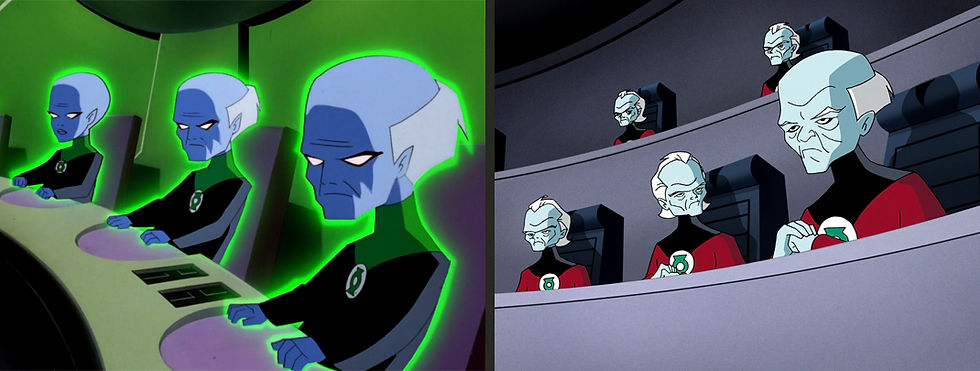
First appearing in Green Lantern #1 (August 1960), the Guardians of the Universe are the original creators of the Manhunters and founders of the Green Lantern Corps. As one can see above, their designs have been overhauled from their first DCAU appearance in the STAS episode “In Brightest Day…,” making them better resemble the characters from the comics. This includes returning them to their more familiar red robes, rather than the black-and-green ones from STAS (which, I think, looks better, as it better links them with their peacekeeping force). Also missing is the female Guardian (above left, first from left), but it is worth noting that the Guardians were all male in the comics until Green Lantern: Rebirth #6 (May 2005).
Based on their portrayal during Geoff Johns’ run on Green Lantern, their initial decision to not get involved is, sadly, par for the course with them. Also, the one Guardian’s line, “I don’t need to tell you how much we’ve gained because of the Corps’ diversity, but sometimes it forces us to make sacrifices,” really comes off as disturbing in the current political climate.

On their way to Green Lantern’s holding cell, he and the Manhunters run into a contingent of other Green Lanterns, who have apparently left their sectors just to kick a man while he’s down. Are they fair-weather friends, or are they stand-ins for fickle audience members?
From left to right, the Green Lanterns shown above are as follows:
Arkkis Chummuck, first appearance Green Lantern #130 (July 1980), is Green Lantern of Space Sector 3014. A native of Toomey VI, Arkkis acquired the ring after accidentally killing a Green Lantern in battle. He will later be killed in battle in the Justice League episode “Hearts and Minds.”
Kilowog, first appearance Green Lantern Corps #201 (June 1986), is Green Lantern of Space Sector 674. A survivor of Bolovax Vik, Kilowog is a polymath, skilled in numerous disciplines including genetics, thermal mechanics, and many others, but he is also known as one of the best recruiters and trainers of the Green Lantern Corps.
Larvox, first appearance Green Lantern #9 (December 1961), is Green Lantern of Space Sector 17. Originating from the planet Sputa, this genderless hero hails from a world where life evolved from insects, bacteria, and plants.
Tomar-Re, first appearance Green Lantern #6 (June 1961), is Green Lantern of Space Sector 2813. A scientist from the planet Xudar, Tomar-Re went on to become one of the most celebrated Green Lanterns in the Corps. Sadly, Tomar-Re is still haunted by one incident from early in his career: the inability to save the inhabitants of Krypton.
Galius Zed, first appearance Tales of the Green Lantern Corps #2 (June 1981), is Green Lantern of Space Sector 1123. A native of the planet Noc’sag, he also met his end in the Justice League episode “Hearts and Minds.”

It is worth noting that Kilowog, Arkkis Chummuck, Tomar-Re, and Larvox appeared previously in the STAS episode “In Brightest Day…” as holograms. Aside from Kilowog, their character models changed little when they shifted to Justice League.

Counting his appearance in “In Brightest Day…,” Kilowog’s appearance in “In Blackest Night” (above left) features the second of four character model designs. This look would remain constant in this episode and “Hearts and Minds,” but his face, along with his costume, would be altered for “The Return” (above center), a change that Bruce Timm didn’t even realize until recording the DVD commentary (“‘Return,’” 00:18:41-00:19:02). Finally, for the 2019 film Justice League vs. The Fatal Five, Kilowog would be redesigned again (above right) to better resemble his appearance from Green Lantern: The Animated Series.

J’onn J’onzz’s ability to reach out and detect Green Lantern across untold light-years speaks to his phenomenal telepathic ability. His sensitivity to other minds may be why he chooses to isolate himself on the Watchtower as much as possible so as to not allow it to overwhelm him (such as it did in the Justice League episode “Tabula Rasa”).

Upon arrival on Ajuris 5, the Javelin-7 is immediately fired upon by … military forces? Security forces? We don’t know. All we do know is that they didn’t bother to initiate contact, and they ignored the Flash’s attempts to communicate. Do they do this with everyone?

Superman’s refusal to fire back with the ship’s weapon systems, claiming that they’re “not here to start a war,” only to leave the ship and attack the ship with their superpowers is dumb. After all, whether by laser cannons or by heat vision, it’s still the same outcome. The only reasons to do this would be to 1) take on three targets at the same time and 2) remind the audience that this is a superhero show and not a Star Trek show.
Wait, there are weapons on the Javelin-7? I thought Batman didn’t like guns!?
After Hawkgirl takes out her ship with her mace, Superman suddenly admonishes her, presumably for excessive force, and then flies after the ship to give it a safe landing. Bitch, you and J’onn J’onzz just did the exact same things to take down enemy aircraft. Look, Supes, we know her aggression on the battlefield makes you wary (see “Secret Origins”) but leave her be.

The Flash’s “I don’t know how to fly this thing!” moment is the first of many that made me groan in this episode (the other being the infamous “If the ring wasn’t lit, you must acquit!”). I know he’s comic relief, but it makes him look excessively stupid. That said, some of this can be explained with the realization that this is probably his first off-world mission. Superman, Hawkgirl, and J’onn J’onzz are all non-human characters with extensive intergalactic experiences (definitely Supes and Hawkgirl; not sure about J’onn), and the creative team presumably wanted to play with Flash’s naïveté here.
Batman and Wonder Woman’s off-world, “fish out of water” episode would come in the form of “Twilight.”
Fortunately for the Flash, he would learn from this experience, acquiring his certification in time to successfully pilot the Javelin in the Justice League episode “Maid of Honor” and the JLU episode “Flashpoint.”
After landing, when the Flash is fired upon by the guards, why did he run back into the ship to try and take off again? He’s the fucking Flash! Run really fast and get their weapons! Knock them all on their ass in half a second! Again, he’s either out of his element, or he looks like an idiot. In fact, multiple members of the creative team have voiced their frustrations with writing the Flash over time, such as Bruce Timm in the aforementioned RetroVision CD-ROM Magazine interview:
Just trying, for example, to come up with a way of staging the Flash so he doesn’t come off looking like a total moron is really difficult, because he can be everywhere at once. We know that really doesn’t work in any kind of filmic medium. Nobody should ever be able to get the drop on the Flash; his reflexes should be so fast that nobody should be able to land a punch on him or shoot him with a ray gun. (qtd. in Gross, “Justice League: The Making” 2)

After the Justice League arrives in the courtroom, when the lead tribunal judge orders their removal, note that the Prosecutor’s lips are moving.

First appearing in Justice League of America #3 (March 1961), Kanjar Ro is a longtime DC Comics villain who was, in the Silver Age of Comics, considered a world-conquering threat. In the special features for the Justice League: Justice on Trial DVD, Bruce Timm discussed the logic behind resurrecting this obscure foe:
One thing that we really tried to do on this show, and some fans were a little put off by it, but we really wanted to get away from the established Superman and Batman villains that we had done in all the Superman and Batman episodes that we had done. So, there’s this entire, you know, sixty-year wealth of material from the DC Comics, in terms of the villains to choose from. We figured, “Well, this is a really good opportunity to, you know, put as much of that into the show as possible. You’ll notice that we hardly ever create brand-new villains that never existed before. Any time we come up with a villain for a show, we say, “Okay, well, it would be really great if we could find a DC Comics character—even if it’s just the name or the motif to use rather than create a brand-new character.”
For instance, in this episode, the informer / guy who sets up John Stewart’s downfall could have just been any old space pirate, but we figured, “Well, it would be great if it’s Kanjar Ro, who was a major Justice League villain from back in the day.” So, we try to do that whenever we can. It serves two purposes: on one hand, yeah, it keeps the fans happy to throw in characters like the Guardians and the Manhunters and, on the other hand, those are just interesting concepts and interesting characters, and it was our chance to do a fairly lavish, big budget look to those kind of characters. It’s like, you know, when I was a kid, I always thought, “Wow, it would be really cool to see these kinds of characters,” and it’s our golden opportunity to do so. (qtd. in “Episode Introduction to ‘In Blackest Night, Part 2,’” 00:00:02-00:01:22)
When Kanjar Ro goes up to testify, note how the court representative merely tells asks him if he consents to having his memories probed and displayed to the court, and not the traditional United States’ sworn testimony oath: “Do you solemnly swear that you will tell the truth, the whole truth, and nothing but the truth?” Granted, this is not a U.S. court, but it’s odd that they would rely on telepathic probing rather than sworn testimony, and it’s not inconceivable that there may be technologies and methods to intentionally alter memories or call them into question as reliable. After all, memory is hardly infallible, and Kanjar Ro technically did not promise to tell the truth.


The story of Green Lantern’s energy beam “bouncing off of a deflector shield” and hitting “a volcanic fault line” in just the right spot on Ajuris 4 is a one-in-a-million shot. Really, is Green Lantern energy that dangerous? Wouldn’t the Guardians of the Universe have created fail safes to prevent any kind of “friendly fire?” Otherwise, every fight involving a Green Lantern could potentially be disastrous, even catastrophic; it would be like a Jedi dropping their lightsaber during a fight on a spaceship, only for the energy blade to burn through every deck until reaching the vacuum of space, causing rapid depressurization and potentially the death of everyone on board. Very suspicious.
Wait a minute, J’onn J’onzz is a telepath. Wasn’t he remotely interested in seeing if Kanjar Ro, an admitted criminal, was telling the truth?
During Kanjar Ro’s testimony, we learn that John Stewart is accused of being responsible for the deaths of three billion due to his energy beam accidentally hitting Ajuris 4. No wonder he’s so despondent.
Based on the timing, I suspect that this incident occurred sometime after “Secret Origins.” Otherwise, I doubt that Green Lantern would have bothered to join the Justice League had he known he was about to be arrested.

In the absence of Batman, I like how Superman steps up at the beginning of Part Two. Sure, he may not be the World’s Greatest Detective, but he is a journalist, and journalism does require a measure of detective work.
“No one’s disputing the facts.” Hawkgirl, just a few moments ago you were calling the Prosecutor’s sole witness a liar. Pick a lane.

The helmeted alien sitting in front of the Flash is another reused STAS character model, this one from “The Last Son of Krypton.”

The plot point of the Flash stepping in as Green Lantern’s defense attorney is, again, another example of using the character largely for comic relief at the expense of making him look and sound stupid. Technically, if he was at the top of his game, he could have asked for a brief continuance, been directed to one of this world’s law libraries, read up on the planet’s laws in a manner of seconds, and take copious notes with which to offer a legitimate defense for John Stewart (like in The Flash #188 [September 2002], where he reads over 200 books on engineering and bridge construction at super-speed, and then rebuilds the bridge connecting Central City and Keystone City in thirty seconds). Instead, he’s stalling by telling old, stale O.J. Simpson jokes, like he’s Norm Macdonald.
Look, I know that writer Stan Berkowitz was going for a “kangaroo court” vibe, but as someone with a passing familiarity with the American legal system, I find this aspect of the story annoying, if not outright horrifying. First off, Green Lantern gets no legal counsel? No defense attorney, or even a public defender? And anyone who volunteers will “share the same penalty as the accused?” The Flash is right, this is a convenient way for the state to railroad anyone they want, regardless of guilt or innocence. Even if a defendant is innocent, it would be next to impossible to prove innocence if the state is hell-bent on making an example of someone.
Also, is there no place for mitigating factors? Green Lantern appears to be going down for what very obviously was a tragic accident. Why aren’t Kanjar Ro and the other pirates also facing charges for their part in this? It was their deflector shield. For that matter, why not sue the manufacturer for what is very obviously a design flaw or factory defect?
I know the response of the creative team would be something like, “Oh, well, it’s an alien planet; their legal system is different from ours.” Okay, HOW DIFFERENT? What are we working with here? A little more info than just “kill the lawyers” would have been helpful.
While stalling for time, the Flash threw out some fancy Latin terms as part of his attempts to filibuster the court:
Habeas corpus is the specific legal right allowing for an imprisoned person to challenge the legality of the charges before a judge, which the Flash is specifically trying to facilitate.
In legal terms, ipso facto means “by the fact itself,” or how an event is a direct consequence of a specific action. For example, since the Flash volunteered to represent Green Lantern at this trial, ipso facto, his life is now in danger.
Phi Beta Kappa, which is actually Greek, refers to an academic honor society for undergraduates and graduates of high academic achievement. This was obviously another joke.

It is worth noting here that the Prosecutor was voiced by Kurtwood Smith, who also played the character of Red Forman on That ’70s Show. Was I the only one expecting him to call the Flash a “dumbass?”

“So much for the vaunted loyalty of the Lantern Corps.” In “Twilight,” Hawkgirl claims to J’onn that “Thanagar is so far away we’ve never even come into contact with the Green Lantern Corps.” If that is true, where’s she getting her intel? Of course, in “Comfort and Joy,” we find out that she hangs out off-world at bars, so it’s entirely possible that she has contacts that she deals with for info about the Corps.
For that matter, in the comics, Thanagar orbits the star Polaris, which is in Green Lantern Sector 2682, which is roughly between 430 and 447 light years from Earth. Of course, that may not be the case here (for example, the New Gods star system is somewhere in this universe, as opposed to the comics, where it’s more in another dimension). None of the Green Lanterns recognize her as Thanagarian, nor do they make any reference to their war with the Gordanians.
While we’re on the subject of the galaxy’s geography, in an August 8, 2004 message board post, Dwayne McDuffie revealed how the reach of the Green Lanterns is severely curtailed in the DCAU. As opposed to the comics, where they police the entire universe, “[i]n our show, the Green Lantern Corps ‘only’ patrols the Milky Way Galaxy. There’s a lot of uncharted space in it and a whole lot more outside of it” (Maestro).

Hawkgirl’s bar fight with four Green Lanterns was a nice attempt to showcase her fighting prowess without the mace. Careful, girl, Superman might disapprove!
Frankly, this episode really makes the Green Lantern Corps look bad—four Keystone Cops and Kilowog, who Hawkgirl convinces to testify on behalf of John Stewart (although, to be fair, he appeared visibly pensive throughout the episode, like he was already considering it). In the comics, there are at least 3,600 members of the Corps; surely he must have some friends who would come to defend him or, at least, comfort him without giving him the stink eye, right?
In regard to Kilowog’s conflicted feelings, it is worth noting that, in the comics, his homeworld, Bolovax Vik, and people were destroyed not once, but twice—first during Crisis on Infinite Earths (though he was able to save the population and transplant them to a new world), and again in Green Lantern Corps #218 (November 1987), this time for good, at the hands of Sinestro.
The Flash’s aforementioned line—“If the ring wasn’t lit, you must acquit!”—refers specifically to “If it doesn’t fit, you must acquit,” which was part of attorney Johnnie Cochran’s closing argument in the aforementioned O.J. Simpson murder trial. This is actually the third time this line has been parodied in the DCAU, as it was also referenced in The New Batman Adventures episodes “Joker’s Millions” and “Over the Edge.”

Superman’s observation—that the destroyed planet’s moon is still orbiting something, as opposed to flying out of orbit—is something that should have been accounted for right away by Ajuris 5. Either the population is incredibly stupid, it’s desperate for a show trial, or there is more going on here than just the Manhunters wanting to damage the Green Lantern Corps.

The scene with the Prosecutor tripping up Kilowog with his own words is painful to watch. In the comics, Kilowog is a super-genius, and here he’s presented like a big lummox. He had a much better showing, I think, in “Hearts and Minds.”

Of course, here is the scene where the true villains are unveiled, at a Manhunter rally that does not skimp on the fascist overtones. According to the head Manhunter, they are responsible for sowing dissent among the Green Lantern Corps, making them look bad, and luring [five of] the Guardians away from Oa. More on that in a moment…

Superman’s rescue of Green Lantern and Flash from the gas chamber is not the first time he saved someone from an unfairly given state execution, as he also saved Ernest Walker in the STAS episode “The Late Mr. Kent.”

Through independent investigation, Superman and the others discover the truth: Ajuris 4 was never destroyed, but it was hidden via an elaborate cloaking device by the Manhunters working with Kanjar Ro. This revelation poses a host of questions:
Again, just how stupid is the planet of Ajuris 5? Ajuris 4 appears to be destroyed, but the moon is still there and there is no notable change in the star system gravity-wise. If I’m not mistaken, Ajuris 4 is a terrestrial planet, probably Earth-sized, and it has its own gravitational influence on other, nearby celestial bodies. Besides hitting its neighbor with debris upon destruction—the size of the planet in the image above implies that it’s close—the sudden change in gravity would affect Ajuris 5 in minor, but scientifically recordable, ways. Also, didn’t anyone—Ajuris 5 or John Stewart himself—investigate the debris field only to discover that it was all holograms? Either everyone is an idiot, or this was some sloppy writing.
For that matter, what the hell was going on on Ajuris 4 during this time period? With a population of three billion, I’m assuming that the planet was at a comparable level of civilization compared to its neighbor. Did they not notice the news that they, apparently, blew up? Was it business as usual, or did the Manhunters occupy the planet, hold it hostage for several weeks, and impose a communications blackout to maintain the illusion? Also, when Kanjar Ro attempted to silence Superman and J’onn J’onzz, he said, “the secret will stay buried with them.” Were they just going to keep Ajuris 4 cloaked forever?
Just what is the nature of the Manhunter’s service to Ajuris 5? Are they hired mercenaries who were paid to provide security for that planet, like an intergalactic version of Constellis (formerly Blackwater), or, as they were robots, did the Guardians just sell them off like they were property centuries ago? As one gets the impression that their plot against the Guardians of the Universe was a long time coming, is it possible, assuming the Manhunters were freelance, that Ajuris 5 was allied with them?
Had this been Green Lantern: The Animated Series rather than Justice League, this could have been part of a galactic version of the Cadmus Arc, with the Manhunters taking advantage of rising anti-Green Lantern sentiment to hatch a plan to destroy them. Consider: there are probably untold multitudes of planets and governmental bodies who do not like the Guardians or the Green Lantern Corps, resenting the fact that an independent, paramilitary organization has the ability and / or potential to impose their authority over them based on nothing except mastery of the green emotional spectrum and the fact that Oan society predates every other by millennia.
Prior to the Montgomery bus boycott, the NAACP was looking for a test case to challenge the segregation laws regarding public transit in Montgomery, Alabama; they eventually chose Rosa Parks’ arrest over similar incidents because they thought it gave them the best chances to rally the Black community behind them. Forgive the comparison, but what if the Manhunters were looking to do a similar thing?
In this theory, the Manhunters, who I’m assuming are sentient and free lifeforms, are looking for a locale to set up a Green Lantern for a test case of their own. They choose Ajuris 5 because they’re either dumb or corrupt, have a screwball legal system, and have a populace either with an existing Green Lantern prejudice or are willing to turn on them. They stage the destruction of Ajuris 5, frame John Stewart for the destruction, and use it as a trap to lure the Guardians away from Oa as part of a broader plan. To their credit, Ajuris 5 goes along with this, covering up the evidence of the world’s continued presence as a means of challenging the authority and autonomy of the Corps in court.
A similar story occurred recently in the Green Lantern comics, with the United Planets (a present-day incarnation of the Legion of Super Heroes galactic governing body) challenging the authority of the Guardians of the Universe and, for a brief period, putting the Green Lantern Corps under new leadership.
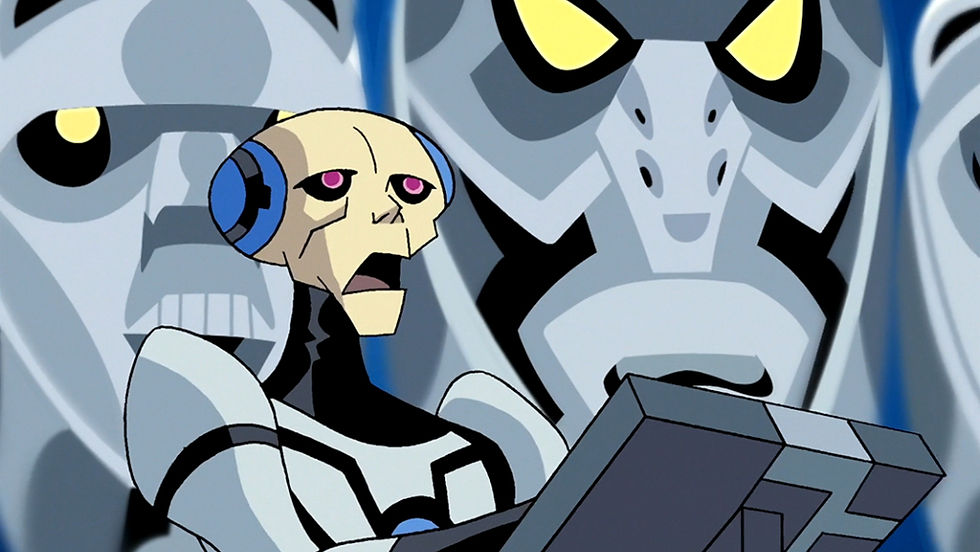
The Prosecutor just lost his case. Does this mean that he’s going to “share the same penalty as the accused?”

Upon discovering the max exodus of Manhunters back to Oa, Green Lantern learns the truth of their history and connection to the Guardians. Considering how they were considered “flawed” because “they couldn't understand the subtle gradations between good and evil,” as well as how they were “reprogrammed for lesser duties—tracking, hunting, guarding,” it makes me wonder that, if the Manhunters are truly sentient, whether they have a legitimate grievance against the Guardians for their previous treatment.

Also, considering the presence of A.I. members of the Green Lantern Corps (such as Stel, from the JLU episode “The Return”; above left), I wonder what those Green Lanterns would think of the Guardians’ treatment of a fellow artificial intelligence.

Above left is an image of the Guardians’ citadel on Oa from Part One. Looks impressive, doesn’t it? However, above right is a shot of the planet and the base from a greater distance, showing the Corps’ headquarters to be a lone garrison on what appears to be a dead world. Seriously, this is the legendary Oa? Previous representations of the planet in the comic books present it as a planet-sized city, like Coruscant in the Star Wars films, inhabited by thousands of Green Lanterns. And, while Oa was rarely visited on Justice League and Justice League Unlimited, we do know that little changed by the time of the aforementioned episode “The Return”:
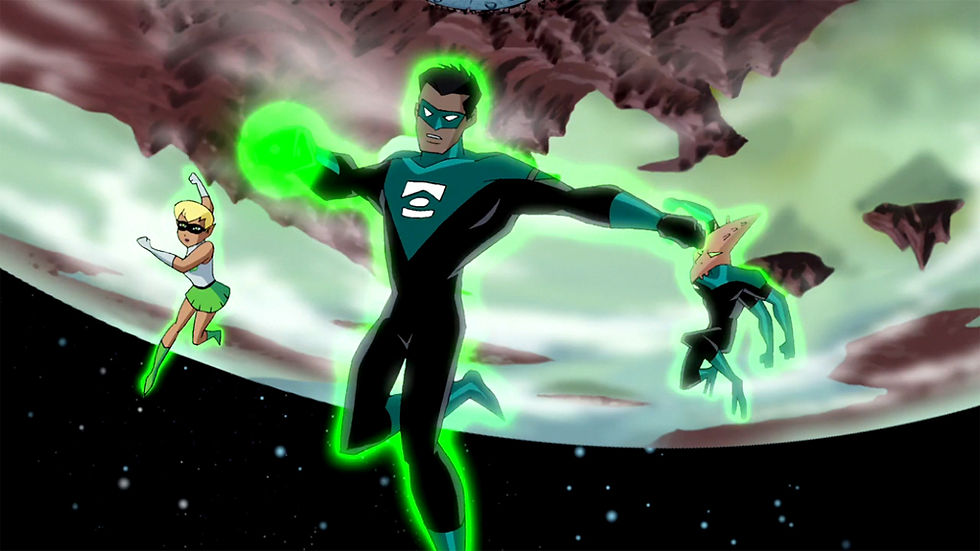
That partial circle above Kyle Rayner’s head is the original base. Compare this to the Oa of the Bruce Timm-produced Green Lantern: The Animated Series (2011-2013):

As well as the Oa from the 2019 film Justice League vs. The Fatal Five:

Look, I know that Oa’s appearance is literally a footnote to this episode, it’s happening at the beginning of the Justice League series, where they are limited in terms of archival materials; and the creative team was crunched by budget cuts put in place by the incoming bosses (see “Background” essay above), but reducing the Guardians and the Corps to a single bunker and six Green Lanterns responding to a crisis diminishes them. They look like a podunk, mom-and-pop operation, as opposed to the super-powered peacekeepers of the universe.

I’m not sure I understand the Manhunter’s plan. Apparently, they needed to lure the Guardians away from Oa, so they could storm the base and seize the Central Power Battery, which they see as theirs, apparently as some kind of reparation for their “betrayal.” So, they were just waiting for centuries for nobody to be home so they could show up and rob the place?

But wait … a faction of Guardians stayed on Oa to keep the light on, as it were, which begs the question: how many Guardians must remain on Oa for the base to remain impenetrable?

Uhhh … I don’t know how the Guardians got to Ajuris 5, but the Justice League flew in their spaceship. Why did they decide to leave the Javelin-7 parked back there?

The Lead Manhunter’s attempt to absorb all the energy from the Central Power Battery mirrors a similar scene in Green Lantern #50 (March 1994), where Hal Jordan—who was possessed by the fear-based entity Parallax, stole the energy from the Corps to become a supervillain. This would also have the benefit (to the Manhunters) of killing the Guardians, as their life force appears to be tied to this power source.

Even after surrendering his power ring following his arrest, John Stewart’s eyes still glowed green, as—according to Dwayne McDuffie’s aforementioned January 20, 2004 message board post—“[h]is eyes are green because he’s absorbed so much ring energy” over the years (Maestro). However, most likely due to his proximity to the Central Power Battery, the Manhunter absorbs this energy as well, causing Stewart’s eyes to revert to normal for one of the only times in the DCAU.


Green Lantern’s plan—to absorb the energy back into himself and use it to recharge the Central Power Battery and remove the Manhunter consciousness—reminds me of the climax to Disney’s Aladdin, where Jafar becomes a genie made of magical energies, only to find that he is now subject to the rules of how those energies can be manipulated. Thus, Jafar can be contained in a magic lamp, and the Manhunter can be absorbed into a power ring and expelled as energy.
In the aforementioned November 2005 interview with ToyFare, Phil LaMarr admitted that “In Blackest Night” was one of his “favorite episodes” because he could say the Green Lantern oath (qtd. in Rossen 48). He would later expand on this statement in the aforementioned October 17, 2023 installment of the Justice League Revisited podcast:
As the comic book nerd, I remember talking to the writers and producers, you know, it’s like, “Wait, how come he doesn’t ever charge his ring?” And they’re like, “Phil, Phil, Phil … in a comic, that’s easy to do—you know, ‘cause you just have one panel, you just put up the oath and whatever. But in an actual animated show, that’d be like watching somebody charge their phone for a minute and a half! That’s boring! So, we’re never gonna have GL do the oath unless there’s a specific plot point for it.” And this was it! He did the oath not to charge his ring, but to save the Guardians! (qtd. in Eisenberg and Enstall, 00:28:21-00:29:06)

While I certainly understand John Stewart blowing off Galius Zed’s apology, I do wish he was a little kinder to Kilowog, who did—in fact—support him during the trial. Fortunately, they would team up again in the Season Two episode “Hearts and Minds.”

Turns out Al McGee was right: John does still have friends in the old neighborhood. Real friends.
Works Cited
Allstetter, Rob. “Bruce Timm Talks Justice League: Part Two.” Comics Continuum. 25 Apr. 2001. <http://comicscontinuum.com/stories/0104/25/timmindex.htm>. Accessed 19 Nov. 2022.
---. “Justice League Animated Update.” Comics Continuum. 17 Nov. 2001. <http://www.comicscontinuum.com/stories/0111/17/index.htm>. Accessed 22 Dec. 2022.
---. “Justice League Characters.” Comics Continuum. 19 Oct. 2001. <http://www.comicscontinuum.com/stories/0110/19/jlindex.htm>. Accessed 22 Dec. 2022.
---. “Justice League’s Blackest Night.” Comics Continuum. 11 Oct. 2001. <http://www.comicscontinuum.com/stories/0110/11/index.htm>. Accessed 22 Dec. 2022.
---. “Schwartz Heads Warner Bros. Animation.” Comics Continuum. 21 Mar. 2001. <http://www.comicscontinuum.com/stories/0103/21/index.htm>. Accessed 18 Dec. 2022.
Anderson, Mitch. “Exclusive Interview with Bruce Timm.” Think McFly Think. com. N.p. 25 Apr. 2010. <http://thinkmcflythink.squarespace.com/movie-news/2010/4/25/exclusive-interview-with-bruce-timm.html>. Accessed 30 Jun. 2024.
b.t. Comment on “’Batman: Caped Crusader (Amazon Prime)’ Animated Series News & Discussion Part 3 (Spoilers).” Anime Superhero. 29 Jul. 2024. <https://animesuperhero.com/forums/threads/batman-caped-crusader-amazon-prime-animated-series-news-discussion-part-3-spoilers.5799781/post-87960044>. Accessed 13 Sept. 2024.
Davis, Joseph. “In Blackest Night.” Internet Archive. 29 Jan. 2008. <https://web.archive.org/web/20080129040858/http://jl.toonzone.net/episode2/episode2.htm>. Accessed 13 Jun. 2026.
---. “Justice League Panel at 2001 San Diego Comic-Con, The.” Aglets Are Sinister. 26 Apr. 2025. <https://www.agletsaresinister.com/post/the-justice-league-panel-at-2ool-san-diego-comic-con>. Accessed 26 Apr. 2025.
Eisenberg, Susan and James Enstall, hosts. “In Blackest Night.” Justice League Revisited, featuring Phil LaMarr. Apple Podcasts, 1 Dec. 2023. <https://podcasts.apple.com/us/podcast/in-blackest-night-phil-lamarr-green-lantern-justice/id1709910091?i=1000631597729>. Accessed 15 Jun. 2025.
---. “In Blackest Night.” Justice League Revisited, featuring Stan Berkowitz. Apple Podcasts, 31 Oct. 2023. <https://podcasts.apple.com/us/podcast/in-blackest-night-writer-stan-berkowitz-justice-league/id1709910091?i=1000633209456>. Accessed 15 Jun. 2025.
“Episode Introduction to ‘In Blackest Night, Part 1.’” Justice League: Justice on Trial. Warner Bros. Animation, 2003.
“Episode Introduction to ‘In Blackest Night, Part 2.’” Justice League: Justice on Trial. Warner Bros. Animation, 2003.
Gross, Edward. “Justice League Episode Guide.” RetroVision CD-ROM Magazine. M&R Multimedia, Inc. n.d.: 8-27. PDF file.
---. “Justice League: The Making of the DC Tooniverse.” RetroVision CD-ROM Magazine. M&R Multimedia, Inc. n.d.: 1-7. PDF file.
“Inside Justice League.” Justice League: Season One. Warner Bros. Animation, 2006.
Maestro (DMcDuffie). Comment on “JLU: Comic Story Adaptations.” Dwayne McDuffie. Delphi Forums, LLC. 11 Sept. 2004. <http://forums.delphiforums.com/Milestone/messages?msg=1403.21>. Accessed 25 Feb. 2025.
---. Comment on “JLU: Comic Story Adaptations.” Dwayne McDuffie. Delphi Forums, LLC. 12 Sept. 2004. <http://forums.delphiforums.com/Milestone/messages?msg=1403.40>. Accessed 25 Feb. 2025.
---. Comment on “New Titans Tonight.” Dwayne McDuffie. Delphi Forums, LLC. 20 Jan. 2004. <http://forums.delphiforums.com/Milestone/messages?msg=733.45>. Accessed 26 Feb. 2025.
---. Comment on “What Should be the Next Cartoon Serie…” Dwayne McDuffie. Delphi Forums, LLC. 8 Aug. 2004. <http://forums.delphiforums.com/Milestone/messages?msg=1270.79>. Accessed 26 Feb. 2025.
---. Untitled. Dwayne McDuffie. The V Hive. n.d. <http://www.thevhive.com/forum/index.php?webtag=DWAYNEMCDUFFIE&msg=21.123>. Accessed 24 Mar. 2006.
---. Untitled. Dwayne McDuffie. The V Hive. 11 Apr. 2006. <https://www.thevhive.com/forum/dwayne-mcduffie/threads/ask-the-maestro/879?thread_skip=50&folder_name=dwayne-s-world>. Accessed 19 Feb. 2011.
McPherson, Mark. “Phil LaMarr Talks Justice League, Static Shock, and the World of Voice Acting.” Twin Cities Geek. Hal’s Pages. 11 Nov. 2022. <https://twincitiesgeek.com/2022/11/phil-lamarr-talks-justice-league-static-shock-and-the-world-of-voice-acting/>. Accessed 23 Jun. 2024.
Moro, Eric. “And Justice for All!” Cinescape. Dec. 2001: 60-63. Print.
“‘Return’ Audio Commentary, ‘The.’” Justice League Unlimited: Season One. Warner Bros. Animation, 2006.
Rossen, Jake. “An Extraordinary League.” ToyFare: The Toy Magazine. Nov. 2005: 46-64. Print.
“ZETA vs BATMAN and How Warner Bros. Almost Killed JUSTICE LEAGUE (Writer Rich Fogel).” YouTube. Uploaded by Watchtower Database. <https://www.youtube.com/watch?v=zvH0oq7YIjw&t=633s>. Accessed 15 Jun. 2025.
Images courtesy of Warner Bros. Discovery, Warner Bros. Home Entertainment, Warner Bros. Animation, DC Comics, Metro-Goldwyn-Mayer, and Paramount Pictures. YouTube video courtesy of Saturday Night Live.


Comments