


CASE FILES - Justice League's "The Brave and the Bold"

Updated: Sep 1
NOTE: This article obviously contains SPOILERS. Proceed at your own risk!

Episode Details
Story: Rich Fogel and Paul Dini
Teleplay: Dwayne McDuffie
Director: Dan Riba
Animation Studio: CNK International (formerly Koko Enterprises Ltd.)
Original Airdate: March 10, 2002 (Part One); March 17, 2002 (Part Two)
Official Summary
Joining forces, Flash and Green Lantern fight to save Central City from the mind control of an evil super-genius named Gorilla Grodd (qtd. in Davis).
My Summary
Investigating a burglary in Central City, Green Lantern and the Flash discover the mastermind to be Grodd, a super-intelligent gorilla and fugitive from Gorilla City. Teaming up with Solovar, a law officer from the hidden city, the duo must stop the simian criminal, who uses his super-science to shroud Central City in a cloaking device and manipulate the populace using mind control. Meanwhile, the rest of the Justice League—discovering the city’s disappearance, as well as an unusual energy signature emanating from its original location—investigate, and the two teams must work separately to achieve a common goal: stop Grodd and prevent him from destroying Gorilla City with a nuclear strike.
Voice Cast
Kevin Conroy as Batman
Susan Eisenberg as Wonder Woman
Phil LaMarr as Green Lantern, Truck Driver (Uncredited)
Michael Rosenbaum as The Flash
Maria Canals-Barrera as Hawkgirl, Deena (Dark-Haired Girl; Uncredited)
Carl Lumbly as J’onn J’onzz
Powers Boothe as Grodd
David Ogden Stiers as Solovar, Insured Driver (Uncredited)
Catherine Cavadini as Dr. Mary, Diane (Blonde Girl; Uncredited)
Richard Doyle as Dr. Louis, Detective Secor (Uncredited), Bum (Uncredited)
Bill Duke as Detective Braugher
Virginia Madsen as Dr. Sarah Corwin
Andre Sogliuzzo as SWAT Officer
Keone Young as Professor Arthur Chin
Phil Morris as General

Background
Compared to the spectacle of previous episodes featuring galactic conquest (“Secret Origins,” “In Blackest Night”), court intrigue (“The Enemy Below”), mythological spectacle (“Paradise Lost”), and good, old-fashioned punch ‘em ups (“Injustice for All,” “War World”); “The Brave and the Bold” comparatively plays out on a smaller scale. Initially focusing on a team-up between Flash and Green Lantern, the episode doesn’t quite have the stakes of its predecessors and, combined with lackluster animation and an overuse of stock DCAU materials from previous series (see “Stray Observations” below), it suffers by comparison. However, this episode is notable for a number of reasons, one of which being that it is the first show to feature writer Dwayne McDuffie as a contributor, though his involvement came about in an indirect way, as the episode was originally intended to be written by DC Animated Universe (DCAU) alumnus Paul Dini.

An architect responsible for some of the best elements of Batman: The Animated Series (BTAS), Superman: The Animated Series (STAS), The New Batman Adventures (TNBA), and Batman Beyond; the former DCAU producer elected to step away to work on other projects both DC-related (Wonder Woman: Spirit of Truth, Zatanna: Everyday Magic) and creator-owned (Jingle Belle, Mutant, Texas). That said, he was still open to freelance work, and he was assigned this episode by the creative team. However, as recounted by writer and Producer Rich Fogel in the February 20, 2024 installment of the Justice League Revisited podcast, he had to bow out for medical-related reasons:
Paul Dini was originally slated to write this one. He was very passionate about it and wanted to do it, and he got through, I think, the first draft of the outline, and then he had to reluctantly drop out of it because he was dealing with carpal tunnel issues, and he couldn’t write. So, he came into my office. He was practically in tears, and he was like, “You know, I’m sorry, I just can’t do it. I can’t do it.” And, at this point, you know, we were behind schedule. We had all sorts of stories in various phases of production, and I’m like, “Oh, my God, what am I going to do now?” So, Bruce [Timm] and I sat down, we went over the material that we had so far. It wasn’t working the way we wanted [it] to, so we restructured it and beat it out the way that we wanted to, and I wrote it up. And so, that was the outline, but I still didn’t have a writer for it.
[…] All my other […] writers were already on assignment for me, so I couldn’t double dip with them. So, I asked around, and [former DCAU Producer] Alan Burnett was working on Static Shock at the time, and he said, “Well, I’ve been working with Dwayne McDuffie, and he’s really good. He’s just finished an assignment for me so, if you want to ask him, you know, go ahead.” So, I said, “Oh, that’d be great.” (qtd. in Eisenberg and Enstall, 00:09:19-00:10:58)

A polymath with a bachelor’s degree in English and a master’s in physics (Fox), Dwayne McDuffie began his superhero career in 1987, when he joined Marvel Comics as an editor and, later, transitioned into writing, creating the cult classic Damage Control and co-creating the Michael Collins incarnation of Deathlok. Later—with partners Denys Cowan, Michael Davis, and Derek T. Dingle—McDuffie founded Milestone Media and, through it, the Milestone Comics line in 1993. Published and distributed by DC Comics, it was a creator-owned company intended to expand representation for minority characters, as well as provide a platform for a diversity of writers and artists. However—even after debuting titles like Icon, Hardware, Blood Syndicate, and Static—Milestone became a victim of clashes with DC over content, limited marketing, and the 1990s comics market crash, leading to them shutting down their comic book division in 1997. Meanwhile, McDuffie—suddenly finding himself with a dearth of comic book opportunities, despite “public praise from the likes of Neil Gaiman and Alan Moore” (Wayne)—found employment in 2000 as a writer and story editor on the aforementioned Static Shock, the animated series licensed by Milestone Media and based on a character he co-created (Allstetter, “McDuffie”). In the aforementioned interview with the Justice League Revisited podcast, Fogel discussed his first contact with the prolific creator:
I was familiar with Dwayne’s comic book work, but I didn’t know him. So, I called him up and got him on the phone, and I was like, “Hey, you know, I’m doing Justice League. You want to do this? We’ve got a story for you. Do you want to do it?” He was like, “Yeah, okay.” And I said, “Okay, I’ll send you the material if you have any questions,” and he said, “Okay.” And that was it, and I thought, “Well, this is the weirdest conversation I’ve ever had.” You know, it’s like most writers are very enthusiastic and want […] the opportunity and all of that. It wasn’t until later that I found out that he had just been up all night finishing Alan’s script on Static Shock. And I had woken him up.
[…] And then he turned around and wrote the script, and we were just delighted with it. It was full of all those qualities that we were looking for, and even though there were things that were in the outline in terms of the relationship between Flash and Green Lantern and Grodd and all of that kind of things, Dwayne plused it all the way along the way, and I think—partially—he was writing from experience. He had a fraught relationship with his brother, who was often getting into trouble that Dwayne had to rescue him from, and so that relationship that Green Lantern has with Flash is very much a little brother kind of thing. You know, when he smacks him upside the head, it’s like, yeah, you could feel that. [LAUGHS.] (qtd. in Eisenberg and Enstall, 00:10:59-00:12:51)
And, in a March 9, 2002 interview with Comics Continuum, McDuffie revealed his side of their initial encounter:
[I got a] cold call from Justice League Producer Rich Fogel. I’m told that Static Shock Producer Alan Burnett had put in a good word for me. Rich told me about a story Paul Dini and he had worked up and asked if I would be willing to give it a try. I assumed this was a rhetorical question and immediately began writing. Originally, Paul Dini was supposed to script the two-parter, but an injury prevented him from doing so. I have a perfect alibi for my whereabouts when Paul was injured. My lawyer says that I cannot stress this enough. (qtd. in Allstetter, “Dwayne”)
(It is worth noting that Dwayne McDuffie would repeat his joke about having nothing to do with Paul Dini’s injuries in a May 2005 interview with Write Now! Magazine [Fingeroth 17] and an Anime Superhero [formerly Toon Zone] interview from 2006 / 2007 [released in March 2011; Weitzman]. Honestly, while I was confident of his innocence at first, now I’m not so sure. Just kidding!)
To his credit, Dini eagerly passed the baton to McDuffie in a May 24, 2001 interview with Comics Continuum, saying how he had “no doubt” that the writer would “turn it into a killer script” (qtd. in Allstetter, “Justice”) and, as it turned out, Dini was correct in his assessment. Though initially a freelance job, this would be the beginning of a long and fruitful relationship, with McDuffie being assigned to write teleplays for “Fury” and Part Two of “Metamorphosis” in Season One and, later, he was brought on full-time as story editor in Season Two. In an interview with RetroVision CD-ROM Magazine, Producer Bruce Timm expressed his pleasure at adding McDuffie’s talent to their already-formidable pool, as well as his rapid ascent in the creative team’s hierarchy:
Circumstances resulted in the story being handed off to Dwayne McDuffie and thank God it did. That was my first time I’d read any of his work, and I instantly fell in love with his take on the characters and his dialogue especially. I realized that this was a guy we could use, to the point now where he’s been promoted to producer on the third season, and he’s in charge of the story department. (qtd. in Gross, “Justice League Episode” 12)

In adapting Rich Fogel and Paul Dini’s original concept for screen, Dwayne McDuffie also had the honor of fashioning the episode’s villain, Gorilla Grodd, for the Justice League series. Originally an enemy of the Flash, over time he evolved into a Justice League / “general use” DC adversary thanks to his presence in The Secret Society of Super-Villains (1976-1978) and Challenge of the Superfriends (1978), the latter as a member of the infamous Legion of Doom. To voice the primate criminal, the creative team tapped the late Powers Boothe, who possessed a considerable resume both on television—including Guyana Tragedy: The Story of Jim Jones (1980), Deadwood (2004-2006), and 24 (2007)—and film, such as Red Dawn (1984), Tombstone (1993), Nixon (1995), and Sin City (2005). In his hands, Grodd became a complex, formidable presence, so much so that he would return in Season Two’s “Secret Society” and for the entirety of Justice League Unlimited’s (JLU) third season. In the aforementioned RetroVision CD-ROM Magazine interview, Timm extolled the virtues of Grodd’s appearances, saying how “[i]f you’re a fan of DC Comics at all, then you have to love supervillain gorillas. I thought he was an interesting character, and we were super-excited to have Powers Boothe come in and play him” (qtd. in Gross, “Justice League Episode” 12); later adding, “[y]ou might think it’s easy to cast a human actor to be the voice of a gorilla, but it’s not. […] What does a gorilla sound like if he could talk? The answer would be Powers Boothe. He was cynical and funny and scary. Just a wonderful performance” (qtd. in Gross, “Justice League Episode” 24).

Finally, “The Brave and the Bold” was the episode that popularized the potential pairing of Batman and Wonder Woman, dubbed “WonderBat” by the online community. While a connection between the two League members was implied in previous episodes—specifically in “Secret Origins,” with Batman’s “let’s see what she can do” comment when they first went into battle together, and with Wonder Woman’s solemn “he was a true warrior” line after he seemingly was killed by the Alien Invaders—this was the first time such affection was on the official record. In “Behind ‘The Brave and the Bold,’” a 2004 DVD special feature, Bruce Timm recounted the origins of the scene in question:
We did this little throwaway bit in “The Brave and the Bold” where, it was literally at the eleventh hour, I was looking at the storyboard with Dan Riba, the director, and we got to the end sequence where Batman was trying to save Wonder Woman from underneath the missile, and he’s digging through the rubble trying to find Wonder Woman, and then, you know, she comes out, she’s all safe and sound, and I just thought it would be kind of neat if we just had this little bit where, you know, she looks over to him and sees that his hands are all burned from digging through, you know, the smoking rubble, you know, it’s like, “Aww, you tried to save me! That was really sweet!” And she leans over and gives him a little peck on the cheek.
And it was just a cute little bit; that’s all it was, right? But the minute that show aired, the Internet was all abuzz, like, you know, “Oh, wow, there’s something going on between Batman and Wonder Woman! What’s this all about?” And it’s just, like, “C’mon, there’s nothing going on between Batman and Wonder Woman! What are you guys talking about? It was just a little throwaway bit! It was just a little bit! It was just cute, you know?” And then, we started thinking about it, and it’s, like, “Well, okay, maybe there’s isn’t anything going on between Batman and Wonder Woman now, but it would be kind of fun to explore it.” (qtd. in “Behind,” 00:05:21-00:06:18)
And, later, in the aforementioned interview with the Justice League Revisited podcast, Rich Fogel provided his take on the event:
Well, that was interesting because—and I remember this specifically—that the scene was written as, you know, that she’s under the rocket. We don’t know whether she’s dead or alive at this point. You know, there’s a moment of that, and then she breaks out and all of that, and everybody breathes a sigh of relief and all of that. And it was in storyboard, actually, that little bit with the kiss was added, so, it was after the script.
And so, we were looking at the board, and there was a lot of debate about whether or not we should do that or not, and Dan [Riba] particularly fought very hard for it. He was like, “You know, this is such a good moment. This is great.” And Bruce [Timm] was like, “Well, I don’t know. You know, that takes us down a direction that I’m not sure we want to go.” And I was like, “Well, you know, it wasn’t in the script, but it is kind of cool.” And so, we kicked it back and forth. And then, finally, we were like, “Well, let’s let it sit and see what happens.”
And it was so well done because the way it was staged is that, you know, she looks at him, she sees the mud and the dirt on his hands, […] so she knows what he doing there, and she acknowledges that. And there’s something very sweet about it. And the thing is that if it had been Superman, it wouldn’t have had the impact because it wouldn’t have cost Superman anything—he’s invulnerable—but Batman really scraped up his knuckles doing that for Diana even though she didn’t really need it, but she acknowledged that. I thought it was very sweet, and it took us in a direction that nobody was expecting when we started the series.
[…] And you have to remember that there’s, like, a year’s amount of time until we start getting feedback because that’s how long it takes to go through production, for us to actually see what it’s going to look like on the screen, for it to get on the air, for us to get reactions from the fans and stuff like that. So, we’re sort of flying blind at this point and just sort of going, “Well, you know, that seems to work for this, and we’ll take another step when it seems appropriate.” And there was something about the connection between [Susan Eisenberg] and Kevin [Conroy] that sort of lit up, and we […] kept going back to it and going, “Well, let’s give a little moment here.” It doesn’t have to be a big thing; let’s just give it a little moment because that seems to work.
And then, as we started thinking about it a little bit more—and we can get into this, you know, when we talk about Season Two and stuff like that—that this was a relationship that, as far as I’m aware, was not ever really explored in the comic books. Everybody was always pairing up Wonder Woman and Superman, you know, and the more we thought about it, we thought, “No, this actually makes a lot more sense.” We’re always looking for “what do the characters bring to the situation? How do they play off of each other and what are the sparks there?” And, in this case, it just felt right, and it made a lot of sense to all of us, and so we just sort of kept poking it. And, luckily, the fans reacted very positively to it and, as you say, the rest is history. (qtd. in Eisenberg and Enstall, 00:30:55-00:35:54)

Above: Wonder Woman considers her attraction to Batman in a scene from JLA #90 (January 2004).
While never reaching the same levels as the connection between Green Lantern and Hawkgirl, Batman and Wonder Woman’s flirtatious back-and-forth would play out over multiple episodes, particularly “Maid of Honor,” “Starcrossed,” and “This Little Piggy.” In the end, it was a welcome, original twist to the series, and it would even find its way into the comic books during writer Joe Kelly’s run on JLA.
Despite its shortcomings, “The Brave and the Bold” was greater than the sum of its parts, bringing WonderBat, Grodd, and Dwayne McDuffie’s presence into the series … as well as other benefits. After all, this episode was the first to give viewers a peek into the Flash’s background, as well as his first extended team-up with Green Lantern. And, of course, there was the episode’s end, which Bruce Timm raved about in his aforementioned RetroVision CD-ROM Magazine interview:
[T]he thing that James Tucker and I were really surprised at was how well the climax works. That’s one of the episodes where it’s paced properly, so at the end when the nuclear missiles are flying towards Gorilla City, and our guys are racing to stop them, that climax just accelerates until the final moment. I just think it fires on all cylinders at that point. (qtd. in Gross, “Justice League Episode” 12)
But, in the end, it is Rich Fogel who delivered the final verdict on the episode, provided in the aforementioned interview with the Justice League Revisited podcast:
I think two things have struck me. One is, I think, it’s an overlooked episode, an underrated episode, in that it’s not one that people immediately go to, but I agree with you that I think it’s very, very exciting and solid. And the other thing that struck me is that this one is the epitome of a team effort that I can look at it and see where there were contributions every step along the way. And it also did a lot to sort of cement the tone of the whole series overall. And that’s something that we can get into as we discuss some of the specifics, but the sort of the balancing of action and character and comedy and drama is all really, really there.
Going, sort of, back to the beginning, one of the challenges that we had in approaching Justice League was how to make it not silly, and our mantra as we were working on “Secret Origins” and some of the other early episodes was “it’s not Super Friends.” It’s not Super Friends. You know, we’re going to take it seriously, and I think this one does that, but it also brings a lot of humor into it. I think it’s a very funny episode, [but] the comedy comes out of character, not necessarily out of the situation.
And it’s, you know, […] I think that, in some episodes, we lean more towards the action stuff. In something like “War World,” I think that one is not as successful because it doesn’t have the sort of comedy element in it. And so, you know, this one sort of hits that sweet spot, and it’s a very difficult balancing act when you’re talking about a city full of talking gorillas. (qtd. in Eisenberg and Enstall, 00:06:29-00:08:40)

Commentary
As stated by Rich Fogel above, one of the central tenets of Justice League was positioning it as far away from its predecessor, Super Friends, as possible, and one of the ways they did that was by emphasizing the differences in the team’s dynamic. Recognizing that the cast was “pretty interchangeable” save for “their powers and costumes” in older media (Jankiewicz 29), the creative team sought to diversify each hero’s personality, behavior, and attitude to drive the narrative. While it took a few episodes to fine-tune, the general interplay between the heroes was present since the series premiere. And of these inter-character relationships, the most immediately compelling was the connection between Green Lantern and the Flash, a first-time pairing that, paradoxically, possessed roots going back into decades of comic book history.

Above, left to right: examples of Green Lantern / Flash team-ups, including The Flash #143 (March 1964), Green Lantern #20 (April 1963), The Flash #168 (March 1967), Green Lantern #43 (March 1966), and The Flash #222 (August 1973).
Beginning in the Silver Age of Comic Books, team-ups between Barry Allen (the Silver Age Flash) and Hal Jordan (the Silver Age Green Lantern) were a regular occurrence, whether it was through guest appearances in each other’s titles or with other heroes as part of the Justice League of America. First occurring in Green Lantern #13 (June 1962), somehow the pairing of the unassuming, Midwestern forensic chemist and the cocky, West Coast test pilot worked, delighting fans and creators alike. Looking back at the original books, their friendship most likely stems from the fact that, of the original Justice League team—with its aliens, demigods, undersea royalty, and billionaire urban legends—they were the most human and down-to-Earth. In fact, their friendship was so significant that, during the JLA / Avengers crossover event (2003-2004), when writer Kurt Busiek was busy mingling various characters from the Marvel and DC Universes with each other, he still found time to reference Barry and Hal’s friendship prior to the series’ climax:

Above, left to right: the cover of Avengers / JLA #4 (February 2004), and a moment of reflection for Barry Allen and Hal Jordan before their battle with Krona.
(It is worth noting here that while collaborations between their Golden Age counterparts, Jay Garrick and Alan Scott, were uncommon outside of the Justice Society of America, team-ups between them would be retroactively added into their continuity later, such as in the Green Lantern / Flash: Faster Friends series, which was published in 1997.)


Above top, left to right: the cover of Green Lantern #66 (September 1995), one page from Green Lantern #67 (October 1995) featuring Kyle Rayner and Wally West having a disagreement as the villain Sonar looks on. Above bottom, left to right: three more pages from the latter issue featuring the end of their first team-up.
However, both heroes would soon find themselves victims of the unavoidable march of comic book history. The first to fall was Barry, who died in battle with the Anti-Monitor in Crisis on Infinite Earths #8 (November 1985), and his costumed identity was passed on to his former sidekick, Wally West, in Crisis on Infinite Earths #12 (March 1986). Meanwhile, Hal lasted until Green Lantern #50 (March 1994), when he became possessed by the fear entity Parallax, leading to the Guardian Ganthet giving the ring to professional artist / inexperienced hero Kyle Rayner. All things considered, a third-generation pairing was inevitable, and they had their first team-up in Green Lantern #66 (September 1995), which sparked a half-friendship, half-rivalry that writer Grant Morrison would later exploit in their JLA series, beginning in January 1997.

Discussing their take on Wally and Kyle in a 1996 Wizard interview, Morrison described their relationship as “just two young guys ragging on each other constantly” (qtd. in Brady 63), adding how “[t]hey’ve got this real friction, since the two of them are closest in age. They also bring out the worst in each other. While they’re competent on their own, when they get together, they’re like Beavis and Butt-Head” (qtd. in Brady 59). Comparatively speaking, JLA artist Howard Porter was a little kinder in a different 1996 Wizard interview, stating how, “I think you have to put the roles of the Flash and Green Lantern together. They don’t get along, but they make a great team, especially as a comedy routine” (qtd. in Senreich 17). Over time, however, their relationship would evolve into more of a friendship than rivalry, and it would continue into the new millennium.

Now a decades-spanning legacy featuring three generations of speedsters and ring slingers, the friendship of Flash and Green Lantern was practically an expectation going into the Justice League series. However, rather than go with one of the tried-and-true partnerships nurtured by the comic books, the creative team threw everyone for a loop by using John Stewart—a supporting Green Lantern character who, at various times, has served as the primary Green Lantern of Earth—and pairing him with the active Flash from the comics at the time, Wally West. In the aforementioned RetroVision CD-ROM Magazine interview, Bruce Timm provided his analysis of this new iteration of their partnership, described as “a classic unity of opposites” by McDuffie (qtd. in “Behind, 00:01:06-00:01:08”):
Taking a cue from the comics, the Flash and the Hal Jordan GL were always like best buddies back in the day. With the new personalities we’ve got for our GL and Flash, we thought, “What kind of friendship would these guys have?” It’s almost an Abbott and Costello, oil and water, movie buddy cop relationship. I think they’re a great comic duo when they’re together. They’re perfect foils for each other. (qtd. in Gross, “Justice League Episode” 12)
And, in the aforementioned “Behind ‘The Brave and the Bold’” special feature, Producer James Tucker added his assessment:
[At the beginning of the series], you start seeing who works together and who doesn’t, who has chemistry and who doesn’t and, as soon as we started, we knew Flash and the Green Lantern did. […] We knew we wanted to use those two characters, and that they had great chemistry together. They worked like gangbusters. And it was also, kind of coincidentally, like a buddy movie. Just in general, people tend to gravitate towards buddy movies; they like seeing two pals dealing with odds, but remaining friends. You know, having their differences but, ultimately, in the end, they’re still pals and comrades. (qtd. in “Behind,” 00:00:56-00:01:03, 00:01:59-00:02:28)
And, finally, from the aforementioned March 9, 2002 interview with Comics Continuum, Dwayne McDuffie had this to say:
Flash is pure id. As such, he’s a pleasure to write. He reacts without thought or tact filter, so he gets almost all of the good lines. On the other hand, Green Lantern is much more the traditional, no-nonsense hero. As much fun as they both are to write as individuals, when you put them together, magical things happen. Flash constantly rubs GL the wrong way but, despite himself, GL likes him. And, wonder of wonders, they make an effective team. (qtd. in Allstetter, “Dwayne”)
So, to summarize, Justice League took the existing Green Lantern / Flash partnership and transformed it into a buddy cop movie. Think Lethal Weapon with superheroes.
Now, as I have previously written about the Justice League adaptations of Green Lantern and Flash, I see little reason to go into their profiles again here, suffice it to say that the series began with both of them at very specific points in their lives. On one hand, you have John Stewart, a middle-aged, galactic soldier returning home after ten-to-fifteen years away from Earth who may or may not be having difficulties reconnecting with other people again after so much time in space. An ex-Marine, he’s an experienced, measured leader, but he can be confrontational and abrasive at times. On the other hand, you have Wally West, a young forensic chemist who has been operating as a costumed hero since he was (presumably) fifteen or sixteen. On his own for most of that time, he’s had to learn how to be a hero through trial and error, but while he’s done an exceptional job building himself up, he is still a child who has yet to fully build himself into a man. These are the two heroes who first encounter each other during the alien invasion occurring in “Secret Origins.”

Teamed up presumably to keep his head in the game (and to keep him away from Wonder Woman), the Flash’s impulsiveness during a strike against the Alien Invaders led to him falling into a goopy trap, much to GL’s frustration, but that was tempered with the fact that Flash was successfully able to get him out of there after he was knocked unconscious by gas. Despite their initial reactions to each other, they were beginning to figure out how to work together by the episode’s third act, and their partnership got a shot in the arm in “In Blackest Night” when, without hesitation, the Flash defended Green Lantern in court with the knowledge that, should he fail, he would receive the same capital punishment as the accused. Touched by such a leap of faith—especially considering how even GL thought that he himself was guilty—John Stewart took a shine to the young hero.


Top row, left to right: Green Lantern rescues Flash from the vacuum of space in “Maid of Honor.” Middle row, left to right: Hawkgirl and Flash mourn the presumed loss of Green Lantern in “The Savage Time,” and the Flash takes a moment to look back at Green Lantern and Hawkgirl before going on a mission against Despero in “Hearts and Minds.” Bottom row, left to right: Green Lantern and Flash have lunch in “Eclipsed,” talk about Hawkgirl in “Starcrossed,” and watch T.V. in the Flashmobile in “Eclipsed.”
As the series progressed, the friendship between John Stewart and Wally West would continue to grow, providing necessary plot points and recurring themes that deepened the flavor of each episode they occurred in. In “The Savage Time,” we see Flash’s anger when he learns that Hawkgirl left a depowered Green Lantern on the battlefield to save others and, in “Hearts and Minds,” we see the reluctance on Flash’s face when he’s forced to do the same. In “Maid of Honor,” the military-minded Stewart—who previously went on record stating that his first priority was destroying the International Space Station’s rail gun over saving the military officers on board (“If I were them, I’d want you to save the world, not waste time coming back for me”)—immediately paused the mission to save Flash when he discovered that he had been sucked out of an airlock. In “A Better World,” we see what Flash’s absence could have brought about in the Justice Lords’ John Stewart, a fascist Green Lantern suddenly lacking Wally’s humanity in his life (“I keep expecting him to come zipping in any minute”). In “Eclipsed,” John takes Wally to task for attempting to profit off of his costumed identity, emphasizing the damage it could do to the League’s credibility. And, in “Starcrossed,” while on the run from the Thanagarian military, Wally attempts to be there for John as he wrestles with the fact that Hawkgirl, their teammate and GL’s love interest, has betrayed them. Over the episodes, both Green Lantern and Flash would provide a balance to the other, with John serving as a “big brother” to call Wally out on his immaturity, and the extroverted Wally helping to remind the more introverted John what it feels like to be human. And it all started in “The Brave and the Bold,” where—despite Flash’s impulsiveness—the costumed duo began to coalesce into an effective crimefighting unit against a mutual foe.

Above, left to right: Green Lantern and Shayera Hol embrace Flash in “Divided We Fall,” Green Lantern restrains a possessed Flash in “The Great Brain Robbery,” and Green Lantern and Flash will always have Paris in “Destroyer.”
Unfortunately, the pairing would take a backseat during Justice League Unlimited, largely due to the Flash’s absence during Season One, but it was referenced, such as in “Kid Stuff,” when Green Lantern admitted that he was “hanging out with Flash too much” (this also implies that, despite his hiatus, Wally was still there to help John as he dealt with his breakup with Shayera Hol). However, this plot thread would be referenced from time to time, such as in “Divided We Fall,” when we see Green Lantern’s relief after pulling Flash out of the Speed Force, and “The Great Brain Robbery,” where GL facing off against a Lex Luthor-possessed Flash serves as a backdrop to learn how close the two of them have become, whether it’s through John’s knowledge of Wally’s abilities and hidden potential, or Wally’s awareness of John’s personal secrets (“Until he went off into the Marines, GL’s nickname was—”). By the time the series ended with “Destroyer,” with the creative team attempting to provide each Justice League member with a respectable farewell, Dwayne McDuffie made certain to give their friendship one more moment in the sun—in this case, by destroying one of Darkseid’s Magma Tappers by literally attempting to throw it into the sun.

Above: John Stewart joins the Justice League for the first time in JLA #76 (February 2003). Man, what the hell is wrong with his face?
Emboldened by the successful “buddy cop” bromance between John Stewart and Wally West, DC Comics attempted to incorporate this into Joe Kelly's run on JLA, much like they did with the aforementioned “WonderBat” pairing of Batman and Wonder Woman. Returned to active duty after nearly a decade in Green Lantern #156 (January 2003), he was immediately brought into the Justice League the following month, as a disillusioned Kyle Rayner stepped away from the team after a friend in his monthly title became the victim of a hate crime. This led to John Stewart serving as the League’s Green Lantern off-and-on for many years—most notably during Dwayne McDuffie’s complicated, truncated run on Justice League of America (2007-2009)—and, obviously, this led to a number of team-ups with Wally West. Of course, the frequency of their pairings would diminish following Geoff Johns’ reboots of the Green Lantern and Flash franchises, which featured the returns of both Hal Jordan and Barry Allen, respectively.
For much of the twentieth century, both Green Lantern and the Flash functioned as generational mantles that were passed down to new and different champions and, regardless of who wore those costumes, they functioned as the fourth and fifth pillars of DC Comics, holding up the firmament with Superman, Batman, and Wonder Woman. Roughly as iconic as the aforementioned Trinity, while these heroes are most often seen as solo acts, it must be admitted that there is something special whenever they team up. After all, as Wally said in Green Lantern #67 (October 1995), “people expect Green Lantern and Flash to be a team,” and Justice League certainly honored that tradition through John Stewart and Wally West’s “Odd Couple” friendship.

Stray Observations
Before we begin, a moment should be taken to discuss the difference between a “writer” credit and “story / teleplay” credits, as seen in “Episode Details” above. To clarify, I direct you to a May 8, 2006 post written by JLU Season Five writer Matt Wayne on the Anime Superhero (formerly Toon Zone) message boards:
As for the difference between credits, “story by / teleplay by” is the way they break it down when one writer does an outline and another scripts from it. “Written by” means the same person did the outline and the script. Those are widely accepted terms, and convenient for the [Animation Guild] union too.
Within those guidelines, different shows have slightly different cultures when it comes to attributing credit. I hear that producers on other shows are credit hogs and try to get a shared “teleplay by” if they change anything past the writer’s second draft. On Justice League, the scripts were constantly revised and shaped by Bruce [Timm], James [Tucker], and Dwayne [McDuffie] (the King Ghidorah of JLU) all the way through the editing process, and this was considered part of the producer’s job. They did more rewriting, dialogue, rerecording, and reediting of scenes once the footage came back than the producers on any of the other shows I’ve worked on, and [they] never decided that meant they cowrote it.
Many a great scene, bit, or line came from somebody besides the credited writer, and you folks who read the show so closely should know that. But I’m willing to take all of the praise. (MattWayne)

The title of the episode, “The Brave and the Bold,” is a reference to several comic books published by DC Comics, the earliest beginning in August 1955. Initially an anthology series featuring a variety of DC comics teams and characters, it eventually evolved into a Batman team-up book beginning in The Brave and the Bold #74 (November 1967). Among other things, the initial series is notable for debuting the Justice League of America in The Brave and the Bold #28 (March 1960).
It should be noted that, while both Green Lantern and Flash made appearances in the series (as seen above center), they were not regulars. That said, both characters did headline Flash & Green Lantern: The Brave and the Bold, a six-issue limited series that was published in 1999 and 2000 (above right). Considering the publishing dates, this could explain why this title was used for this particular episode and team-up.
Also, this comic book obviously inspired the name of James Tucker’s sister animated series Batman: The Brave and the Bold (2008-2011).
According to Rich Fogel in the aforementioned interview with the Justice League Revisited podcast, the original working title of the episode was “Gorilla Warfare,” but they thought that “was a little too cute for the room” (qtd. in Eisenberg and Enstall, 00:22:20-00:22:30).
Speaking of which, while intelligent apes are a science fiction staple, it is worth noting that Tim Burton’s Planet of the Apes film was released in theaters the previous year, so that may have been an influence on the creative team.

Above, left to right: the covers of Superman #138 (July 1960), Star-Spangled War Stories #126 (May 1966), The Flash #172 (August 1967), Strange Adventures #8 (May 1951), and Wonder Woman #170 (May 1967).
Of course, the creative team hardly needed an excuse to feature apes in an episode, as DC Comics was notorious in the 1950s and ’60s for featuring gorillas on the covers of their comic books. In the aforementioned “Behind ‘The Brave and the Bold’” special feature, Bruce Timm offered his take on the phenomena:
Gorillas, you know? You gotta love ‘em! You know, it’s like intelligent, mad scientist gorillas is, again, it’s an old school DC Comics troupe, you know, there was this period of time when, you know, literally almost every other issue of a DC Comic would have a giant gorilla on the cover because they thought that, you know, kids liked gorillas. And, for some reason, they’d look at the sales figures and say, “Oh, hey, look! You know, every time we have a gorilla on the cover, you know, we sell an extra 200,000 copies,” so they had gorillas everywhere! (qtd. in “Behind,” 00:03:41-00:04:04)

It is also worth noting that this is not the first DCAU story featuring gorillas or apes. Previous appearances include the splicer Garth, from the BTAS episode “Tyger, Tyger”; Titano, from the STAS episode “Monkey Fun”; Peaches, from the TNBA episode “Animal Act”; Fingers, from the Batman Beyond episode “Speak No Evil”; and the Ultra-Humanite, from the Justice League episode “Injustice for All.”
As a resource for Justice League fans, drafts of Part One and Part Two of Dwayne McDuffie’s “The Brave and the Bold” scripts are available to read on the late writer’s official website. I will be making frequent references to them moving forward.

The episode begins with Dr. Louis and Dr. Mary, a pair of anthropologists who are excavating a site in Africa. They are described as “[a] dedicated, middle-age British anthropologist” and “Dr. Louis’s equally dedicated assistant” in McDuffie’s script, respectively (McDuffie, “The Brave and the Bold: Part One”).
Dr. Mary’s mention of “Mad dogs and Englishmen” is a reference to the 1931 song of the same name written by British playwright Noël Coward. In a March 17, 2002 post on the Anime Superhero (formerly Toon Zone) message boards, Dwayne McDuffie explained the reference thusly: “The rest of the quote is ‘go out in the noonday sun.’ […] It’s another way of saying ‘you have to be either crazy or exceptionally dedicated to do what we’re doing under these adverse conditions.’ Or ‘sure is hot out here’” (Dwayne McDuffie).
A satirical patter song mocking British imperialism, I remember first hearing “Mad Dogs and Englishmen” as a segment from Season Two of The Muppet Show.

Digging into the earth, Dr. Mary discovers a fossil identified by Dr. Louis as appearing “to be older than the Proconsul africanus.” Named in 1933 by paleontologist Arthur Hopwood, the Proconsul africanus was an ape that lived in Africa during the Miocene Epoch roughly 14 to 23 million years ago; it is considered a distant ancestor to both humans and modern apes.

As Dr. Louis studies their discovery, the mountain behind them shifts into the futuristic Gorilla City. First appearing in The Flash #106 (May 1959), it is a city of gorillas who gained their intelligence through alien interference. Afraid to reveal themselves to humanity, their city is protected by a cloaking device.
In the original script, Gorilla City is described as being shrouded by “dense foliage in the deepest jungle” (McDuffie, “The Brave and the Bold: Part One” 1), but in the episode it's just kind of sitting in the middle of a plain, cloaked to resemble a mountain. The first version makes a bit more sense—a hidden city surrounded by a dense jungle—but the second version seems like a liability. Does Gorilla City have to routinely fend off corporations seeking to drill for precious minerals? How do they deal with mountain climbers?

Suddenly, the archeological dig is interrupted by Gorilla Grodd, who is escaping Gorilla City with its security forces in hot pursuit. Startled by the sudden presence of intelligent gorillas, Dr. Louis drops the fossil he was holding. In truth, he got off lucky—in the original script, Grodd’s “rocket bike” knocks Dr. Louis over during the escape, causing him to drop the skull, which “shatters into pieces on the rocks below” (McDuffie, “The Brave and the Bold: Part One” 2).

Making his debut alongside Gorilla City, Gorilla Grodd first appeared in The Flash #106 (May 1959). As stated above, he is a Flash villain who became a larger, more formidable DC Comics antagonist over the decades, and his trajectory in the DCAU mirrors that rise. Incredibly violent and man-eating in the comics, here Grodd presents on the surface as a savvy networker and criminal mastermind, but underneath he is also a Randian thinker, a rabid speciesist, and an old-school colonizer.
Speaking of Ayn Rand, the writer and philosopher who developed Objectivism, Dwayne McDuffie confirmed Grodd’s character trait in a March 21, 2005 post on his now-defunct message boards, asking readers “[h]as anyone noticed that Justice League’s version of Gorilla Grodd is a strict Randian? In case anyone was wondering where I come down on the topic, I mean” (Maestro). This was then followed up in a March 3, 2006 post, where he added how “[i]t was Stan Berkowitz’s idea, but I approve, as I think Randian Objectivists are selfish pricks with pretensions. Perfect for a supervillain” (Maestro). While not expressly presented in “The Brave and the Bold,” this predilection would come into play in later appearances.
When asked about this creative decision in a June 2026 email interview, Stan Berkowitz discussed how “I don’t think Rand’s philosophy works very well in the real world, and it’s a shame so many people subscribe to it. What better way to show its absurdity than to have it be mouthed by a talking gorilla!”

As stated above, in addition to his status as one of DC Comics’ most iconic villains, Grodd is also notable for his membership in the Legion of Doom, from Challenge of the Superfriends (1978).
The following is Cartoon Network’s profile for Gorilla Grodd: “[a] scientific genius and dangerous renegade from Gorilla City, a hidden civilization of highly evolved, talking apes. In addition to his natural physical strength, Grodd’s powerful mind force can move solid objects and control weaker minds” (qtd. in Allstetter, “Justice League Characters”).
In addition, the following is Dwayne McDuffie’s description of Grodd from the original script: “[a] suave, amoral super-genius gorilla from Gorilla City” (McDuffie, “The Brave and the Bold: Part One”).

Above, left to right: Solovar from “Dead Reckoning,” and Solovar from Crisis on Infinite Earths #2 (May 1985).
Also making his first appearance in The Flash #106 (May 1959), Solovar was originally the leader of Gorilla City but, for Justice League, he has been reimagined as the city’s chief of security.
Traditionally possessing darker fur like Grodd, this is the first appearance of Solovar with lighter, grayer fur. This look would be adopted again in media such as The Flash television series (see here; 2014-2023) and the Injustice 2 comic book series (see here; 2017-2018).
The following is Dwayne McDuffie’s description of Solovar from the original script: “Gorilla City’s head of security. Also well-spoken and [sophisticated]” (McDuffie, “The Brave and the Bold: Part One”).

Solovar was voiced by the late David Ogden Stiers, a veteran actor best known for his performance as Major Charles Emerson Winchester III on M*A*S*H (1972-1983). It is worth noting, however, that Solovar was not his only performance in a DC Comics-related property:
He was cast as the Martian Manhunter in Justice League of America (1997), the made-for-T.V. film that was intended to be a pilot for a television series on CBS.
In addition, he was later cast as the Penguin in Batman: Mystery of the Batwoman (2003), replacing Paul Williams, from BTAS and TNBA.

Recognizing that they’ve been seen by humans, Solovar and his agent return to Gorilla City, allowing Grodd to escape. Dude, your cover’s already blown. Just catch the bad guy!
Solovar’s weapon is a repainted version of the pistols used by both Jor-El and Kryptonian officers from the STAS episode “The Last Son of Krypton, Part 1.” In addition, their rocket bikes are reminiscent of the ones from the same episode (they probably had to redesign them because of the difference in the body shape of the riders).


Following the opening credits, the scene shifts to Central City (above image) on a street that looks very similar to the one where the Justice League fought the Manhunters in “In Blackest Night” (below images; note the storefronts for Ace Clothing, Tom’s Cafe, and Ole’s Market). Considering how the previous one was supposed to be Detroit, this looks like another attempt to cut costs at the expense of verisimilitude.
Speaking of which, keep an eye out for Ace Clothing, Tom’s Cafe, and Ole’s Market, as we’ll be seeing a bunch of them in the next few minutes.
Wait, based on this image, is the Flash eating at the “Restaurant Diner” or the “Diner Restaurant?” Either way, the name of the establishment is both redundant and dumb. It would be like me going to shop at the “Emporium Store.”
You know what? I’m not done with this yet. What the fuck is “The Thing Store?” Is it a pawn shop? A boutique selling accessories for the Addams Family’s strangest family member? Or is it some kind of bullshit hipster nonsense?
“Welcome to the Thing Store. We sell things.”
“Gee, where can I buy a collapsible top hat, a left-handed melon baller, and a vintage He-Man figure? Quick, to the Thing Store!”

In the “Restaurant Diner,” the Flash is holding court, clearing several plates of food while chatting up two women at a nearby booth. As previously stated, this version of the Flash requires massive amounts of nourishment to compensate for his energy expenditures; this originally became a plot point during Mike Baron’s run on the character (1987-1988).
According to McDuffie’s script, the young women in question are Deena (the dark-haired one) and Diane (the blonde one), who are described as “college coeds” or, at least, college-aged (McDuffie, “The Brave and the Bold: Part One”). Sadly, the Flash is currently in his oblivious, “I’m-God’s-gift-to-all-women” phase, so neither Deena or Diane are interested. Hell, McDuffie even spells this out in his script: “[t]hey are completely unimpressed with him” (McDuffie, “The Brave and the Bold: Part One” 4).


Suddenly, outside the diner, a truck crashes through an intersection, knocking another car off the road and careening into the diner’s window. It’s showtime, Flash.
The truck is being driven by Professor Arthur Chin (above top right), with Dr. Mark Stevens literally riding shotgun (above top left; note how his weapon is identical to ones used by the gorillas in the teaser). Both are employed at the River Bluffs Research Center, and they are both currently hijacking a truck containing radioactive isotopes. And, as we find out later, both are being mentally controlled by Grodd.
Wait, why is Professor Chin driving erratically like that? As far as I can see, there are no cops tailing him. He’s not trying to shake a police cruiser. Does “steal these isotopes” translate to “drive like a chaotic asshole and get noticed by both the authorities and that guy in our city that runs really, really fast,” or does mind control make you a shitty driver?

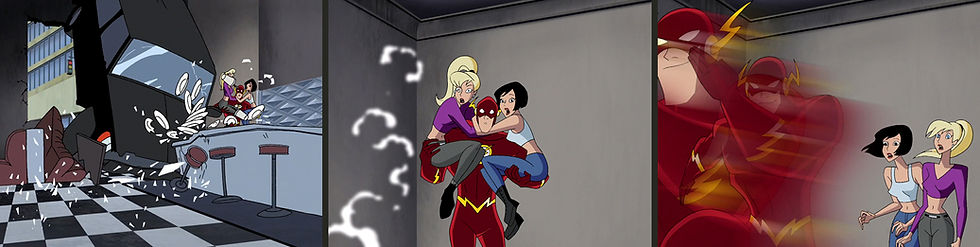
“Guess I’m not as much of a romantic liability as you thought, huh, ladies?” After checking with the driver to make sure he was okay, the Flash leaves to chase down the truck.

Okay, considering the speed of the truck and the speed of the Flash, this scene immediately following Flash’s departure of the diner is probably one to two blocks away from “Restaurant Diner.” Considering how there was an Ole’s Market on the same block as the diner (see above), why is there another location roughly one to two blocks away?
In addition, notice the odd circular hole in the street corner at the bottom left of the above left panel, but when the blue car is knocked into that street corner (above center panel), suddenly there’s a geyser of water from where a fire hydrant should have been in the above right panel. The only explanation is an animation error.

In another animation error, note how the signs for Tom’s Cafe and Ace Clothing are reversed.


The extended chase scene, with Flash attempting to catch up with a speeding truck, is laughable on two levels:
According to Cartoon Network’s character profile for the Flash, he should be able to run “at velocities approaching the speed of light” (qtd. in Allstetter, “Justice League Characters”). Meanwhile, a speeding truck on a busy city street cannot go anywhere near that fast. If the Flash was at the top of his game, he should have been able to remove the occupants of the truck, restrain and disarm them, and bring the truck to a stop in a matter of seconds.
Based on the recurring appearances of Ace Clothings, Tom’s Cafes, and Ole’s Markets on Central City’s streets, it looks like either 1) the truck is driving in circles or 2) all three stores appear in this metropolitan area with the frequency of Dollar General. What is more likely, however, is that the creative team took the city street backgrounds and used computers to place text on the empty signs over the businesses, and there was a limited number of pre-prepared text to place on them. Obviously, this is another example of the “good was good enough” ethos that permeated Season One (“ZETA,” 00:13:23-00:15:31).
This scene is an example of the difficulties the creative team faced trying to write for the Flash, as stated by Bruce Timm in the aforementioned interview with RetroVision CD-ROM Magazine:
Just trying, for example, to come up with a way of staging the Flash so he doesn’t come off looking like a total moron is really difficult, because he can be everywhere at once. We know that really doesn’t work in any kind of filmic medium. Nobody should ever be able to get the drop on the Flash; his reflexes should be so fast that nobody should be able to land a punch on him or shoot him with a ray gun. (qtd. in Gross, “Justice League: The Making” 2)

Look, I understand that there was a learning curve to animating these new characters, and I get that the Flash must have been particularly challenging. That said, I find this scene, where the animators appear to be dragging an animation cel of a literal stick figure across the background to simulate the Flash running, to be particularly unfortunate.

Catching up to the truck on a bridge, the Flash attempts to get the driver to pull over. However, Professor Chin attempts to sideswipe Flash with the truck, causing it to fall on its side.
In another animation error, Professor Chin is wearing glasses in this scene. In his first appearance (see above), he was not wearing glasses.

Out of control, the truck crashes through the bridge’s railing and, using his super-speed, the Flash manages to rescue the truck’s occupants. As for the truck, it is saved by the newly arrived Green Lantern, who is investigating the robbery of the radioactive isotopes.

You know, for a truck that tipped over and fell off a bridge, those canisters are in perfect condition. They don’t appear to be perforated or even jostled—in fact, they are completely undisturbed.
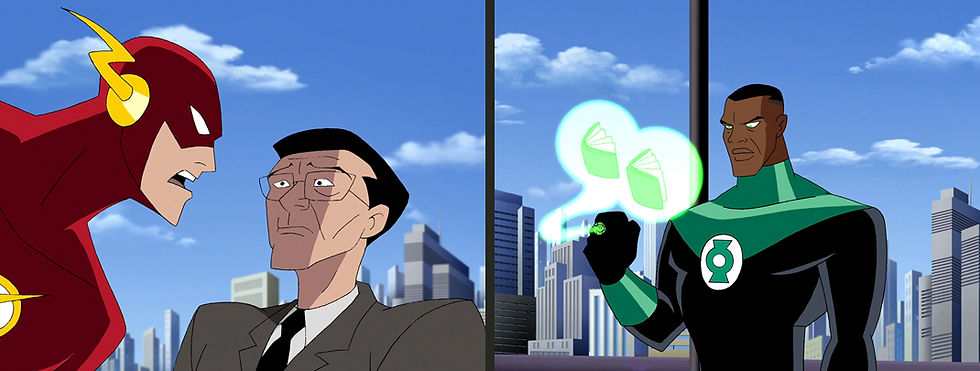
Snapped out of their hypnosis, Professor Chin and Dr. Stevens have no idea where they are or what they’ve done. Upon discovering that they both work for the aforementioned River Bluffs Research Center, Green Lantern and Flash go to check it out.

Arriving at the facility, the superheroes question Dr. Sarah Corwin, the person apparently in charge. In the original script, she is described as “[a] cool, intellectual female researcher—a tightly-bunned ‘Lilith Crane’-type” (McDuffie, “The Brave and the Bold: Part One”), which obviously references the character played by actor Bebe Neuwirth (above right) on the long-running sitcoms Cheers (1982-1993) and Frasier (1993-2004, 2023-2024). Yeah, I see the resemblance.
According to Dr. Corwin, both Chin and Stevens were “under enormous pressure to finish their current project,” which she is reluctant to go into, claiming that it is “classified information.” Look, I get it—whenever I’m on a deadline, that also makes me want to go out and commit a felony.

While Green Lantern attempts to get blood from a stone with Dr. Corwin, the Flash takes a moment to play with the lab animals. Also present is Grodd, who is posing as a test subject, but his cover is nearly blown when the Flash offers him a banana. Of course, later in the episode, we learn that Grodd hates the tropical fruit in question.
Of course, Grodd’s reluctance could also stem from the fact that he’s being offered food that was in somebody else’s mouth. Eww, human germs.
The presence of a “do not feed the lab animals” is interesting. At first glance, it came off as a convenient plot point; a way for Dr. Corwin to get mad and tell the heroes to leave. In reality, however, the care of the animals specifically falls to employees known as animal technicians, who are different from the regular research scientists. That said, it does pose one additional question: why are there bananas lying around unattended in the first place?

Kicked out of the research facility, the Flash makes a stop to grab “a little snack” from a street vendor. Please note that, in the above right image, the Flash has picked up an armful of what appear to be double cheeseburgers but, in the above left image, there is an animation error that makes them look like some kind of unholy, A.I. slop abomination. Look at how the yellow squiggles do not go to edge of the patties as they do in the above right image—I mean, are they double cheeseburgers, or are they hot dogs with mustard (which they cannot be, considering the hamburger shape)? It is also worth mentioning that, in the original script, the food items in question were hot dogs (McDuffie, “The Brave and the Bold: Part One” 10-11). Overall, that above left image just makes my brain hurt.
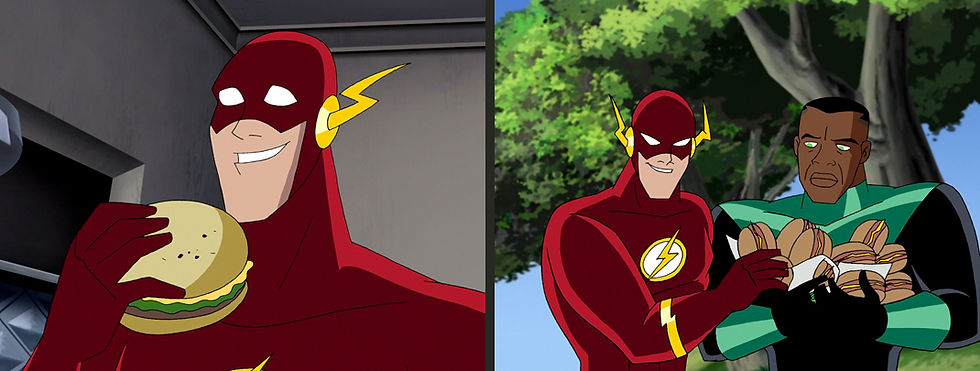
Also, compare the burgers here to the cheeseburger that the Flash was preparing to eat in the earlier diner scene (above left), the “hamburger patties” in this scene (above right) seem a little too pink to have been cooked properly. But they are hot dog-colored. Ow, my head!

Alerted to reports of a gorilla loose in one of the city’s parks, the Flash impulsively ditches Green Lantern and races ahead to fix the problem. In Flash’s defense, Central City is his town, and he probably feels responsible for it much like Batman does for Gotham.
Of course, there had to be a scene with the gorilla using the monkey bars.

Seeking to evade capture, Solovar steals a car and takes off down the street. I love how, in the original script, the name of the ponytailed victim of the carjacking is called “Mid-Life Crisis Man” (McDuffie, “The Brave and the Bold: Part One” 12).
Huh, I guess Solovar can drive a stick shift.
Ugh, is that Ole’s Market again in the above third panel? Be better, Central City!

Seeking to avoid another extended street chase, the Flash grabs a rake and throws it in the way of the vehicle, destroying the tires and forcing the car to crash. Man, the Flash took a bit of a risk here, as stopping the car in that manner could have killed Solovar.

During the chase, Flash refers to the escaping gorilla as “Mojo,” which is a reference to Mojo Jojo, a villain from the Hanna-Barbera cartoon The Powerpuff Girls (1998-2005, 2016-2019). Considering the Flash’s age and maturity level, I’m certain that he is a regular viewer. Also, this is the second time a Hanna-Barbera cartoon character is referenced in relation to a gorilla character, as Green Lantern brought up Magilla Gorilla when confronted by the Ultra-Humanite in “Injustice for All.”

Strangely enough, even with the obvious damage to the tires thanks to the rake, in the next scene the tires show no marring whatsoever. Another animation error?

When the Flash checks Solovar to see if he’s okay, the gorilla responds by saying, “Get your stinking paws off me, you filthy human!” This is obviously a reference to Charlton Heston’s classic line—“Take your stinking paws off me, you damn, dirty ape!”—from the original Planet of the Apes film (1968).
Man, the Flash is pretty slow on the uptake. He’s been chasing a gorilla who can easily drive a car—a stick shift, no less!—but he freaks out when the gorilla talks to him.

Unbeknownst to Flash and Solovar, Dr. Corwin is on a nearby rooftop with an energy weapon (at the behest of Grodd, no doubt) with the intent of zapping the Scarlet Speedster with some kind of mind control. To that end, I ask the following: why use a gun at all? Shouldn’t Grodd’s mind control helmet be enough? I concede that this way is more dramatic—and it sets up Wally’s flashback to his origin and previous adventures—but I would like to know how this got him from A to B.

In regard to the flashback sequence, where we see the Flash’s origin and some of his more unusual transformations, there is some question as to its origins:
In the aforementioned interview with the Justice League Revisited podcast, Rich Fogel claims that this sequence, which was storyboarded by Bruce Timm, was created before the screenplay was even written, and it was later incorporated into the script by the creative team (Eisenberg and Enstall, 00:25:04-00:26:04).
However, in an interview with RetroVision CD-ROM Magazine, Dwayne McDuffie claims that he created the sequence for the script himself: “I just went through every copy of Flash I could find and found the freakiest covers and sort of strung them together. The Flash always had great covers: ‘It’s the Flash, but his head is really big!’ ‘It’s the Flash, but he’s immensely fat!’” (qtd. in Gross, “Justice League Episode” 12).
The Flash’s psychedelic flashback begins with his origin, which occurred in Showcase #4 (Barry Allen; October 1956) and The Flash #110 (Wally West; January 1960). However, rather than choose between one or the other, they technically did both, as recounted by Dan Riba: “[w]e actually did the Flash origin in that dream sequence. Even though we know it’s Wally West, Barry Allen and Wally had the same exact origin, so it worked either way!” (qtd. in “Behind,” 00:05:03-00:05:16).
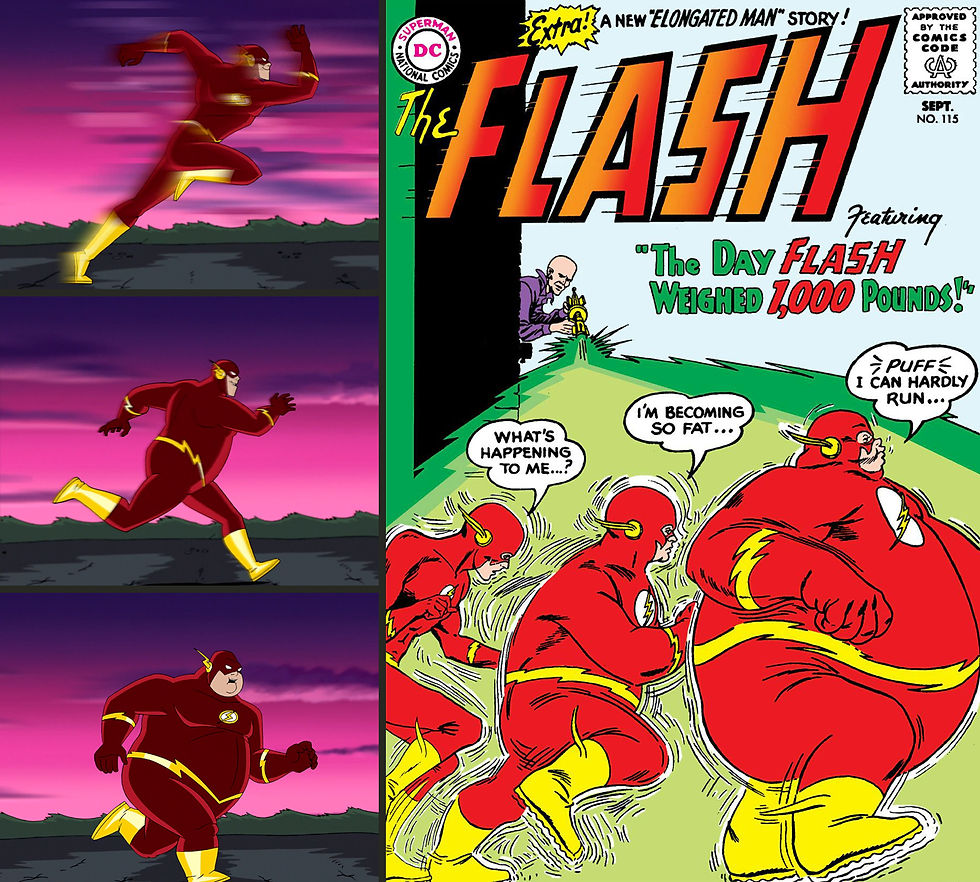


Unlike the previous transformations, there have been multiple covers featuring the Flash with an enormous cranium, such as Justice League of America #7 (November 1961), Green Lantern #13 (June 1962), and The Flash #177 (March 1968).


Finally, the sequence where the Flash transforms into a gorilla could refer to JLApe: Gorilla Warfare!, a 1999 DC Comics crossover event that played out over various DC Annuals that year, such as in The Flash Annual #12 (October 1999).
That said, according to Dan Riba in “Behind ‘The Brave and the Bold,’” a 2004 DVD special feature, the origins of Gorilla Flash were a little closer to home: “The bit with Gorilla Grodd in a Flash costume; that actually didn’t happen on a cover, but it’s based on a Halloween costume that I had done years ago, so that was actually me. And Bruce [Timm] actually had that put in the script because he remembered that Halloween party” (qtd. in “Behind,” 00:04:46-00:05:01).

Looking back at this episode over twenty years later, this moment can be interpreted as foreshadowing the episode “Dead Reckoning,” where Grodd combines magic and science in an attempt to transform all of humanity into gorillas. Obviously, this was coincidental (the creative team had no idea how long the series would last, nor where the long-term story arc would go), but it does mesh well regardless.

Coming to after a prolonged blackout, the Flash finds himself in a holding cell at the Central City police station. Please note that one of the background characters here looks like the actor who played Cousin Spunky, from the BTAS episode “Baby-Doll.”

Dragged into an interrogation room, the Flash encounters two detectives that are obviously meant to be a “good cop / bad cop” pairing. In the original script, they are identified as Detectives Braugher (“[a] tough, [B]lack city detective”) and Secor (“Braugher’s ‘good cop’ partner”; McDuffie, “The Brave and the Bold: Part One”).
Detective Braugher is designed to resemble his voice actor, Bill Duke, a character actor best known for roles in films such as American Gigolo (1980), Predator (1987), and Menace II Society (1993).
At first, I thought Detective Secor was meant to resemble Barry Allen, but I’m no longer about that possibility. I mean, the blond hair is there, but the glasses, the fuller lips, and the lack of the trademark bow tie make me think differently now. Still, based on the detail put into his design, I suspect that he’s meant to resemble somebody.
Speaking of Bill Duke, this interrogation scene is reminiscent of one he starred in from the aforementioned Menace II Society; this was confirmed by Dwayne McDuffie in a July 8, 2004 post on his now-defunct message boards (Maestro).

During his interrogation, the Flash is presented with video footage of him stealing the previously stolen radioactive isotopes at super-speed from police impound. Naturally, he does not remember any of this.
This scene, while simple on its surface, is heavy with implication. Consider: by my estimate, the Flash has been active as a hero in Central City—both as Kid Flash and adult Flash—for at least five to six years, and one would think that he would have garnered at least some good will by now. However, so far in this episode, both the cops and average citizens just seem to tolerate his presence. Granted, by this point the Flash has only made a small handful of appearances on Justice League, but did his first outing in his hometown have to be so negative?
Also, compare this to the relationships that Batman and Superman have with Gotham City and Metropolis, respectively. In BTAS and TNBA, the Dark Knight’s very presence generates both fear and awe from the general public. In STAS, the Last Son of Krypton experienced some xenophobia at first, but overall, he was loved by the majority of the population until “Legacy” (and the adoration was back to normal by “Secret Origins”). By comparison, Central City seems to treat Flash like a disrespected local celebrity, sort of like running into Krusty the Clown or Troy McClure in The Simpsons’ Springfield.

In fulfilling his duties as “good cop,” Detective Secor asks Flash how he takes his coffee. And before you ask, yes, I cannot help but think of this scene whenever I hear “37.”

Fortunately, the Flash is bailed out by Green Lantern, who lays into him for his perceived actions. All things considered, I’m surprised Batman didn’t tag along as well.
When Green Lantern doubts Flash’s claims about meeting a talking gorilla, I love how he punctures Stewart’s cognitive bias with the line, “We both got a Martian’s phone number on our speed dial.” Only in a comic book—or, in this case, an animated program based on a comic book—can a line like this hold any weight.

As the duo leave the police station, I got a good look at the sign in front of what is supposed to be the Central City Police Department. First off: horribly generic. Second: look at shape of the text, particularly the “P,” the “O,” and the “C.” Aside from cutting costs, is there a reason why the word “POLICE” looks like it was printed on a janky, ’90s printer?

Above, left to right: the Gotham City Police Department, as seen in the BTAS episode “What is Reality?,” the TNBA episode “Critters,” and the Batman Beyond episode “Shriek.”
It is also worth mentioning that the design of the Central City Police Department—at least the front steps and doorway—appears to be retooled production art of the Gotham City Police Department, which has been used in multiple Batman series.


Speaking of doing it on the cheap, during the pan across the park, showing the police’s “ape hunt,” why is there what appears to be Metropolis Police Cruisers (as seen in the above bottom right pic, from “Injustice for All”) in Central City? Assuming that the stylized “M” on the door stands for “Metropolis,” I guess that’s why the storyboarders hid the doors behind shrubbery.

Returning to the park, Green Lantern and Flash find Solovar, who decides to actually communicate with them this time, rather than run away. Here we learn how Solovar is tracking Grodd, who attempted to conquer Gorilla City with “advanced mind control technology.” He escaped (as seen in the teaser at the beginning of the episode), and here we are.


The Gorilla City skyline (above left) seen in the flashback features designs reused from the 30th Century Metropolis, from the STAS episode “New Kids in Town” (above right).

Based on the timeline of Grodd’s initial attempt to mind-control Gorilla City, I suspect his escape here immediately precedes his escape from the city itself in the episode’s teaser.
In fact, in the original script, Solovar’s line about Grodd stealing the city’s security plans occurs during the flashback, as the simian criminal shuts down the shield wall via remote control as he exits the city (McDuffie, “The Brave and the Bold: Part One” 25).


Acting like a moron once again, the Flash ditches Green Lantern and Solovar before the ape can inform him about the mind control-negating headbands in his possession. Returning to River Bluffs Research Center, the Flash confronts Dr. Corwin only to be cold-cocked by Grodd, who uses the Scarlet Speedster as a diversion while he and Dr. Corwin ready their device for activation.

The shield generator room at the River Bluffs Research Center (above center) reused the design of the Bay Ridge Research Center’s particle fusion room from the Batman Beyond episode “Heroes” (above left). The concepts would later be recycled for the Gorilla City shield generator room in the JLU episode “Dead Reckoning” (above right).
Wait a minute—River Bluffs Research Center? Bay Ridge Research Center? You mean to tell me that the creative team even repurposed the name of the facility from Batman Beyond? “Let’s see: body of water + land formation + ‘research center.’ Done!”


Grodd turns on the shield generator, which rapidly expands across Central City, eventually shrouding it in a combination force field / cloaking shield. Part One of Grodd’s plan is complete.
Notice how the River Bluffs Research Center (as seen in the top row, fifth pic from the left) is dramatically located on the edge of a cliff overlooking the water? It looks like the ocean but, since Central City is in the Midwest somewhere and the facility is literally called “River Bluffs,” it is obviously located next to a river. Assuming that the location is the center of Grodd’s energy wave, where is the river? If you check the final pic in the bottom row, there appears to be a lake on the edge of town (which has been partially obscured by the force field), but I see no river, let alone no river going through Central City.

The disappearance of Central City is immediately detected by the Watchtower. Hey, I almost forgot that there were other heroes on this show.

As a consequence of the Grodd’s energy field, communication with Central City has been cut, as Green Lantern and Flash are just now finding out.
Again, Central City is a Midwestern, landlocked location. Where is that coastline coming from? I mean, beyond the coast, we can see open water stretching out into the horizon, and Central City does not appear to be situated next to an ocean or Great Lake.

In fact, let’s go back to the image of the cloaked Central City from the end of Part One. First off, not to beat a dead horse, but I see no ocean, no river, no major body of water, aside from that little, dinky lake towards the bottom right of the image. I have no idea where River Bluffs Research Center could possibly be located, and if it is in the center of the cloaking field, I have no idea where that body of water that Flash was looking out at is supposed to go.
Second, does urban sprawl not occur around Central City? I mean, perhaps metropolitan areas looked like this in the 1940s and ’50s, but today, major American cities do not stop at the city limits, as they are surrounded by suburbs, smaller towns, and the National Highway System, to name a few things.
That no highway thing is another sticking point. Do you mean to tell me that the only way to get to Central City is by rural roads?
Finally, in the current comics, Central City corresponds with the real-life Kansas City, Missouri, as it sits opposite Keystone City (aka Kansas City, Kansas) on the Kansas / Missouri border and is separated by the Missouri River. That would mean that, ideally, the “river” in “River Bluffs Research Center” would have been the Missouri River, and it would have been on the edge of town overlooking its sister city.

After crashing the Javelin-7 into the energy barrier, the Justice League begin to investigate on the ground, quickly finding that even J’onn J’onzz is unable to pass through it.
I find it interesting how, when J’onn questioned the Javelin-7’s readings, Wonder Woman immediately jumped to its defense, saying how “Batman designed this ship; it its sensors say something is there—” Personal headcanon: I think they were seriously telegraphing that Diana had a crush on Batman even before the missile bit at the end of the episode.
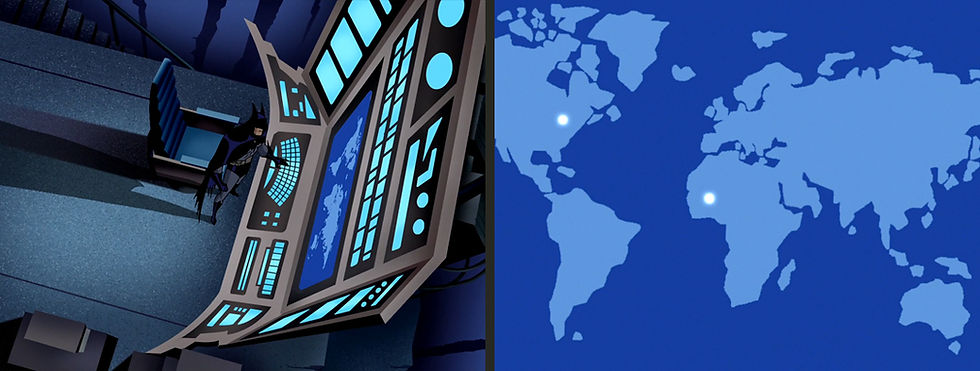
Speaking of Batman, the Dark Knight analyzes the data and discovers a second, identical energy signature in Africa. Despite Solovar’s claims that “gorilla technology is highly advanced,” the Dark Knight’s technology did a pretty good job of detecting and measuring it.
As with Central City, I find Gorilla City’s location to be a little baffling. Current scholarship places it in the Democratic Republic of the Congo, but Batman’s map places it as being possibly in Mali or Niger. Then again, the map also places Central City somewhere closer to Ohio or Pennsylvania.

Exploring the seemingly-abandoned Central City, Green Lantern, Flash, and Solovar discover a rally being held by Grodd. One would question why the criminal would bother evangelizing mind-controlled people but, as we will learn in future episodes, Grodd does love the sound of his own voice.
Grodd’s words—particularly where he described humans as “inferior creatures” that are “slow, ugly, immoral, and [having] an unpleasant body odor”—actually have an unfortunate historical pedigree, as detailed by Rich Fogel in the aforementioned interview with the Justice League Revisited podcast:
[It was] something that Dwayne [McDuffie] really added in there that I thought was brilliance, which is that speech is full of slurs and aspersions that historically were thrown at Black people in America. And so, he was using that as a platform to criticize racism in America as he experienced it as a Black man, you know, from his point of view. And so, by having all of that venom spewing out from the gorilla, it sort of laid it bare that, you know, he’s saying all these things about the humans and, obviously, they’re not true. (qtd. in Eisenberg and Enstall, 00:38:57-00:39:43)
The Flash’s retorts to Grodd were amusing, particularly when he took offense to calling humanity “slow” (a slap in the face to the Fastest Man Alive). In addition, his “why don’t you go climb a skyscraper?” line is obviously a reference to King Kong.
That said, it’s Green Lantern who gets one of the best lines in Season One: “Flash, don’t heckle the supervillain!”
As the mind-controlled citizens of Central City attempt to “destroy” the intruders, Grodd and Dr. Corwin slip away to implement the final part of their plan.

Meanwhile, in Africa, the rest of the Justice League arrives and meets up with Batman, who is busy getting readings on the second energy source. Please note that the Javelin-7, which took damage on the outskirts of Central City (above right), is pristine once again.

The Justice League is taken captive by the military of Gorilla City. Upon awaking, they are immediately interrogated by the General, identified as “[a] gruff, hard-nosed gorilla officer” in the original script (McDuffie, “The Brave and the Bold: Part Two”).

Arriving at the local military base, Grodd takes over the officers’ minds and uses the facility to launch a nuclear strike against Gorilla City. Arriving too late to stop them from launching, Green Lantern takes off in an attempt to stop the missiles.

The military installation—described as “missile base” in the original script; McDuffie, “The Brave and the Bold: Part Two” 18)—is a retooled version of the Fort Sherman Missile Base, from the STAS episode “Bizarro’s World.”

Speaking of “Bizarro’s World,” the launched missiles from that episode resemble the ones used here as well.

Releasing himself from his shackles, Batman immediately frees Wonder Woman with a Batarang. This is no surprise, particularly in a Dwayne McDuffie story, as in the McDuffie-written Justice League of America #13 (November 2007), Batman refers to Wonder Woman as “the best melee fighter in the world” (McDuffie, “Injustice”).
Of course, Hawkgirl is no slouch either, as she takes on a gorilla soldier with her arms still restrained.

The scene with the Justice League attempting to flee Gorilla City, with the obligatory shot of frightened gorilla civilians recoiling in horror at the humans (and Martian and Thanagarian), is obviously an homage to the aforementioned Planet of the Apes film (1968).
During their confrontation with the gorilla military, the energy field cloaking Gorilla City shuts down, and they detect missiles coming their way. Suddenly, the General is open to hearing the Justice League out.

Meanwhile, Green Lantern successfully disarms two of the four warheads. Based on the explosion, I assume that he was able to disarm the nuclear component before detonation.
I can see why the creative team elected to bench Superman for this particular episode, as he has had multiple experiences disarming missiles mid-flight, such as in the STAS episode “Ghost in the Machine” and the aforementioned “Bizarro’s World.”

Back in Central City, Solovar and the Flash confront Grodd and Dr. Corwin. In particular, the Flash does everything in his power to piss off Grodd, which isn’t much. According to Dwayne McDuffie in the aforementioned “Behind ‘The Brave and the Bold’” special feature, “[n]obody could be more annoying to Grodd than Flash” (qtd. in “Behind,” 00:04:15-00:04:18). I would assume that this is similar to how Bugs Bunny is annoying to Yosemite Sam.
In the above center image, when the Flash drums on Grodd’s helmet, this is the moment where he sabotages the device by crossing some wires. As McDuffie continued, “another thing that was really fun was that we got to see the Flash [as] a little bit smarter than people thought he was at that point in the show” (qtd. in “Behind,” 00:04:21-00:04:27).

In eliminating his second missile, Green Lantern is temporarily incapacitated by flying debris, leaving the remaining two to be handled by his teammates in Gorilla City. Of them, J’onn J’onzz deactivates one by phasing through the missile and removing key components, while Hawkgirl and Wonder Woman take on the second.

Frankly, I’m surprised that the fourth one didn’t go off, what with Hawkgirl breaking it in half with her mace, and Wonder Woman largely pushing it out of the way of Gorilla City civilians as it landed. She took a big risk assuming that the nuclear components were disabled … or maybe she was unfamiliar with the concept of nuclear weapons?

Fearing that Wonder Woman was killed by the downed missile, the Dark Knight attempts to dig her out but, fortunately for her, she is unharmed.

This is the beginning of a beautiful ship.

Goaded by Flash into attempting to use his mind control abilities against him, Grodd’s tampered-with helmet electrocutes the would-be warlord. Grodd would later fall for this same gambit against Lex Luthor in “Alive!”

On the plus side, this accident is the origin of Grodd’s mental abilities, as seen in “Secret Society.” While not a true telepath, he gains the ability to influence moods and cause extreme agony.

Rushing to his side, Dr. Corwin reveals to Flash and Solovar that she and Grodd were in a relationship. While it seems an odd choice for a speciesist who considers human beings inferior to take one as a lover, keep in mind that prejudice never stopped colonizers and slavers from having sex with the indigenous peoples they brutalized.
As for Dr. Corwin’s part in this, well … all I can say is that it’s always the quiet, unassuming ones you’ve got to watch.

Grodd’s interest in human women would become a recurring plot point, as he would partner with Giganta—a Gorilla City resident that he transformed into a human—in “Secret Society,” and the demonic Tala, in “Dead Reckoning.”

Appearing to suffer brain damage from his helmet’s malfunction, Solovar brings Grodd back to Gorilla City and, apparently, puts him on display in a public area. Please note that the scene reuses designs from the Metropolis Zoo, which were initially used in the STAS episode “Monkey Fun.”

Regaining his senses as the Justice League walks away, the enraged ape vows vengeance…

…which he would seek through team work, specifically with both the original Secret Society, in Season Two’s “Secret Society,” and the larger, expanded Secret Society (aka the Legion of Doom) during Justice League Unlimited’s third season.


Finally, in addition to the above, “The Brave and the Bold” is also noteworthy for providing a testing ground for two voice actors who would later go on to perform bigger, more significant roles in the series:
Phil Morris, who voiced the Gorilla General, would later be cast as Vandal Savage, appearing in “The Savage Time,” “Maid of Honor,” and “Hereafter.”
Virginia Madsen, who voiced Dr. Sarah Corwin, would later be cast as Roulette, appearing in the Justice League Unlimited episodes “The Cat and the Canary” and “Grudge Match.”
Works Cited
Allstetter, Rob. “Dwayne McDuffie Talks Justice League.” Comics Continuum. 9 Mar. 2002. <http://www.comicscontinuum.com/stories/0203/09/index.htm>. Accessed 31 Dec. 2022.
---. “Justice League Animated Update.” Comics Continuum. 24 May 2001. <http://www.comicscontinuum.com/stories/0105/24/index.htm>. Accessed 20 Dec. 2022.
---. “Justice League Characters.” Comics Continuum. 19 Oct. 2001. <http://www.comicscontinuum.com/stories/0110/19/jlindex.htm>. Accessed 22 Dec. 2022.
---. “McDuffie Talks Static Shock.” Internet Archive. 10 May 2000. <https://web.archive.org/web/20000510214406/http://www.comicscontinuum.com/stories/0004/05/index.htm>. Accessed 8 May 2026.
“Behind ‘The Brave and the Bold.’” Justice League: The Brave and the Bold. Warner Bros. Animation, 2004.
Berkowitz, Stanley. “Re: Questions About Justice League…” Received by Joseph Davis, 1 Jun. 2026.
Brady, Matt. “Just Us Leaguers.” JLA Special: A Special Wizard Publication. 1996: 59. Print.
---. “Just Us Leaguers.” JLA Special: A Special Wizard Publication. 1996: 63. Print.
Davis, Joseph. “The Brave and the Bold.” Internet Archive. 14 Feb. 2008. <https://web.archive.org/web/20080214072727/http://jl.toonzone.net/episode7/episode7.htm>. Accessed 14 Jun. 2026.
Dwayne McDuffie. Comment on “Duh! I Know What the Point was of Those Two Explorers in the Beginning of the B&B.” Anime Superhero. 17 Mar. 2002. <https://animesuperhero.com/forums/threads/duh-i-know-what-the-point-was-of-those-two-explorers-in-the-beginning-of-the-b-b.2948581/#post-43547351>. Accessed 26 Feb. 2025.
Eisenberg, Susan and James Enstall, hosts. “The Brave and the Bold.” Justice League Revisited, featuring Rich Fogel. Apple Podcasts, 20 Feb. 2024. <https://podcasts.apple.com/us/podcast/the-brave-and-the-bold-with-rich-fogel/id1709910091?i=1000645995432>. Accessed 3 May 2026.
Fingeroth, Danny. “Creative Milestones: The Dwayne McDuffie Interview.” Write Now! Magazine. Transcribed by Steven Tice. May 2005: 3-26. Print.
Fox, Margalit. “Dwayne McDuffie, Comic-Book Writer, Dies at 49.” Internet Archive. 22 May 2013. <https://web.archive.org/web/20130522161824/https://www.nytimes.com/2011/02/24/arts/design/24mcduffie.html>. Accessed 8 May 2026.
Gross, Edward. “Justice League Episode Guide.” RetroVision CD-ROM Magazine. M&R Multimedia, Inc. n.d.: 8-27. PDF file.
---. “Justice League: The Making of the DC Tooniverse.” RetroVision CD-ROM Magazine. M&R Multimedia, Inc. n.d.: 1-7. PDF file.
Jankiewicz, Pat. “Justice League: Superman, Batman & Their Super Friends Get Animated for the 21st Century.” Starlog. Jan. 2002: 28-33. Print.
Maestro (DMcDuffie). Comment on “Justice League, Maestro on DVD!” Dwayne McDuffie. Delphi Forums, LLC. 8 Jul. 2004. <http://forums.delphiforums.com/Milestone/messages?msg=1162.3>. Accessed 26 Feb. 2025.
---. Comment on “I Love the Incredibles.” Dwayne McDuffie. Delphi Forums, LLC. 21 Mar. 2005. <http://forums.delphiforums.com/Milestone/messages?msg=2065.7>. Accessed 26 Feb. 2025.
---. Untitled. Dwayne McDuffie. The V Hive. 3 Mar. 2006. <https://www.thevhive.com/forum/dwayne-mcduffie/threads/ask-the-maestro/775?thread_skip=50&folder_name=dwayne-s-world>. Accessed 19 Feb. 2011.
MattWayne. Comment on “Matt Wayne’s Finest?” Anime Superhero. 8 May 2006. <https://animesuperhero.com/forums/threads/matt-waynes-finest.4120731/#post-62419121>. Accessed 21 Jan 2023.
McDuffie, Dwayne. “The Brave and the Bold: Part One (#385-584).” Dwayne McDuffie. N.p. n.d. <https://dwaynemcduffie.com/wp-content/uploads/2024/07/WEBSITE-JLU-TV-ep112-The-Brave-and-the-Bold-part1-SCRIPT.doc.pdf>. Accessed 11 May 2026. PDF File.
---. “The Brave and the Bold: Part Two (#385-585).” Dwayne McDuffie. N.p. n.d. <https://dwaynemcduffie.com/wp-content/uploads/2024/07/WEBSITE-JLU-TV-ep113-The-Brave-and-the-Bold-part2-SCRIPT.doc.pdf>. Accessed 11 May 2026. PDF File.
---. “Injustice League Unlimited, Chapter Two.” Justice League of America: The Injustice League. Illustrated by Joe Benitez. DC Comics. 2009.
Senreich, Matthew. “In the Major League.” JLA Special: A Special Wizard Publication. 1996: 14-18. Print.
Wayne, Matt. “What Dwayne McDuffie Meant to Comics and Why There’s an Award in His Name.” Internet Archive. 6 Oct. 2017. <https://web.archive.org/web/20171006150431/http://www.playboy.com/articles/what-dwayne-mcduffie-meant-to-comics-award>. Accessed 8 May 2026.
Weitzman, Alex. “Toonzone Presents: An Interview / Tribute to Dwayne McDuffie.” Anime Superhero. 9 Mar. 2011. <https://animesuperhero.com/toonzone-presents-interview-tribute-dwayne-mcduffie/>. Accessed 8 Dec. 2022.
“ZETA vs BATMAN and How Warner Bros. Almost Killed JUSTICE LEAGUE (Writer Rich Fogel).” YouTube. Uploaded by Watchtower Database. <https://www.youtube.com/watch?v=zvH0oq7YIjw&t=633s>. Accessed 15 Jun. 2025.
Images courtesy of Warner Bros. Discovery, Warner Bros. Home Entertainment, Warner Bros. Animation, DC Comics, Paul Dini, the Walt Disney Company, Marvel Comics, The Muppets Studio, Paramount Television, Charles / Burrows / Charles Productions, Cartoon Network Studios, View Askew Productions, Miramax Films, and Milestone Media. YouTube videos courtesy of the Muppet Songs and the movies 90s channels.


Comments