


Tales from Development Hell: Paul Dini's "Batman Team-Up" Movie

Updated: Sep 6
Back in 2003, Paul Dini announced a direct-to-video project featuring the Dark Knight teaming up with a number of Justice League heroes. What happened?
For every project that sees release there are hundreds that are either abandoned or cancelled outright by their parent companies. They may feature wonderful stories that have been championed by established talents but, for whatever reason, they are unable to survive the development gauntlet required to reach its premiere date. And even though they are aborted for a variety of reasons—developmental delays, creative concerns, financial decisions, corporate turnover, etc.—the memories of these elevator pitches live on in the memories of fans who read about them once or twice on websites such as The Hollywood Reporter, ScreenRant, and Bleeding Cool. This is another Tale from Development Hell.

After over a decade working on the multiple series that comprise the DC Animated Universe (DCAU), Paul Dini declined a position with the Justice League creative team, electing instead to work in the development side of Warner Bros., working on “several classic characters” ranging from “classic Looney Tunes […] to DC superheroes” (Archie); this would eventually transform into a stint as a producer on Duck Dodgers (2003-2005). Of course, he was still working in the same offices with his former colleagues and, when the opportunity arose, he welcomed the opportunity to write some Justice League episodes as a freelancer. However, Dini also contributed to the DCAU in other, less perceptible ways with fellow alumnus Alan Burnett, who chose to remain on the Kids’ WB! side as a supervising director on Static Shock and The Zeta Project (Allstetter, “Briefly”). “Alan Burnett and I have worked on some new Batman direct-to-videos,” he admitted in an October 2001 interview, adding how “[w]e wrote scripts for two of them and have no idea when [Warner Bros.] is going to proceed and put them into production. We will make an announcement as soon as those get a little more real” (qtd. in Archie).
As it turned out, it would not get “a little more real” until November 2003, when Paul Dini—who was promoting his first Justice League episode, “Comfort and Joy,” at Wizard World Texas—teased that one of his Batman projects was coming close to fruition. Based on the success of Batman: Mystery of the Batwoman (2003), he revealed that a new, direct-to-video Batman film would most likely be greenlit “in the next month or two” (qtd. in Allstetter, “Paul”). Apparently put on hold while Batwoman was being finished (Wharton), the film project was “started two years ago by Alan Burnett and myself” (qtd. in Wharton). When pressed about the story, he revealed that “[i]t’s a lot of fun. It’s a Batman team-up with a lot of heroes” (qtd. in Wharton).
Unfortunately, the “month or two” came and went and, on May 25, 2004, Dini announced that he was leaving Warner Bros. Animation (Dini, “All”). While initially very tactful in his departure, he later revealed during a December 2012 Fatman on Batman interview that he left because “[t]hey cut the writer’s deals back to nothing, and I got this offer to go work on Lost and, it’s like, “See you guys!” (qtd. in Smith, 01:08:32-01:08:39). Despite his departure, he was more than willing to discuss the status of his direct-to-video at, coincidentally, Wizard World Texas the following year, where he was in attendance this time as part of a Lost (2004-2010) panel. During this appearance, he discussed that “there were plans for a big, original Batman animated movie with Justice League cameos,” but it had been scrapped (qtd. in Franklin). This information was later confirmed by Producer Bruce Timm in a November 10, 2004 post on the Anime Superhero (formerly Toon Zone) message boards, saying, “There are currently no new BTAS DTVs in the works (that I’m aware of)” (b.t.). With Dini moving on to greener pastures and Warner Bros. Animation uninterested in additional DCAU films (including the Justice League DTV World’s Collide [b.t.], which would eventually become the 2010 film Justice League: Crisis on Two Earths), it appeared to be the final nail in the project’s coffin.

Writers’ Table Scraps
However, even though the movie itself was shelved, the script still found ways to get its story out there. The first instance of this was in 2008, when writer Brad Meltzer organized a star-studded, online charity auction, with the proceeds used to restore the childhood home of Superman co-creator, Jerry Siegel (Renaud, “Comics”). While the auction was successful—raising $101,000, more than doubling the initial goal of $50,000 (Renaud, “Meltzer”)—it should be noted that one of the donated items for auction came from Paul Dini, as recounted on his LiveJournal blog in a September 15, 2008 post:
If you’re into comics at all, then you must have heard of best-selling author and all-around good guy Brad Meltzer’s attempts to restore the childhood home of Jerry Siegel, co-creator of Superman. Brad has put together an auction to raise money for the restoration and, so far, they’ve been doing really well. A number of comics pros have contributed items to the auction, myself included. While I don’t draw in any sort of way that people would pay money for, I did contribute an unproduced Superman animation script I wrote about eight years ago. We were going to do a Superman / Mxyzptlk VS Batman / Bat-Mite story for a DC team-up direct-to-video, but the project never moved beyond the script stage. I cut out the 40+ page Superman portion of the script (an entire, stand-alone episode) and donated [it] for the auction. (Dini, “Nonstop”)
It should be noted that, in its summary on the Ordinary People Change the World page, the script is titled “Batman / Superman: When Twerps Collide” (“Siegel”). Yes, the sound you hear right now, dear readers, is the sound of me kicking myself for only learning about this auction eighteen years too late.

The material would surface again on October 14, 2011 via sister series Batman: The Brave and the Bold or, more specifically, through its episode “Bold Beginnings!” In this installment, Green Arrow, Plastic Man, and Aquaman are held captive by Mr. Freeze and, as they attempt to escape, they trade stories about their first times teaming up with the Dark Knight. However, while presented as a strong, Silver Age-inspired story, Producer James Tucker revealed in a World’s Finest interview that same day that the episode had ties to the earlier script:
This story actually started out as a DTV (direct-to-video) script written years ago that was to feature the Batman: The Animated Series-version of Batman in a The Brave and the Bold-type movie featuring three segments consisting of Batman teaming up with Elongated Man, Green Arrow, and Zatanna written by Paul Dini and Alan Burnett. I’d place it around the time of Batman: Mystery of the Batwoman, either right before or after; I don’t recall. For whatever reason, the script didn’t get produced, and it sat on the shelf for years. Fast forward to our third season. We were a bit behind of getting in a finished script for our deadline and had gotten a hold of the script for the aborted DTV. We took two of the segments and adapted them to what became the Green Arrow and Plastic Man (formerly Elongated Man) segments of the episode. Steve Melching wrote the rest of the episode and did a great job of condensing those segments and creating a great framing device using Aquaman’s thwarted efforts at telling his story. I thought the episode turned out well, especially […] considering its convoluted path from a 75-minute DTV to a 22-minute TV show. (qtd. in Harvey)
Note that the above recollection does not mention a Superman segment of any kind, but it is possible that the script itself went through multiple drafts, as they tend to do (by comparison, writer Dwayne McDuffie once revealed that his script for Justice League: Crisis on Two Earths went through seven drafts over a six year period; Maestro); it is also possible that Tucker only mentioned the segments relevant to the topic. Also, please note that the writing credit for this episode is attributed to “Alan Burnett & Paul Dini” in addition to Steve Melching, who adapted the original script (“Bold,” 00:15:44). So, to recap, these “leaks” provided us with a general idea of the three or four segments that the original script contained, but we would have to wait another four years for the final pieces of the puzzle.

Children’s Programming Viewers Are a Superstitious and Cowardly Lot
After over a decade of teases, the other shoe would finally drop during an interview with Batman: The Animated Podcast. In the middle of discussing the Batman: The Animated Series (BTAS) episode “Harley’s Holiday,” Paul Dini brought up the DTV in the context of explaining the restrictions that the creative team placed on itself to maintain BTAS as a gritty crime noir:
We were really under […] our own rule to put Batman in kind of a realistic world. We felt—we didn’t want to do supernatural, we didn’t want to do magic, we didn’t want to do, you know, ghost stories. We felt as far as we could push it—at least, in the initial episodes—was Ra’s al Ghul and the Lazarus Pit and stuff like that. That was as far into the fantastic or the supernatural as we got. Even Zatanna, we said, was a stage illusionist … although we kind of left the door open on that, you know, a little bit. But we didn’t want to deal with—you know, it’s like he’s such a strong character, and he’s such a human character, that we wanted to explore that first before we brought in Superman; before we brought in everything else. (qtd. in Michael, 01:13:39-01:14:24)
It should also be noted here that, in addition to their desire to keep Gotham City rooted in the real world, the creative team also initially wanted to keep appearances by other superheroes to a minimum. Dismissing team-ups as “just too obvious for me” (qtd. in Kindred 33), Bruce Timm elaborated on their official stance in a Spring 2000 interview with Comicology:
Going back to the original [1992] Batman series, we always tried to pretend that Batman was the only superhero in the world. It makes it more believable somehow. You can buy the whole mythos of Gotham City and all of the weird villains if you don’t also admit that there’s a guy from Krypton flying around. [And] whenever we did have a guest star, it was always someone like Zatanna, who we could rationalize; she’s [presented as] more of a stage magician than a real sorceress. (qtd. in Lamken 25)
In reference to BTAS, Dini would often echo these comments, saying how “[t]here’s no reason for Batman to seek out those characters. There’s no reason for them to be there except that you are doing a super hero team-up” (qtd. in Kindred 33). However, the creative team would relax these rules in later series, with Timm admitting that “by the time we did the [The New Batman Adventures], we really wanted to do the Demon, so that opened up a can of worms” (qtd. in Lamken 25). And on Justice League, with the Dark Knight regularly teaming up with six other superheroes on a regular basis, that mandate was pretty much abandoned. So, with that context in mind, we return to Dini’s comments from Batman: The Animated Podcast:
[…] But once we had done Superman, […] and the look had changed to sort of accommodate Superman’s world, that we felt, like, “Okay, we’ve done probably eighty episodes of the real crime stuff. Now we can open it up and do the supernatural—we can do mummies, we can do magic, and things like that.” So, I did have an idea for, after we had done Mr. Mxyzptlk in Superman, Alan Burnett and I actually wrote a direct-to-video that was never made. I think, maybe, it was parceled up here and there—we used some other ideas—but it was a direct-to-video, and the last time I looked at it, it was sort of like “Batman’s interesting team-ups,” and the framework was Batman is off on a mission somewhere, and Robin has been told, you know, “Stay in the cave, this is too dangerous.” And Robin wants to quit because “Batman doesn’t take me seriously.” And Alfred told him of three times he had to team up with another hero and how that worked out. (qtd. in Michael, 01:14:30-01:15:36)
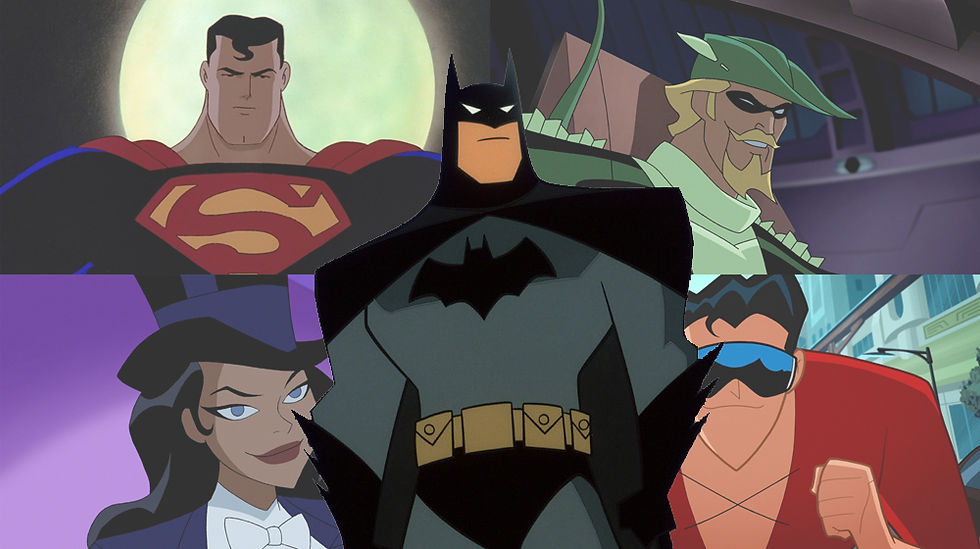
With the floodgates open, Paul Dini then proceeded to summarize the plot of the shelved direct-to-video film on the podcast … and what a story it was. By splicing it together with what I’ve gathered from the above narrative, I believe we can get a clearer view of what would have been a dynamite DCAU movie.

Hell is Other Superheroes
As stated above, this film would have featured a framing device where Alfred Pennyworth would tell Robin (presumably the Tim Drake version) a series of stories about Batman’s team-ups with various superheroes such as Superman, Elongated Man, Green Arrow, and Zatanna. Please bear in mind that, by Dini’s own admission, this was written around 2001, which means that while Superman and Zatanna had been previously established (Superman: The Animated Series [STAS], the BTAS episode “Zatanna”), Green Arrow and Elongated Man would not have been, as production on Justice League Unlimited (JLU) would not begin in earnest until at least 2003, give or take. Had this DTV been pursued, I assume an additional rewrite would have been necessary to bring their characterizations in line with the JLU series.
While we have no idea of the order the segments would appear in in original script, I’m starting with the Man of Steel and the segment whimsically referred to by Dini as “Batman / Superman: When Twerps Collide” in the donated 2008 script. In the aforementioned interview with Batman: The Animated Podcast, he describes the plot thusly:
So, there was a Batman / Superman team-up with Mxyzptlk and Bat-Mite that was a lot of fun. […] Bruce Wayne goes to Clark Kent and says, “I think I’m going nuts.” “Why?” “Well, I’ve been having these hallucinations,” and he explains what they are. And Superman says, “You’re not crazy. It’s a guy. I know the guy.” And it turns out it’s not Mxy doing it—it’s actually his cousin, you know. We made Bat-Mite his cousin, who was a Batman fanboy, and it was just, like, a big “who can outdo each other,” and, you know, they’re causing massive destruction. And Superman and Batman are trying to stop them or outthink them or something. So, there was that, initially. That was the—that was, I guess, a big part of that direct-to-video. (qtd. in Michael, 01:15:36-01:16:25)


Above, left to right: Mr. Mxyzptlk and Bat-Mite destroy Earth-1, and the universe it exists in, in Superman and Batman: World’s Funnest (January 2001).
It should be noted that the story bears a strong resemblance to Superman and Batman: World’s Funnest (January 2001), the one-shot comic story created by writer Evan Dorkin, where Mr. Mxyzptlk and Bat-Mite get into a magic-fueled brawl with each other, kill the Silver Age Superman and Batman, and then go on a Milk and Cheese-style rampage across the DC Multiverse. It is unknown if this was intended as some kind of adaption of the story, though it is worth mentioning here that Dini and Dorkin are friends, and that Dini was responsible for bringing both him and his partner, artist Sarah Dyer, into the DCAU fold as freelance writers for STAS and Batman Beyond (Liu). At the very least, the stakes remain the same, as Dini indicated in a snippet of the script he posted in his aforementioned LiveJournal post:
Mxy’s hands rip the very fabric of reality around them. In a flash, Batman, Superman, Mxy, and Bat-Mite are back at the Fortress of Solitude.
MXY: We’re settling this now!
As Mxy speaks, his face grows more and more maniacal. As we go to a close-up on his now-swirling black eyes, images start to form of stylized, perhaps silhouetted versions of Superman and Batman subjected to one arduous task after another. We see: Superman punching a flurry of meteors out of the sky before they hit the [Earth], Batman desperately dodging sprays of bullets fired from speeding cars on either side of him, Superman struggling to cap an exploding volcano, Batman trying to save kids from a burning building, Superman being smashed to the ground by a giant war robot, Batman punching and kicking one criminal after another. TRUCK OUT on this final image to show Batman is surrounded by an endless flood of criminals as this image turns back into Mxy’s dot-like eye.
MXY (VO): We’re gonna put these costumed gnats through their paces over and over and over again until one or the other drops. I don’t care how long it takes or if we wipe out every being on this plane of reality to do it!
The excited Mxy wipes away the drool running down the side of his mouth, then grins evilly at Bat-Mite.
MXY: You game, cuz?
Bat-Mite shrugs and nods happily.
BAT-MITE: I got no place to be for the next three hundred years. (Dini, “Nonstop”)

However the piece would end, I’m sure it would be explosive, especially considering Dini’s previous experience writing Mxyzptlk on STAS, having worked on the scripts for both “Mxyzpixilated” and “Little Big Head Man.” And as for Bat-Mite, while the character would be a new one for the DCAU, the Batman scribe would go on to write the character in three of the four Bat-Mite episodes on Batman: The Brave and the Bold—including “Legends of the Dark Mite!,” “Bat-Mite Presents: Batman’s Strangest Cases!,” and “Mitefall!”—so the characterization should have remained consistent across series. And finally, assuming the casting would remain the same, watching fifth-dimensional imps voiced by the late Gilbert Gottfried and Paul Reubens fight for forty minutes would be worth the price of admission alone.

Following the battle of the twerps, the next vignette would have featured Zatanna maybe, as Paul Dini recounted on the podcast:
[Next was] Batman and Zatanna, in an actual magic story, against Klarion the Witch Boy. And, uh … you know, it was okay. It was a little weak. […] It was more of kind of like, “Okay, here’s a short one,” but it was … I wouldn’t have made it the same way; I would have dropped that segment out and put in Green Arrow or […] something else because you got magic, magic, magic in the first one; then you got more magic in the second one. (qtd. in Michael, 01:16:29-01:16:54)

As of this writing, there is little information about this segment, though considering Dini’s admission that he may have recycled material from this movie in other places (Michael, 01:17:11-01:17:21), it’s certainly possible that elements of this section found their way into other projects. After all, following their initial BTAS team-up, Dini would partner Bats and Zee again against Circe in the Justice League Unlimited episode “This Little Piggy,” Abra Kadabra in the teaser for the Batman: The Brave and the Bold episode “Chill of the Night!,” and Brother Night in the Justice League Action episode “Speed Demon,” so any of them could be recipients.

As for the Green Arrow portion, Dini provided no information, but the story was adapted (presumably in its entirety) for the aforementioned Batman: The Brave and the Bold episode “Bold Beginnings!” so, for the sake of argument, let’s assume that the plot is the same. This story chronicles the first team-up between the Dark Knight and his most ardent emulator against the Cavalier, who abducts wealthy heiress (and Star City resident) Ruby Ryder in an attempt to steal money from her trust fund. However, the chase to defeat the showy swordsman devolves into a conflict of one-upmanship between them, as the two incredibly similar heroes vie to be first to complete the mission. Of course, the parallels here were not accidental, as recounted in a March 2024 Collider article:
Believe it or not, Green Arrow ripping off Batman is actually DC Comics’ precedent. Back during the character’s earliest adventures, Green Arrow had his own Arrowcar, Arrowsignal, and even his own Arrowcave. […] In fact, even Speedy, Green Arrow’s original sidekick, was a red-suited rip-off of the original Robin. […] But despite the long-time similarities between these two, Green Arrow eventually developed into his own character entirely, one who occasionally took a darker turn than even Batman would dare to go. (Petty)

In retrospect, having the DCAU Green Arrow’s first chronological appearance be in this DTV would have worked pretty well, as it could have established a connection and rapport between himself and Batman. This could also have paid future dividends, particularly in their first official “meeting” in the Justice League Unlimited episode “Initiation,” where the Dark Knight tries to convince the Emerald Archer that the Justice League needs heroes like them to maintain the integrity, perspective, and humanity of the team. But this relationship would have had to start somewhere, and where better than on a mission where they would each be forced to compete with someone that they first saw as an imitator?

(Before we continue, we should acknowledge the cleverness of pairing Batman and Green Arrow against the Cavalier, a Golden Age Batman villain who first appeared in Detective Comics #81 [November 1943]. Like the heroes, he is a wealthy man who chose to embrace a costumed life of adventure, only here as a criminal rather than a hero. Also, like the Zorro-inspired Batman and the Robin Hood-inspired Green Arow, the fact that the Cavalier is “obsessed with 18th century romanticism” and dresses like one of the Three Musketeers is a further parallel between them. Finally, it should be noted that there are uncorroborated claims that the Cavalier was, at one time or another, considered for BTAS, so it is not that great a stretch for Dini and Burnett to dust him off and use him here.)

Finally, there is the fourth segment, which Dini described as “Batman and Plastic Man versus the Ventriloquist” (qtd. in Michael, 01:16:56-01:17:01). As with the Green Arrow story, let’s assume that the original is essentially the same as the one from “Bold Beginnings!,” though as the Ventriloquist and Scarface did not appear in the series, they were replaced by original series’ character Babyface (which works out pretty well, as both characters share the same 1920s gangster patois). In this tale, Plastic Man—in the guise of his former, criminal alias, Eel O’Brian—attempts to infiltrate the criminal’s gang only to get caught, necessitating an assist from the Dark Knight.
Speaking of character substitutions, this narrative conflicts with Tucker’s claims from the October 2011 interview, where he revealed that the segment included the Elongated Man instead of his shape-shifting counterpart, but I have a theory as to the need for a substitution. But first, a necessary aside.

Above, left to right: Plastic Man and Elongated Man, as they appeared in Who’s Who in the DC Universe (1985-1987), and a scene from Justice #8 (December 2006) showing a jealous Ralph Dibny confronting Eel O’Brian.
First appearing in Police Comics #1 (August 1941), Plas began his four-colored life as a Quality Comics character who was later purchased by what would become DC Comics in 1956, when the then-National Comics acquired Quality’s intellectual property and incorporated it into their comics line (Kantor). However, the character did not really hit his stride until the mid-’90s, when writer Grant Morrison added him to the roster of the Justice League in JLA #16 (March 1998), instead of League veteran Elongated Man (first appearance: The Flash #112; May 1960). When questioned about their selection, Morrison offered this explanation:
[T]he reason I want to use Plastic Man is because he’s a guy who doesn’t have his own book, but he’s one of those superheroes where even people who don’t read comics know the name and recognize him. [Since JLA fans] are definitely used to the Elongated Man, I thought, “Well, let’s get the real guy in” (qtd. in Beatty 80-81).
However, despite his newfound fame, it did not translate into an appearance in the DCAU—despite the fact that he once had his own animated series, The Plastic Man Comedy Adventure Show (1979-1981)—though he was referenced as a League member in the Justice League Unlimited episode “The Greatest Story Never Told,” much to the chagrin of Elongated Man. In retrospect, the reason for his omission may have been a combination of factors, such as the character’s rights becoming tied up with Lana and Lily Wachowski (of Matrix fame), who pitched a Plastic Man feature film (Millien) and, later, according to an August 26, 2020 Facebook post by Justice League Producer Dan Riba, he was “optioned […] for a cartoon series by Andy Suriano.” The proposed show, co-created by Suriano and SpongeBob SquarePants voice actor Tom Kenny, was eventually rejected, but the creators of Batman: The Brave and the Bold remembered his voice work as Plastic Man from the pilot and asked him back to reprise his role when the rights became available again (Harris). Given the circumstances, it is perfectly conceivable that Plastic Man may have been the initial choice by Burnett and Dini for this segment but was later replaced by Elongated Man due to rights issues.

Circling back to our earlier topic of reusing discarded concepts in other projects, Dini also revealed that this segment featured a character that he would eventually upcycle during his tenure writing Batman comics years later:
I did wind up borrowing a little bit from that when I wrote Detective Comics, and I gave Scarface to a female Ventriloquist. And so, there was, like, maybe the germ of that in what I did with him later in Detective Comics. […] The direct-to-video was that he had a gang and there was a girl in the gang, and she was flirting with Scarface and, somehow, this was not happening with the Ventriloquist. So, the Ventriloquist was kind of coming on to her, and she was encouraging [Scarface’s] attention, and the Ventriloquist was the odd man out, and it was very weird. But we didn’t do it, and then I thought, later on, “You know, why not a girl [Ventriloquist]? Why not play them like Bonnie and Clyde? And, you know, if they really get rid of Arnold Wesker, as they did in the comics at that time, we could bring in a girl who’s been badly abused and left for dead, and she finds this strong personality in Scarface. (qtd. in Michael, 01:17:58-01:19:03)

Above, left to right: two pages from Detective Comics #844 (July 2008) featuring the origin of the new Ventriloquist, and two pages from Detective Comics #827 (March 2007) featuring her debut on the streets of Gotham.
Following the death of the first Ventriloquist, Arnold Wesker, in Detective Comics #818 (June 2006), Paul Dini took his opportunity when he began writing Detective months later and, in the background of his stories, he created Peyton Riley, the daughter of an Irish crime boss who was married to the son of an Italian gangster in an attempt to form an alliance. Unfortunately, her husband was abusive, and when he unsuccessfully attempted to kill her, she found Wesker’s remains and took Scarface as her own. Making her first appearance in Detective Comics #827 (March 2007), she cut a formidable swath of terror across Gotham City until she faded into the comics background. While the character from this DTV would probably have been nothing like Riley, it is interesting how the germ of a good idea can percolate and develop into something better over time.

That’s All, Folks!
After those comments, the podcast’s conversation shifted to other topics, so there was no follow-up pertaining to Robin’s initial conflict with Batman or how the film itself would end but, at the very least, this narrative does encapsulate how the DTV would most likely have played out. However, in regard to its demise, Dini was forthcoming in a somewhat self-depreciatory manner:
It was fun; it was never produced. I think little ideas got cannibalized and used in other things or split up or just abandoned altogether and stuff like that. It would have been fun but, again, it didn’t have the coherent quality of SubZero or Mask of the Phantasm. It really, when you put it all together—as much as I like the individual segments—it really came off across sort of a pot boiler, you know, like we strung three things that weren’t episodes into … we had sort of taken the set pieces from three different episodes and strung them together. (qtd. in Michael, 01:17:09-01:17:46)
While I appreciate his candor, I’m not sure I agree with the sentiment, as—based on his description—the screenplay may not have necessarily been low quality. After all, another script he wrote that featured “the set pieces from three different episodes” that he strung together was the BTAS episode “Almost Got ’Im,” which IGN rated as the best episode of the series after “Heart of Ice” (Wheatley). Considering that the writers were Paul Dini and Alan Burnett, two of the writers most responsible for making BTAS the iconic series that it is today, I’m certain that the material would have been exemplary had the project been approved and polished by Warner Bros. Animation.
That said, there is one issue remaining as, in the over twenty-year period that Dini has referenced this script, he’s never mentioned its actual title. After all, “the unnamed Batman team-up DTV movie” is a little unwieldly. With apologies to James Tucker, I can think of no better name than Batman: The Brave and the Bold, which references the long-running comic book anthology that evolved into a Batman team-up book beginning with The Brave and the Bold #74 (November 1967). Considering how this project would have most likely premiered before Tucker’s wonderful animated series, it’s possible that he would have had to choose a different title.
Works Cited
Allstetter, Rob. “Briefly.” Comics Continuum. 26 Jan. 2001. <http://www.comicscontinuum.com/stories/0101/26/index.htm>. Accessed 18 Dec. 2022.
---. “Paul Dini Previews Justice League.” Comics Continuum. 25 Nov. 2003. <http://www.comicscontinuum.com/stories/0311/25/pauldini.htm>. Accessed 3 Jan. 2023.
Archie. “Paul Dini.” The Warner Bros. Animation Archive. n.d. <http://wba.toonzone.net/dini/>. Accessed 31 Aug. 2022.
Beatty, Scott. “Initiating Justice.” Wizard JLA Special. 1998: 78-83. Print.
“Bold Beginnings!” Batman: The Brave and the Bold. Season 3, Episode 9. Warner Bros. Animation. 14 Oct. 2011. HBO Max. <https://play.hbomax.com/video/watch/28189442-32ca-4703-97aa-80e98bd4e433/3824cf73-3771-4719-9ab6-075426244487>. Accessed 9 Jul. 2026.
b.t. Comment on “Paul Dini Talks About the Animated DC Shows.” Anime Superhero. 10 Nov. 2004. <https://animesuperhero.com/forums/threads/paul-dini-talks-about-the-animated-dc-shows.3751361/#post-55861861>. Accessed 12 Sept. 2023.
Dini, Paul. “All Good Things…” Internet Archive. 9 Jun. 2004. <https://web.archive.org/web/20040609085516/http://www.jinglebelle.com/news.html>. Accessed 9 Jul. 2026.
---. “Nonstop Nonsense.” LiveJournal. 15 Sept. 2008. <https://kingofbreakfast.livejournal.com/84776.html>. Accessed 9 Jul. 2026.
Franklin, Garth. “Paul Dini Gives ‘Lost’ Spoilers.” Internet Archive. 6 May 2006. <https://web.archive.org/web/20060506034201/http://www.darkhorizons.com/news04/041109d.php>. Accessed 24 Sept. 2023.
Harris, Will. “Tom Kenny.” Internet Archive. 11 Mar. 2014. <https://web.archive.org/web/20140311142316/http://www.avclub.com/article/tom-kenny-59920>. Accessed 10 Jul. 2026.
Harvey, James. “Producer James Tucker Discusses New ‘Batman: The Brave and the Bold’ Episode.” Internet Archive. 16 Oct. 2011. <https://web.archive.org/web/20111016033023/http://www.worldsfinestonline.com/news.php/news.php?action=fullnews&id=1152>. Accessed 9 Jul. 2026.
Kantor, Jonathan. “20 Strange and Stretchy Facts About DC’s Plastic Man.” Comic Book Resources. Valnet, Inc. 27 Dec. 2018. <https://www.cbr.com/plastic-man-everything-to-know-dc/>. Accessed 10 Jul. 2026.
Kindred, Christopher. “Fox Moves Batman to Saturday Morning.” Animato!: The Animation Fan’s Magazine. Fall / Winter 1993: 29-34. Print.
Lamken, Brian Saner. “Justice for All (Or, a League of His Own).” Comicology. Spring 2000: 24-25. Print.
Liu, Edward. “Evan Dorkin & Sarah Dyer.” The World’s Finest. 6 Sept. 2006. <https://dcanimated.com/WF/superman/backstage/interviews/dorkindyer.php>. Accessed 24 Aug. 2022.
Maestro (DMcDuffie). Untitled. Dwayne McDuffie. JohnCompanies, Inc. 24 Feb. 2010. <http://dwaynemcduffie.com.lamphost.net/forums/viewtopic.php?p=20588#p20588>. Accessed 19 Feb. 2011.
Michael, Justin, host. “Harley’s Holiday.” Batman: The Animated Podcast, featuring Paul Dini. Apple Podcasts. 25 Nov. 2015. <https://podcasts.apple.com/us/podcast/21-harleys-holiday-paul-dini-cheyenne-curtis/id964103963?i=1000357784858>. Accessed 8 Jul. 2026.
Millien, Mark. “What Happened to the Wachowskis’ Plastic Man Movie with Keanu Reeves?” Comic Book Resources. Valnet, Inc. 28 Feb. 2022. <https://www.cbr.com/wachowskis-plastic-man-movie-keanu-reeves/>. Accessed 10 Jul. 2026.
Petty, Michael John. “‘Arrow’ Started as a Batman Ripoff, but Changed for the Better.” Collider. Valnet, Inc. 10 Mar. 2024. <https://collider.com/arrow-batman-stephen-amell/>. Accessed 10 Jul. 2026.
Renaud, Jeffrey. “Comics Royalty Team-Up to Save Superman Creator’s House.” Internet Archive. 17 Oct. 2019. <https://web.archive.org/web/20191017035058/https://www.cbr.com/comics-royalty-team-up-to-save-superman-creators-house/>. Accessed 9 Jul. 2026.
---. “Meltzer Thanks Comics Community for Saving Siegel House.” Comic Book Resources. Valnet, Inc. 6 Oct. 2008. <https://www.cbr.com/meltzer-thanks-comics-community-for-saving-siegel-house/>. Accessed 9 Jul. 2026.
Riba, Dan. “Well at least Plasticman was mentioned…” Facebook. 26 Aug. 2020. <https://www.facebook.com/photo/?fbid=10151806661372527&set=a.10150962835367527&comment_id=10158426147752527>. Accessed 10 Jul. 2026.
“Siegel & Shuster Society Charity Auction.” Internet Archive. 22 Sept. 2008. <https://web.archive.org/web/20080922011917/http://www.ordinarypeoplechangetheworld.com/page/siegel-and-shuster-society-auction.aspx>. Accessed 9 Jul. 2026.
Smith, Kevin, host. “The Dini Dossiers, Part 3.” Fatman on Batman, featuring Paul Dini. SModcast. 13 Dec. 2012. MP3 file. Created 24 Dec. 2012.
Wharton, David Michael. “Wizard World Texas: Paul Dini Brings ‘Comfort and Joy’ to Justice League.” Internet Archive. 23 Nov. 2003. <https://web.archive.org/web/20060625121002/http://www.comicbookresources.com/news/newsitem.cgi?id=2986>. Accessed 5 Jan. 2023.
Wheatley, Cliff. “Top 10 Batman: The Animated Series Episodes.” IGN. IGN Entertainment, Inc. 16 Aug. 2021. <https://www.ign.com/articles/2017/09/05/top-10-batman-the-animated-series-episodes>. Accessed 11 Jul. 2026.
Images courtesy of Prime Video, Warner Bros. Discovery, Warner Bros. Home Entertainment, Warner Bros. Animation, DC Comics, and Paul Dini.


Comments