


CASE FILES - Justice League's "Legends, Part 2"

Updated: Sep 19
NOTE: This article obviously contains SPOILERS. Proceed at your own risk!

This is Part 2 of a two-part episode review. To read Part 1 of the review of “Legends,” please click here.
Stray Observations
While it is true that there was both a crossover event called Legends (1986-1987) and an ongoing series called Legends of the DC Universe (1998-2001), the title of this episode, “Legends,” is most likely being used as an honorific meant to convey respect to the Justice Guild and, through them, the Justice Society of America.
As stated previously, while not adapted from any specific storyline, “Legends” draws influence from the numerous “Earth-1 / Earth-2” team-ups from the Silver and Bronze Ages of comics.


Above bottom, left to right: the Evangelion mechas, and Bruce Timm illustrations of Asuka Langley Soryu and Rei Ayanami. Images courtesy of Noriko Kobayashi (TV Tokyo) and Bruce Timm.
The episode begins with the Justice League fighting a giant robot on the streets of Metropolis. Its design was heavily influenced by the anime series Neon Genesis Evangelion (1995-1996) or, more specifically, the piloted Evangelion biomechanical humanoid mechas (“Commentary,” 00:12:54-00:13:00; Eisenberg and Enstall, 00:44:50-00:44:55). It would appear that Bruce Timm is a fan of the program, if his above illustrations of Asuka Langley Soryu (pilot of EVA Unit-02) and Rei Ayanami (pilot of EVA Unit-00) are any indication.


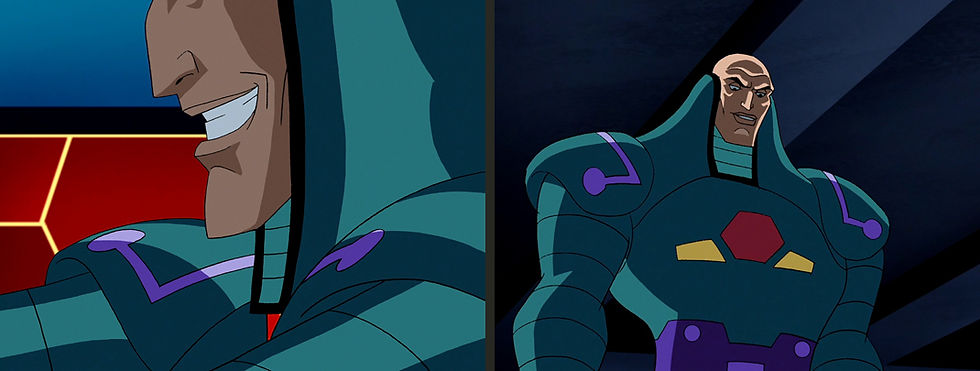
Above bottom, left to right: the maximum amount of Lex Luthor’s face that we see in “Legends,” and Lex Luthor in his power suit, as seen in “Injustice for All.”
Unbeknownst to the Justice League, the robot is being piloted remotely by Lex Luthor in, based on broadcast order, what is technically his first appearance on the series. As stated previously, due to “the vagaries of network programming” (Allstetter, “Justice League’s ‘Fury’”), this episode aired five months before “Injustice for All,” which was supposed to be his first appearance based on production order. Unfortunately, due to the lack of a proper introduction, it is certain that his unidentified cameo wearing unfamiliar armor resulted in confusion among the portion of the audience unfamiliar with the source material.
In reference to Luthor’s silent appearance, Dan Riba compared it to John Hollis’ performance as the unnamed Ernst Stavro Blofeld in the James Bond film For Your Eyes Only (1981), where they couldn’t officially use him due to rights issues. He would elaborate on the cameo in the aforementioned March 19, 2024 installment of the Justice League Revisited podcast:
I was watching again, and I realized that we kind of played him like Blofeld. We played Lex sort of like, you know, [Dr. Claw in] Inspector Gadget. It’s just like you’re just seeing body parts and […] I realized, “Oh, I think because we didn’t have Clancy, he had no dialogue.” […] If we had really shown him up too much, it would have called attention to the fact that he doesn’t speak. So, we just kind of like … we just kind of Blofeld him a little bit. (qtd. in Eisenberg and Enstall, 00:45:41-00:46:12)
Considering the massive cast for this episode, it is possible that there simply was not enough money in the budget to bring Clancy Brown in to do only one or two lines, so he was used in a silent capacity, with one of the other actors supplying his electrocution groans.
Supporting my argument about budgetary constraints is the fact that Batman also had no lines of dialogue, while Superman had two for the entire episode.


With Green Lantern, Hawkgirl, and J’onn J’onzz knocked unconscious during the battle, the Man of Steel manages to rip open the robot’s casing, allowing the Dark Knight to precisely throw a Batarang into its reactor, disabling the machine.


In its final throes, Luthor’s mecha unfortunately pitches back on its feet and threatens to fall on the unconscious trio. Seeking to save his friends, the Flash attempts to create a tornado to slow and hopefully prevent the robot from crushing them. However, an explosion occurs, causing it, the teammates, and quite a bit of the immediate vicinity to disappear.

Unable to provide assistance, the World’s Finest duo can only survey the resulting damage from afar. In the aforementioned March 19, 2024 installment of the Justice League Revisited podcast, Dan Riba discussed how the creative team deliberately tried to make the devastation different from real-world events: “[w]e had just gone through 9/11, and we didn’t want to reflect on anything that looked real. So, when that robot gets destroyed, we wanted to make that destruction look fantastic and science fiction-y and not remotely resembling Ground Zero” (qtd. in Eisenberg and Enstall, 00:53:15-00:53:34).

Waking up somewhere that is not Metropolis, the fantastic foursome survey their surroundings. It is worth noting here that “Legends” is the first episode of the series to not prominently feature Superman, Batman, or Wonder Woman. Since that trio is often referred to as the Trinity, should this assembly get their own nickname? The B-Team? GL’s Kooky Quartet?
Speaking of John Stewart, in the absence of Superman and Batman, this is the first episode where Green Lantern naturally assumes leadership of the team. Over this series, he would excel in this capacity to the point where, when Wonder Woman herself assumed more of a leadership role in JLU, the Trinity became more of a Quadrinity.
Compare the above left image to the previous one showing the absence of street and several floors of multiple buildings. First off, it appears that Luthor’s robot did not actually explode, as it is still largely in one piece, and the debris that would be expected from the destruction in Metropolis is just … gone. The only remains here are from the damaged street and buildings where the mecha landed. Perhaps the explosion seen was more the result of a tear in the fabric of space-time, allowing the robot and heroes to shift into a parallel reality.


Attempting to telepathically reach out to their allies, J’onn is overwhelmed by apocalyptic visions. Among the clips used here include scenes from “Secret Origins” and “In Blackest Night.”


In regard to Seaboard City’s design, Bruce Timm had this to say in the aforementioned DVD commentary for “Legends, Part Two”:
I remember we had a hard time coming up with what’s the city going to look like, and we decided to kind of make it look like the old comic books in terms of the buildings being just very boxy and very stripped down, and the color palate—we didn’t want to go complete comic book color with it; we didn’t want to have, like, you know, purple buildings and yellow skies and stuff. We wanted it to be somewhat believable, but it clearly is a much brighter, pastel world than what we were used to doing in our show. […] Even their color palette is a little bit brighter than even what we were doing. I always complained that our first season color palette was too bright anyways, but for the Justice Guild guys, it’s brighter still. It’s even more bright. (qtd. in “Commentary,” 00:10:20-00:11:30)
Based on the small-town vibe, I can’t shake the feeling that Seaboard City may have been at least partially based on Happy Harbor, Rhode Island, with the Injustice Guild’s ocean-adjacent mountain hideout filling in for the Secret Sanctuary, the Justice League of America’s first headquarters.
Splitting up to attempt to get their bearings, Green Lantern experiences déjà vu while exploring this decidedly not-Metropolis location. This is compounded after being passed by a vintage ice cream truck playing the traditional old English song “Pop Goes the Weasel.”
It is worth noting that this is the second use of “Pop Goes the Weasel” in a DCAU episode, as it was the song played by Titano’s stuffed toy in the STAS episode “Monkey Fun.”
“Pop Goes the Weasel” is also a recurring musical leitmotif in the cult television series The Prisoner (1967-1968). An example of its use can be found in the above video, beginning at the 00:09:47-00:10:12 section.

Above left: the Fiddler, as he appeared in Who’s Who in the DC Universe (1985-1987). Above right, top: the Music Master, as he appeared in “Legends.” Above right, bottom: the Fiddler, as he appeared in “Flash and Substance.”
Conveniently robbing the Seaboard City Music Center near where Green Lantern and Flash are standing is the Music Master, an analogue for the classic DC Comics villain the Fiddler. First appearing in All-Flash #32 (December 1947-January 1948), the character shares Music Master’s gimmick, which is creating destructive vibrations with his musical instrument of choice. However, instead of using a violin, Music Master has chosen to weaponize the accordion.
Music Master was voiced by the late German actor Udo Kier, who appeared in over 200 roles during his lifetime, including Flesh for Frankenstein (1973), Blood for Dracula (1974), Blade (1998), and numerous films by noted Danish director Lars von Trier.
It should be noted that the Fiddler would make his own appearance on Justice League Unlimited, specifically in the episode “Flash and Substance” as a patron of “this little hole-in-the-wall on Fourth Street.”

The item stolen by the Music Master is identified as a Stradivarius, a type of string instrument created by either Antonio Stradivari (1644-1737) or his family; these instruments are considered by many to be the finest violins ever created and, as a result, incredibly valuable collector’s items. In Villains United #1 (July 2005), Deadshot identifies the Fiddler’s “fiddle” as a genuine Strad.
The Music Master’s robbery mirrors one by the Fiddler in Comics Cavalcade #28 (September 1948), where he attempted to steal an entire collection of them (for more information, see here).


When Green Lantern steps in to stop the robbery, the Music Master has a moment of genuine perplexity as he attempts to register this unknown figure who possesses the powers of Green Guardsman. In the end, he gets away, but without the Strad.

Above left: the Golden Age Atom, as he appeared in Who’s Who in the DC Universe (1985-1987). Above center, top: Tom Turbine, as he appeared in “Legends.” Above center, bottom: the Silver Age Atom, as he appeared in “The Return.” Above right: Tom Strong, as he appeared on the cover of Tom Strong #1 (June 1999).
Confusing Green Lantern and the Flash for thieves, Tom Turbine is the first hero on the scene. This Justice Guild member is an analogue for Al Pratt, the Golden Age Atom, who first appeared in All-American Comics #19 (October 1940). A shorter hero than his contemporaries, the Atom originally had no super-powers, but he later acquired them during a fight with a supervillain named Cyclotron (created by Roy Thomas). It appears that Tom Turbine wears a small cyclotron on his belt, which is the source of his abilities.
Maybe it’s me but, compared to the other Justice Guilders, Tom Turbine appears to have more of a pulp hero / Doc Savage vibe to him. In addition, Tom shares a first name with Alan Moore’s own analogue pulp hero, Tom Strong, who first debuted in 1999. I don’t think that was by accident.
Tom Turbine was voiced by actor Ted McGinley, who is best known for playing Stan Gable in Revenge of the Nerds (1984) and Jefferson D’Arcy on Married…with Children (1987-1997).
It should be noted that the Silver Age Atom, Ray Palmer, would later make his own appearances on Justice League Unlimited, most notably in the episodes “The Return” and “Dark Heart.”

In addition to the above, Tom Turbine possesses the same perpetually squinting eyes that the Golden Age Superman had.

From a production standpoint, Tom Turbine is the second Atom-related character to appear in the DCAU, as the character Micron first appeared in the Batman Beyond episode “The Call.” When asked about whether the character that would develop into Tom Turbine was anything like Micron in a December 24, 2001 interview with Anime Superhero (formerly Toon Zone), Bruce Timm responded how “[o]ur ‘Atom’ analogue will not look anything like [Justice League Unlimited’s] Micron. Sorry, but you’re way off base there, pal! Remember: Golden Age Atom. Micron was a futurized version of the Silver Age Atom. His actual look is kinda hard to describe. You’ll just have to wait and see!” (qtd. in Harvey, “Justice”).

Finally, it should be noted that, while the Golden Age Atom never appeared in the DCAU himself, his godson Al Rothstein did appear as Atom Smasher, a frequent supporting character, during Justice League Unlimited.


Above top left: Wildcat, as he appeared in Who’s Who in the DC Universe (1985-1987). Above top right, top: Cat Man, as he appeared in “Legends.” Above top right, bottom: Wildcat, as he appeared in “The Cat and the Canary.” Above bottom: a Cat Man turnaround model sheet from Justice League, illustrated by character designer Glenn Wong.
After depowering Tom Turbine, Green Lantern is attacked by Black Siren and Cat Man. The latter Justice Guild member is an analogue for Wildcat, who first appeared in Sensation Comics #1 (January 1942). A professional heavyweight boxer, Wildcat became a crimefighter to clear his name after being falsely accused of murdering another boxer in the ring. In post-Crisis continuity, he is also a former trainer and mentor to Black Canary, Catwoman, and Batman himself.
Cat Man was played by character actor Stephen Root, who has performed in movies such as Office Space (1999), O Brother, Where Art Thou? (2000), and Get Out (2017); as well as Jimmy James on NewsRadio (1995-1999) and the voices of Bill Dauterive and Buck Strickland on King of the Hill (1997-2009, 2025-present). In a March 19, 2002 interview on the now-defunct Comics2Film website, fellow voice actor Corey Burton spoke favorably of his costar:
He was in NewsRadio, Office Space, and O Brother, Where Art Thou? Three totally different characters; three totally hilarious and captivating characterizations. What a fantastic character actor. He’s FUN-NY. And, at the same time, so distinctive. He never does anything you’ve seen anyone do before. He’s one of those totally dedicated character actors who really does his homework and really invests. They don’t come any better these days. (qtd. in Yukinori)
It should be noted that Wildcat would later make his own appearances on Justice League Unlimited, most notably in the episode “The Cat and the Canary.”

As stated by Bruce Timm previously, Cat Man serves as “a Batman / Wildcat hybrid” (qtd. in Harvey, “Bruce”), but he strikes me more like the Adam West Batman from the campy Batman series (1966-1968).

Above, left to right: the Thomas Blake Catman, as he appeared in Who’s Who in the DC Universe (1985-1987); the Thomas Blake Catman, as he appeared on the cover of Villains United #4 (October 2005); and the unrelated, Golden Age Cat-Man—with his sidekick, Kitten—as he appeared on the cover of Cat-Man Comics #18 (July 1943).
Of the naming of the Justice Guild characters, it would appear that calling the Wildcat analogue character “Cat Man” proved uniquely challenging. Now, it is true that DC Comics has a Catman character—real name Thomas Blake—who first appeared in Detective Comics #311 (January 1963). Originally a Silver Age footnote, he was revitalized by writer Gail Simone for her Secret Six titles, beginning with Villains United #1 (July 2005). However, there was also a Golden Age Cat-Man, who was created by Irwin Hasen and an unknown writer (Thomas and Conway) who first appeared in Crash Comics Adventures #4 (September 1940) by Holyoke Publishing. While the latter is considered public domain, DC Comics wanted to make sure that they were legally protected, so they specifically made sure that Cat Man’s headstone read as “T. Blake” later in the episode, as Dan Riba revealed in the aforementioned March 19, 2024 installment of the Justice League Revisited podcast:
There is a legal aspect to it; a DC kind of thing. It wasn’t like the scene is there because of an edict, but it helped us in a way because there is a Catman, who is a villain that DC owns, but there was also a Cat-Man that was a hero character that […] may be in public domain, and it may not be and who knows what. But because DC owns a guy named Catman, we had to put his name, that character who is technically a villain in the comics, but we put his name on that grave so that they could legally protect themselves and say, “No, we’re not—even though it’s supposed to be a cipher for Wildcat.” But it was, you know, we didn’t have to; it was best not to make up a name, just use the name that they owned already. (qtd. in Eisenberg and Enstall, 00:22:53-00:23:40)
It should be noted that, in addition to the Golden Age Cat-Man, Irwin Hasen is also credited as co-creator of Wildcat with Bill Finger, effectively making this character a double tribute to Hansen.

Of course, it should be noted that this would make the second appearance of a Thomas Blake in the DCAU, as a more villainous version of the character first appeared as the leader of a cat-worshiping cult in the TNBA episode “Cult of the Cat.”

Above left: the Black Canaries, as they appeared in Who’s Who in the DC Universe (1985-1987). Above right, top: Black Siren, as she appeared in “Legends.” Above right, bottom: Black Canary, as she appeared in “The Cat and the Canary.”
As for Justice Guild member Black Siren, she is an analogue for Black Canary, whose Golden Age version first appeared in Flash Comics #86 (August 1947) and whose Silver Age version first appeared in Justice League of America #75 (November 1969). Originally a resident of Earth-2, the original Black Canary immigrated to Earth-1 and later, due to a needlessly complicated 1983 comic book plot co-written by Roy Thomas, her previously unseen daughter took her place.
Black Siren was voiced by prolific voice actor Jennifer Hale. In the DCAU alone, she has voiced Gsptlsnz in the STAS episode “Little Big Head Man,” Jessie in the Batman Beyond episode “Hooked Up,” and Sroya Bashir, Inza, Giganta, Killer Frost, Zatanna, and Bernadeth on Justice League and JLU.
It should be noted that Black Canary would later make her own appearances on Justice League Unlimited, most notably in the episodes “The Cat and the Canary,” “Double Date,” and “Grudge Match.”
Shameless promotion: I have previously written about the multiple, unsuccessful attempts to adapt Black Canary for the DCAU prior to her first appearance on JLU. To read, please click here.

Originally a character created for the Justice League series, a Black Siren would later be adapted for the aforementioned CW series Arrow (2012-2020) and The Flash (2014-2023). In this incarnation, she is a villainous, Earth-2 version of Black Canary. She was played by actor Katie Cassidy, who also portrayed Black Canary on Arrow.

Fortunately for Green Lantern, J’onn J’onzz and Hawkgirl arrive. Upon seeing their combatants, J’onn deadpans, “It seems we are not in Metropolis anymore,” referencing Dorothy’s famous line from The Wizard of Oz (1939).

Above left: the Golden Age Green Lantern, as he appeared in Who’s Who in the DC Universe (1985-1987). Above right: the Green Guardsman, as he appeared in “Legends.”
Striking from above with a giant, green jackhammer, John Stewart comes face-to-face with the Green Guardsman, an analogue for the Golden Age Green Lantern, Alan Scott. First appearing in All-American Comics #16 (July 1940), this Green Lantern was unconnected to the Green Lantern Corps, as he became the recipient of an ancient lantern constructed from a meteorite inhabited by a mystical “green flame.”

The Green Guardsman was voiced by actor William Katt, best known for portraying Ralph Hinkley in the television series The Greatest American Hero (1981-1983). A superhero series about a teacher who receives a super-suit from aliens but must learn how to use its powers via trial and error, the character’s last name was soon changed to “Hanley” after John Hinckley, Jr.’s assassination attempt of President Ronald Reagan on March 30, 1981.
William Katt’s performance as Green Guardsman was remembered fondly by the cast, with Corey Burton recalling how “[h]e carried that off so well … for something that could’ve been so corny. […] He was rather quiet and reserved, but he has a heroic quality, as well as a politeness about him. I think that works really well for the character he played” (qtd. in Yukinori). And as for Green Lantern voice actor Phil LaMarr, he acknowledged him as an “iconic, on-camera actor,” adding how “he’s the only one of us playing a hero in here who’s worn a suit!” (qtd. in Eisenberg and Enstall, 00:26:51-00:27:07).

I suspect that Green Guardsman’s white hair may be a reference to Hal Jordan’s “graying temples” look, which began appearing in Green Lantern #1 (June 1990). An attempt at the time to portray Jordan as an older hero, this was retroactively explained away in Green Lantern: Rebirth #3 (February 2005) as being caused by the influence of the fear entity Parallax.

Above left: the Golden Age Flash, as he appeared in Who’s Who in the DC Universe (1985-1987). Above right: the Streak, as he appeared in “Legends.”
Coming to after getting socked in the jaw by Tom Turbine, the Flash attempts to join the fray, only to be blindsided by the Streak, an analogue for the Golden Age Flash, Jay Garrick. First appearing in Flash Comics #1 (January 1940), this Flash gained his abilities by inhaling “hard water vapors” at a laboratory he worked at.
The Streak was voiced by actor and singer David Naughton, who is best known for performing in films such as Midnight Madness (1980) and An American Werewolf in London (1981). In addition, he was a regular pitchman in the long-running “Be a Pepper” Dr. Pepper ad campaign, which ran from 1977 to 1981 (Alter).
In the aforementioned interview on the now-defunct Comics2Film website, Corey Burton also spoke of his fondness for the actor:
I’ve always had a warm spot in my heart for David’s work even before [An American Werewolf in London]—with his Dr. Pepper commercials. […] He was so sensational on those commercials, I couldn’t help but admire such a great, old-fashioned song-and-dance kinda guy. Such great energy. [The ads] were just short of being too corny, but he didn’t cross that line. And American Werewolf—he was great in that. I’ve always felt that he’s a talent that’s been pretty underutilized all these years. (qtd. in Yukinori)

Finally, watching the battle from across the street, is Ray Thompson, voiced by the aforementioned Neil Patrick Harris. An original character, Ray was created for the show because the Justice Society never had a “kid sidekick” of their own (“Commentary,” 00:06:04-00:06:21). In his way, he represents all team mascots of the era, such as Snapper Carr (the Silver Age Justice League), Rick Jones (the Avengers), Robin (the aforementioned 1960s Batman series), Wendy and Marvin (Super Friends), and the like.

Fight scene! This altercation stems from the same type of misunderstanding that triggers the majority of brawls between superheroes. It’s almost as if each introduction between characters requires a certain “punching each other” feeling-out period before they bond.

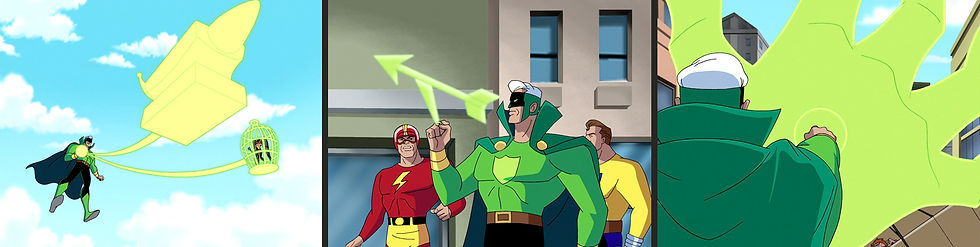
It is worth noting that—unlike Green Lantern, who is more apt to use his power ring to create simple energy beams and barriers (at this point in the series)—Green Guardsman often uses his power ring to create more elaborate constructs such as jackhammers, anvils, and giant hands, much like Green Lanterns in the comic books do.


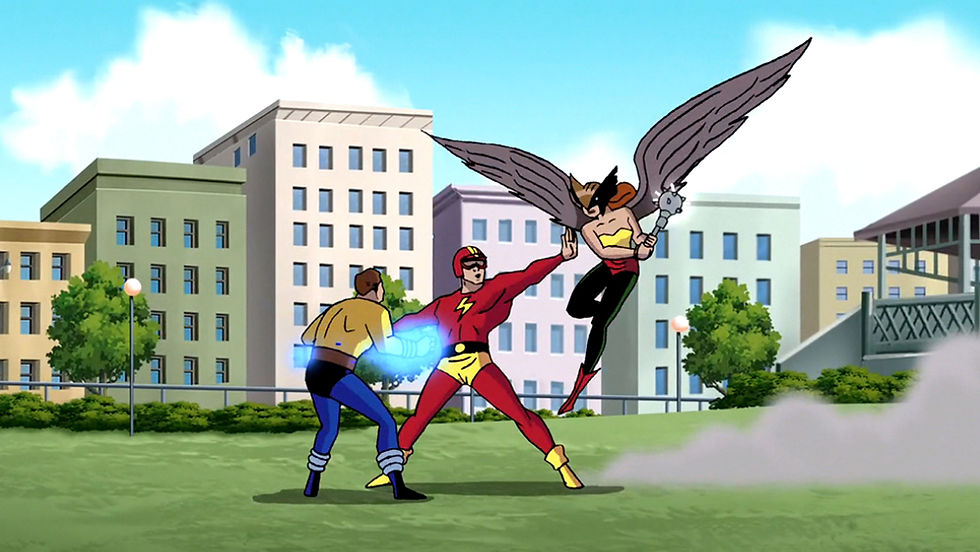
During the battle, Tom Turbine knocks J’onn J’onzz into a nearby building, causing debris to rain down on Ray Thompson and prompting the Flash to rescue him. Seeing an opponent save their sidekick, the Streak breaks up the fight.
Knowing what we know at the end of the episode, I wonder if any bystanders watching the fight saw Ray get rescued and thought, “Damn. Almost got ’im.”

The misunderstanding behind them, the Justice Guild invites the League to their headquarters, a mansion virtually identical to the one the Joker purchased in the TNBA episode “Joker’s Millions.”
In addition to the above, the Justice Guild’s residence may also be a reference to Avengers Mansion, which first appeared in Avengers #2 (September 1963).

Introducing themselves to the League while sitting around their meeting table, this scene with the Justice Guild is obviously an homage to the cover of All-Star Comics #3 (December 1940).
It is worth noting here that, in the aforementioned DVD commentary for “Legends, Part Two,” it was revealed that Bruce Timm was responsible for the designs of the Justice Guild characters, though James Tucker “took a pass on some of the heroes too” (qtd. in “Commentary,” 00:05:11-00:05:27).

Suddenly, J’onn J’onzz is struck by a bout of dizziness, similar to an earlier moment where he attempted to use his telepathic powers to contact Superman and Batman. This is most likely due to his close proximity to Ray Thompson.

The scene with Black Siren asking Hawkgirl to help her get milk and cookies under the pretense of “letting the men talk” is no doubt a reference to how undervalued female superheroes were considered to be in the old comics. Even Wonder Woman was only utilized as an “honorary member” and team secretary in the Justice Society of America despite the fact that she was easily the most powerful.
In reference to Hawkgirl’s response that “they can talk all they like,” Dan Riba recalled in a 2024 interview how “[i]t was hard not to laugh at the record for that because, yeah, that was very, very funny” (qtd. in Eisenberg and Enstall, 00:44:28-00:44:34). Regarding her character, Black Siren, Jennifer Hale joked that “I love that she can, you know, fight crime, bake cookies, but not speak up in a meeting” (qtd. in Eisenberg and Enstall, 00:14:46-00:14:50).

Observing the Justice Guild interact with each other from across the room, Green Lantern confides in the Flash that he recognizes the team from the comic books of his childhood and, by reading them, he learned the necessary lessons on heroism that may have contributed to his becoming a Green Lantern.
While admitting the fact that his character being a comic book fan like him was a coincidence (Eisenberg and Enstall, 00:09:27-00:09:32), Phil LaMarr did admit in a 2024 interview how this character trait influenced his performance of the character:
Well, I mean, [“Legends”] is a really significant episode to me on a couple of levels. One, because it drew a connection between me and my character—we’re both comic book fanboys—but, also, it added a layer of background to the character. It’s like, what a superhero did in their childhood other than Batman is never ever told. So, that helped me. It’s like, “Okay, good. I know what that layer of his personality is going forward.” (qtd. in Eisenberg and Enstall, 00:38:38-00:39:19)

Meanwhile, in their mountainous headquarters, the Injustice Guild of America meets to discuss the sudden appearance of the Justice League. The Injustice Guild is an analogue for the equally-imaginatively named Injustice Society of the World, who made their debut in All-Star Comics #37 (November 1947). They were essentially the Legion of Doom of their day.

In the Injustice Guild’s meeting room appears to be a portrait of Vandal Savage, which could mean that a variant of him exists (or once existed) in this reality. A member of the aforementioned Injustice Society, he first appeared in Green Lantern #10 (December 1943). Of course, he would soon make his own Justice League debut in “The Savage Time,” itself a Golden Age period piece.
It should be noted here that, while Bruce Timm largely designed the Justice Guild heroes, it was James Tucker who designed the Injustice Guild villains (“Commentary,” 00:05:28-00:05:34; kyerkes98). In the aforementioned April 19, 2002 Comics Continuum interview, Rich Fogel referred to them as “some of our most outlandish and colorful villains ever” (Allstetter, “Justice League’s ‘Legends’”).

Above left: the Sportsmaster, as he appeared in Who’s Who in the DC Universe (1985-1987). Above center, top: the Sportsman, as he appeared in “Legends.” Above center, bottom: the Sportsmaster, as he appeared in “The Cat and the Canary.” Above right: the Penguin, as he appeared in Who’s Who in the DC Universe (1985-1987).
Rebuking the Music Master for his failed robbery is the Sportsman, an analogue for the Sportsmaster. First appearing in All-American Comics #85 (May 1947), Lawrence “Crusher” Crock was a frequent foe of both Wildcat and the Golden Age Green Lantern.
Maybe it’s just me, but there’s something about the Sportsman’s facial features that remind me of the classic Penguin as well.
The Sportsman was performed by actor and comedian Michael McKean, who is best known for playing Lenny Kosnowski on Laverne & Shirley (1976-1983), as well as characters in films such as This is Spinal Tap (1984), Clue (1985), Airheads (1994), and Best in Show (2000), among many others.
It should be noted that the Sportsmaster would later make his own appearances on Justice League Unlimited, most notably in “The Cat and the Canary” and “The Great Brain Robbery.”

Above left: the Icicle, as he appeared in Who’s Who in the DC Universe (1985-1987). Above right: Dr. Blizzard, as he appeared in “Legends.”
Confronting the Sportsman in an attempt to end his tirade is Dr. Blizzard, an analogue for the Icicle. First appearing in All-American Comics #90 (October 1947), he was another adversary of Green Lantern.
Dr. Blizzard was voiced by prolific voice actor Corey Burton. Specifically in reference to the DCAU, he is best known for providing the voice for Brainiac on STAS, Justice League, JLU, and Static Shock; in addition, he has also performed Forager, Sonar, and the Key on Justice League and JLU as well.
In the aforementioned March 19, 2002 interview on the now-defunct Comics2Film website, Burton admitted that he did not audition for Dr. Blizzard, and that he most likely received the part due to his performances as Brainiac. He described his time recording for “Legends” thusly:
Andrea [Romano] would ask me, “What were you thinking for this character? We were thinking of a voice like this and so-and-so … but let’s hear what you got first.” Andrea is such a pro. She knows us [voice actors] very well, and knows our “bag of tricks,” so to speak. So, together, we’re usually pretty quick to arrive at the actual characterization. Plus, on these cartoons, they try to keep it very theatrical film, very underplayed—especially because they work with so many theatrical actors who may not have the craft of the melodramatic voice acting. [W]e tend to keep it very close to our own natural voices on the Warner stuff. Not a whole lot of vocal trickery going on.
[…] [Dr. Blizzard] was kind of simmering, kind of Clint Eastwoody, slightly British tinged. I must have had a bit of a whisper to it for the iciness. Actually, the most difficult voices to do are whispering ones […] because it puts so much stress on your voice to whisper loudly, and you dry out your vocal cords. It’s amazing how a stage whisper can be the hardest thing you can do to your voice. That and hysterical laughter. (qtd. in Yukinori)
While the script for “Legends” was never released, it has been revealed that Dr. Blizzard was described as “a cold-hearted villain made of ice” in its pages (Yukinori).

While Icicle himself never appeared in the DCAU, it was never without its ice- or cold-themed villains, as Mr. Freeze, Killer Frost, and Captain Cold appeared in various episodes. In addition, it is worth noting that Killer Frost’s design possesses strong Icicle influences.

Above left: the Wizard, as he appeared in Who’s Who in the DC Universe (1985-1987). Above center: Sargon the Sorcerer, as he appeared in Who’s Who in the DC Universe (1985-1987). Above right: Dr. Blizzard, as he appeared in “Legends.”
Serving as mediator is Sir Swami, an analogue of the Wizard. First appearing in All-Star Comics #34 (April 1947), he took on the entire Justice Society during his first appearance.
Based on his design, it appears that Sir Swami also draws influence from Sargon the Sorcerer, a Golden Age hero who first appeared in All-American Comics #26 (May 1941).
Dr. Blizzard was voiced by actor Jeffrey Jones, best known for his performances as Ed Rooney in Ferris Bueller’s Day Off (1985), Charles Deetz in Beetlejuice (1988), and Dr. Skip Tyler in The Hunt for Red October (1990).
It should be noted that this is not the first time Jeffrey Jones has materialized in the DCAU, having appeared previously as Harvey Bullock’s landlord Nevins in the BTAS episode “A Bullet for Bullock.” In addition, he also voiced Detective Marcus in The Zeta Project episode “The Wrong Morph.”

While the Wizard himself never appeared in the DCAU, it was never without its magic-themed or magic-using villains. In Justice League / JLU alone, various episodes have featured Felix Faust, Hades, Morgaine Le Fay and Mordred, Ares, Circe, Mordru, Tala, Deimos, and Abra Kadabra.

Seeking to move the plot along, Sir Swami proposes a contest to see who can commit “the most spectacular crime,” with the winner “earn[ing] the honor of devising a plan to destroy the Justice Guild” and their new allies. Seems needlessly elaborate somehow.
Rewatching this scene really does sell the idea that Ray Thompson created living, breathing duplicates of the former heroes and villains, rather than just projecting mental automatons with no will of their own. After all, neither Thompson nor any of the survivors are in this scene. Why would they deliver their monologues to an empty house unless they were “real” to themselves and to each other?
On a final note, is it just me, or does the Injustice Guild remind anyone of the villains from the campy Batman series (1966-1968)? Something tells me that Sir Swami, the Sportsman, and the Music Master would fit in quite well with Egghead, King Tut, and Louie the Lilac.


Back at Justice Guild mansion, Tom Turbine provides the Justice League with his theory of parallel Earths and how the Flash accidentally facilitated their arrival, and J’onn J’onzz speculates how the creators of the Justice Guild comic books may have been mentally linked to this universe. These theories were pulled almost verbatim from The Flash #123 (seen above; September 1961).

Fortunately for the Justice League, Tom Turbine has been “tinkering” on a trans-dimensional gateway. Based on his dialogue, he is under the impression that it works, but he hasn't been able to find “a suitable energy source” to power it. This plot point will come back into play at the end of the story.
Based on what we know at the end of the episode, I wonder if Ray Thompson had any designs on using the gateway himself. While the real Tom Turbine built it before the disaster, perhaps Thompson did not think much of it until he was confronted by actual superheroes from a parallel Earth. The current Turbine did say to the League that he would “toil night and day until I discover a way to get you home”; perhaps Ray Thompson was plotting a way to return with them to a world full of superheroes.

The proceedings are interrupted by Sergeant O’Shaughnessey and his deputy, who deliver a message from the Injustice Guild. As stated above, the character is voiced by Michael McKean in an uncredited role.
Sergeant O’Shaughnessey is obviously a nod to Chief Clancy O’Hara—played by actor Stafford Repp—from the campy Batman series (1966-1968). Both characters speak with what appears to be an exaggerated Irish accent.
According to Rich Fogel, stereotypical “Irish cop” characters like Chief O’Hara and Sergeant O’Shaughnessey were not uncommon back in the day: “We saw those characters in the comic books!” (qtd. in “Commentary,” 00:20:25-00:20:27).

In the letter, the Injustice Guild vows to commit crimes based on the classical elements: fire, air, water, and earth. Sensing that they intend to strike immediately, the Justice League and Guild break into two-person teams to stop them.
Upon hearing the contents of the letter, Hawkgirl immediately questions what kind of supervillain tips off the authorities before committing their crimes. You’ve never met the Riddler, have you, Shayera? Have you ever even been to Gotham City?


Above bottom: a membership kit for the Junior Justice Society of America, circa 1942-1948; image courtesy of Heritage Auctions.
Before rushing into battle, the Justice League members were made honorary members of the Justice Guild, and they were presented with team decoder rings deputizing them as such. Green Lantern’s comment that “you could order rings just like these off the back of the old comic books” is a reference to the various superhero clubs that fans could join, starting in the 1940s.
Huh … suddenly the Streak’s line about Ray Thompson being an “official Justice Guild Junior Justice Guildsman” makes sense.
As this is animated, I can’t tell if the Flash’s “nice plastic” line is ironic or serious. After all, use of plastics for creating children’s toys and tchotchkes became standard after World War II. That said, considering how excited Ray Thompson was when retrieving them—and considering how important those membership trinkets were to children (and emotionally-stunted adults like Thompson)—I’ll bet it is plastic.

Green Lantern and the Streak team-up to take on Sir Swami, who the Streak deduces will attempt to steal the Flame of Rasputin ruby from the Seaboard City Museum, thus fulfilling the “fire” element of the Injustice Guild’s plans. This may be a reference to the Ruby of Life, the gem that was the source of Sargon the Sorcerer’s powers.
On their way to the museum, the Streak tells Green Lantern how he’s “a credit to [his] people,” not realizing that it isn’t the compliment that he intended to give. Obviously, this is a moment to comment on the casual racism that was common back then (and, sadly, still today), though an argument could be made that “his people” could have referred to his alternate Earth, but it’s unlikely.
Regardless, in a January 2005 interview with Back Issue!, Phil LaMarr commented on the scene, saying how “[w]hen we read it in the script, it was just like ‘Whoa,’ and you do a double-take, but that does make sense [given the time period these characters came from]. That’s just an aspect of those characters that, if you were to portray them now, it’s a flaw you wouldn’t necessarily choose to show” (qtd. in Johnson 36).

Above left: Sir Swami attacks Green Lantern and the Streak in “Legends.” Above center: Johnny Thunder (and Thunderbolt), as they appeared in Who’s Who in the DC Universe (1985-1987). Above right: Thunderbolt, as he appeared in “Initiation” (top) and “The Greatest Story Never Told” (bottom).
During their fight, note how Sir Swami shoots blasts of pink energy at them. I believe this is a reference to Thunderbolt, the pink, magical partner to Johnny Thunder who, as it is later revealed, is a magical imp from the same fifth dimensional locale as Mister Mxyzptlk . First appearing in Flash Comics #1 (January 1940), Thunderbolt (and Johnny Thunder) would eventually join the Justice League during the JLU era.
Unfortunately for this incarnation of the “Flash / Green Lantern team-up,” Sir Swami gets away with the ruby.

Reluctantly teaming up with the strait-laced Green Guardsman is Hawkgirl, who confront the Music Master as he steals a “priceless antique flyer” from the Museum of Flying, thus fulfilling the “air” element of the Injustice Guild’s plans. Unfortunately for the Thanagarian warrior, her aggressive, mace-based assault was frowned upon by the Guardsman.
His plan to catch Music Master by “using their wits” is dumb, especially considering how he could have just grabbed the flyer out of the sky with a giant, green hand.

During the chase, the Music Master knocks a swing stage off of a building, forcing the heroes to interrupt their pursuit to save them.
Considering what we know about the victims hanging from the building here, imagine how much this must suck, especially considering how Ray Thompson forces you to work this job just so the Justice Guild members can save you, over and over, must be maddening.
When Hawkgirl asks Green Guardsman to save the workers while she continued pursuit, he lamely admits that his powers do not work on aluminum, a reference to the Golden Age Green Lantern’s weakness to wood (and the Silver Age Green Lantern’s weakness to the color yellow). Technically, he still could have just grabbed the workers with his ring and, afterwards, perhaps prevented the scaffold from dropping by lowering it to the ground by grabbing the ropes. Compared to John Stewart, the Green Guardsman is kinda worthless.

Continuing her pursuit, Hawkgirl is eventually defeated by the Music Master’s sonic attack, and she crashes into a nearby cemetery and passes out. Another win for the Injustice Guild.


Meanwhile, Dr. Blizzard attempts to steal a newly dedicated fountain during its ribbon-cutting ceremony, thus fulfilling the “water” element of the Injustice Guild’s plans. However, he is quickly confronted by the Flash and Black Siren, who doesn’t really add much during this team-up.
It’s interesting to note that, compared to the other Justice League members, the Flash seems very much in his element trading quips with the supervillain over a fairly run-of-the-mill robbery. Considering what we know about the Scarlet Speedster post-“Flash and Substance,” this is really just another day at the office for him. He might as well be facing off against Captain Cold.
Speaking of which—considering how Captain Cold, the Fiddler, and Abra Kadabra are regulars in his Rogues’ Gallery—I wonder if he picked up on the similarities between them and the Injustice Guild members. Now, obviously this would be impossible, as “Flash and Substance” would not premiere for another four years, but anything is possible within the realm of DCAU continuity.

It should be noted that Dr. Blizzard’s mode of transportation is propelling himself forward on platforms made of ice in a manner identical to Iceman on Spider-Man and His Amazing Friends (1981-1983).


Unfortunately for Flash, he loses his upper hand when he must stop a school bus full of nuns from crashing into a truck full of dynamite … one that mysteriously has no driver and no brakes. He barely survives the crash…


…only to be encased in ice by Dr. Blizzard. While it looks like he may not have gotten the fountain, the icy villain appears to have acquired an even better prize.


Finally, J’onn J’onzz and Cat Man (with Ray Thompson in tow) track down the Sportsman, who has just stolen the trophy for the Seaboard City Clay Court Tennis Championship, thus fulfilling the “earth” element of the Injustice Guild’s plans.
Ray Thompson’s “Holy hijacking, Cat Man!” comment is a reference to Robin, from the campy Batman series (1966-1968), who would frequently use similar, over-the-top exclamations.

Unfortunately, their pursuit of the Sportsman is interrupted as J’onn is once again plagued by apocalyptic visions. Please note that, once again, Ray Thompson is in his immediate vicinity.
The Sportsman wins this round. Injustice Guild: 4. Justice Guild: 0.

Waking up in the cemetery, Hawkgirl notices a line of graves on a hillside. Upon investigating, we discover that these graves are for the Justice Guild.
Based on the gravestones, we can learn the real names of the Justice Guild members. From left to right:
While overlooked by Hawkgirl in Part One, we learn that Black Siren’s real name is Donna Nance—a take on Black Canary’s real name, Dinah Lance—in Part Two.
The Green Guardsman’s real name is Scott Mason; the Golden Age Green Lantern’s real name is Alan Scott.
As it turns out, Tom Turbine is the hero’s real name.
While obscured by overgrowth, Cat Man’s real name appears to be listed as T. Blake (aka Thomas Blake), as confirmed by Dan Riba in the aforementioned March 19, 2024 installment of the Justice League Revisited podcast.
Finally, while barely visible in the above image, the available letters heavily imply that the Streak’s real name may be Jay Garrick, the secret identity of the Golden Age Flash.
When Hawkgirl brings this to his attention, Green Lantern is notably upset, but he leaves the Guild’s mansion with Hawkgirl to investigate.

Meanwhile, at the—hmm … okay, I’ve got one!—“Hall of Injustice,” the Guild members show off their nefarious prizes, but Dr. Blizzard’s acquisition of Black Siren and the Flash makes him the winner.


Above top, left to right: the Flash escapes a glacier in the STAS episode “Speed Demons.” Above bottom: left to right: a Lex Luthor-possessed Flash creates an explosion using vibrations in “The Great Brain Robbery.”
Some viewers may question why the Flash did not simply vibrate his molecules to melt the ice to escape, as he did in the STAS episode “Speed Demons.” However, in a revision native to the Justice League / JLU series, it was revealed that the Flash can cause explosions whenever he accelerates himself or nearby items by vibrating his molecules, such as in “The Great Brain Robbery” and the beginning of “Legends,” actually. The scene in “Speed Demons” could be explained by the Flash anticipating the invulnerable Superman surviving should he cause the ice to explode, but such an attempt would potentially kill Black Siren.
The Flash’s line about Dr. Blizzard turning them into snow cones may be a reference to the two-part Batman episodes “Green Ice” (aired November 9, 1966) and “Deep Freeze” (aired November 10, 1966). In the episode[s], Mr. Freeze captures the Dynamic Duo and attempts to transform them into Frosty Freezie frozen treats.

Waiting for Black Siren and the Flash to return, the Justice Guild receive a phone call from Sergeant O’Shaughnessey, who says that the Injustice Guild has just robbed the Seaboard City Mint. Wait, wasn’t the next step supposed to be Dr. Blizzard devising a plan to destroy the heroes?
The direct, red phone line to the police department is a reference to the Batphone, the direct line used by Commissioner Gordon and Batman on the campy Batman series (1966-1968) since the Bat-Signal would most likely be too expensive. As seen in the video above, the one in the commissioner’s office was under a glass cake dome, just like the Justice Guild’s.

Returning to the cemetery, Hawkgirl finds Green Lantern standing before the Justice Guild’s graves. Coming to terms that his childhood heroes are deceased, he vows to discover who the current Guild is.

In the aforementioned DVD commentary for “Legends, Part Two,” Bruce Timm discussed the significance of this Green Lantern / Hawkgirl team-up, the first one since “War World”:
So, this is still during the early phase of the Green Lantern and Hawkgirl’s relationship. They weren’t really flirting with each other or anything, but she’s kind of bonding with him a little bit here, going off on his part of the adventure. And sympathizing with him, and, you know, because he’s, like, the big comic book geek who’s finding out that his heroes aren’t real and trying to get to the bottom of it. And Hawkgirl, we had played pretty, you know, tough up until this point, but this is one of the first chances where she gets to show her softer, feminine side. (qtd. in “Commentary,” 00:08:21-00:08:51)

It should be noted that the gravestones between Parts One and Two are notably different. In Part One (above right), each Justice Guild’s symbol is carved into the granite above their names, but in Part Two (above left), the symbols are missing.

In a more glaring animation error, the Green Guardsman’s name is written as “Scott Masoh” in the above image.


Beginning their investigation, Green Lantern stops the ice cream man to ask about the graves on the hill, and the terror on his face says it all. When pressed further, he hesitantly whispers, “He might hear you!” Why do I get the feeling that there have been other survivors that Ray Thompson has “wished into the cornfield” on previous occasions?
As the ice cream man drives away, Hawkgirl exclaims “curiouser and curiouser,” an obvious reference to the line from Lewis Carroll’s Alice’s Adventures in Wonderland (1865), a book she no doubt read as part of her espionage studies in preparation for the Thanagarian invasion.

Meanwhile, the Justice Guild and J’onn J’onzz arrive to find the Injustice Guild escaping from their crime scene by blimp. Unfortunately, they cannot shoot down the dirigible because Black Siren and the Flash are tied to the side. Guess it’s time to use their wits again, right, Green Guardsman?

While the episode attempts to present the concept of supervillains making a getaway vehicle out of a blimp as patently ridiculous, it is worth noting that this has happened in the DCAU on two previous occasions: the Scarecrow used a blimp to rob a fundraiser for Gotham University in the BTAS episode “Nothing to Fear,” and the Joker kidnapped Lois Lane using a customized dirigible in Part Two of the STAS three-part episode “World’s Finest.”

Felled by an attack by the Sportsman, the Green Guardsman catches Tom Turbine in a giant, green hand, and refers to him as “old chum,” an old-fashioned expression for a close friend favored by Batman on the campy Batman series (1966-1968).

Watching them land on a nearby rooftop, Sir Swami lets loose another blast of pink energy, causing a TV antenna to restrain Tom Turbine and the Green Guardsman. I’m telling you, the pink energy is a Thunderbolt reference!


Seeing his teammates fall, Cat Man improvises, riding his motorcycle through a building to the roof and using the momentum to launch himself onto the blimp. Entering the flying vehicle, he takes on all four members of the Injustice Guild by himself, much like Batman would.

Continuing their investigation, Green Lantern and Hawkgirl visit the local library, only to find that it unused and full of books with blank pages. While not overtly connected, similar cases of dystopian erasure can be found in novels like Fahrenheit 451 (1953), by Ray Bradbury, and 1984 (1949), by George Orwell. In addition, a parallel scene can be found in the aforementioned Pleasantville (1998), where the books in the T.V. world are blank until David (as Bud Parker) begins telling the teenagers in attendance the stories that they contain in the real world (00:52:58-00:54:55).

A similarity can also be found in the BTAS episode “Perchance to Dream,” where Bruce Wayne’s inability to read the books and newspapers in his library alert him to the fact that all is not what it seems.

Hawkgirl suggests checking out the newspaper archives in the basement, which she would obviously be familiar with, having done her aforementioned Earth research prior to “Starcrossed.” Unfortunately for them, the doorway to the archives leads to a brick wall. Smashing through it with her mace, the duo find themselves in a place that is not the archives room.


Finding working electricity, Green Lantern and Hawkgirl find themselves in the remains of a destroyed subway station. In the tunnels, they find newspapers from forty years ago that tell of growing conflict, and the paper that Stewart later shows the Justice Guild that refers to them dying has an image of a mushroom cloud, implying nuclear attack. He also recognizes the dates on the papers as corresponding with the publication of the last Justice Guild comic book in their world.
Considering the episodes’ air dates were in 2002, it is heavily implied that the conflict hinted at in The Seaboard Times was the October 1962 Cuban Missile Crisis, the 13-day standoff between the United States and the Soviet Union where the world stood on the precipice of nuclear war.


The Justice Guild, Flash, and J’onn J’onzz make short work of the Injustice Gang, leading to the deflating blimp crashing into the street and the supervillains being handed over to the police. As they drive away, the Flash observes, “Is it just me, or those two are the only cops in this town?”


Running excitedly into the meeting room shouting about the Justice Guild’s latest victory, Ray Thompson stops dead in his tracks and even steps back in fear upon seeing Green Lantern and Hawkgirl sitting at the table. They know, and he knows that they know.

Confronted with the reality of their fantasy world, Ray attempts to distract the team with a robot attacking downtown, but Green Lantern prevents them from leaving. Look at that expression on Ray’s face; it’s the first time all episode where it’s anything but wide-eyed joy and astonishment. He’s mad.


Finally, J’onn J’onzz reveals that Ray is the key to solving the mystery, and he reaches into his mind, which apparently shuts off his illusion, allowing the Justice Guild to see him for the first time.

Above left: Brain Wave, as he appeared in Who’s Who in the DC Universe (1985-1987). Above center: a Ray Thompson model sheet from Justice League. Above right: Ray Thompson, as he appeared (sans disguise) in “Legends.”
No longer seen as an innocent child, the real Ray Thompson is revealed to be a mutated being that was presumably irradiated by the nuclear fallout forty years ago. He is based on Brain Wave, a supervillain who first appeared in All-Star Comics #15 (February / March 1943) and possesses vast mental abilities, including telepathy, telekinesis, and the ability to create mental projections of virtually anything.
According to the aforementioned DVD commentary for “Legends, Part Two,” Bruce Timm was the creator of the mutated Ray Thompson design, with some assistance from James Tucker (“Commentary,” 00:14:00-00:14:22).
While the post has long since been deleted, I do recall a Justice League insider revealing on the Anime Superhero (formerly Toon Zone) message boards that Ray Thompson was referred to as Brain Wave in early drafts of the “Legends” script.
I like the detail shown in some scenes where, after the illusion of his appearance is gone, the ground underneath him reverts back to scorched earth, like his very presence taints the surrounding landscape.

According to the aforementioned DVD commentary for “Legends, Part Two,” the throbbing vein on Ray Thompson’s head is a reference to the Talosians, from the Star Trek pilot episode “The Cage” and, later, “The Menagerie” (“Commentary,” 00:14:09-00:14:16).
In terms of the character’s appearance, it should be noted that there are some similarities to the description of Anthony Fremont in Jerome Bixby’s original short story “It’s a Good Life.” While not directly described in the text, the story does refer to how he casts an “odd shadow” (Bixby 69) and possesses a “bright, wet, purple gaze” (Bixby 68). In addition, he is also referred to as a “nice, nice goblin” when discussed around children, but the adults no longer let them near him (Bixby 78).

Seeking to distract the Justice Guild while he deals with the Justice League, Ray Thompson summons the robot, creating a nice bit of symmetry considering how the episode began with Lex Luthor’s giant robot attack. The robot is modeled after Rog, a piloted robot that first appeared in Doom Patrol #93 (February 1965).
In the aforementioned DVD commentary for “Legends, Part Two,” the creative team concedes that the Bruno Premiani-designed robot is from the wrong era, but Bruce Timm explained how “[w]e looked at ‘40s era robots, and they looked really dumb. It’s like, it’s one thing to make something look really dumb, but we wanted it to be dumb and cool. And I don’t remember who found that Doom Patrol robot, but we said, ‘Oh, now that’s what we need’” (qtd. in “Commentary,” 00:12:38-00:12:49).


As the Justice Guild take on the giant robot, the Justice League attempt to fight Ray Thompson, but they are clearly outmatched. Ray Thompson makes the floorboards under the Flash turn to liquid, and then he brings the ceiling down on Green Lantern. J’onn J’onzz attempts a mental assault, but Ray is more powerful. Hawkgirl is taken out by the Justice Guild seal on the wall and, with the team down, he telekinetically levitates John Stewart into the air to kill him slowly.


Seeing the Justice League in danger, the Justice Guild weigh their options, as they know that—if what they said is true—it could be the end of them and their reality. However, as they see Ray Thompson crush Green Lantern with his mind, the team decides to act according to their nature.


For a final time, the Justice Guild of America fight for truth and justice, this time against their mad creator. In the aforementioned DVD commentary for “Legends, Part Two,” Bruce Timm and James Tucker were in disagreement over whether the heroes were independent of Ray and had their own agency, or if this was Ray Thompson symbolically fighting a war inside his head between his desires and sense of right and wrong:
JAMES TUCKER: Wasn’t the idea that basically that Ray’s basically talking to himself at this point? I mean, he’s—
BRUCE TIMM: No, I think he’s recreated them!
JAMES TUCKER: Oh, so they’re separate entities?
BRUCE TIMM: Yeah, kind of. He’s actually brought them back to life, kind of.
JAMES TUCKER: Oh, I always thought they were just…
BRUCE TIMM: No, they don’t do what he wants!
JAMES TUCKER: I thought it was some weird psychological thing where he was fighting himself.
BRUCE TIMM: No, it’s very Roy Thomas.
JAMES TUCKER: I overthought it. (qtd. in “Commentary,” 00:13:18-00:13:41)


As Ray Thompson dies, the illusion breaks, and the land reverts to a scorched earth wasteland and, as Green Lantern looks on, the Justice Guild of America disappears into a flash of ethereal light.
According to Bruce Timm in the aforementioned DVD commentary for “Legends, Part Two,” the scene with the Justice Guild fading away was the first aspect of the episode that they conceived in South Korea. As Timm put it, “we started with this bit and wrote the story backwards” (qtd. in “Commentary,” 00:17:48-00:17:52).

In designing the alternate Earth post-Ray Thompson, the creative team was very careful to make the remains of Seaboard City not look like a nuclear hellscape—note the clear, blue sky and the clean water. How this happened in-story is open to interpretation—perhaps the Justice Guild was able to shield their home from the worst of the devastation, or maybe Ray Thompson used his mental abilities to make the landscape no longer toxic to the survivors. After all, it would be hard to play superhero dress-up while slowly dying of radiation poisoning.
In the aforementioned DVD commentary for “Legends, Part Two,” the creative team reflected on the designs for the city’s remains:
DAN RIBA: It was really hard to come up with this melted city because we didn’t want to make it too horrific—too real—so we had to be sort of, like, sand or wax that kind of had to feel…
BRUCE TIMM: Yeah, we were still in our phase of not wanting to go too dark.
DAN RIBA: Yeah, they’re almost like sandcastles.
BRUCE TIMM: Well, not only that, but he’s the other thing too, though: remember that we dealt with this is we had to keep the sky blue because we didn’t want this to be a completely hopeless end at the end because this is literally the destroyed world has happened years ago. He’s actually kept the people from going on with their lives and, not only that, but the Justice League are going to leave these people here, so it’s like—so we needed to leave a ray of hope. I remember the original painting on this had like a mustardy brown sky.
JAMES TUCKER: It was a lot dirtier.
BRUCE TIMM: Yeah, it was a really horrific end of the world, so we needed to brighten up the sky. That looks like something from The Fall of the House of Usher [1960]. The Roger Corman movie. So, there is a ray of hope here. You know.
JAMES TUCKER: No pun intended. (qtd. in “Commentary,” 00:17:58-00:18:56)
In the aforementioned March 19, 2024 installment of the Justice League Revisited podcast, Dan Riba added some additional insights regarding the somewhat hopeful ending:
When that world is destroyed at the end, we didn’t want to make it look like a real atomic holocaust. We kind of made it look sort of like a ‘50s tabletop wax models melting. We wanted to give it a sort of melted kind of fantastic look because we were too used to seeing real horror on television, and we didn’t really want to reflect that. It’s emotional enough. The story content is enough. We don’t really need to really go there and make it super realistic. We just suggest it and make it [look], you know, fantastic. (qtd. in Eisenberg and Enstall, 00:53:35-00:54:10)

As the Justice League processes what happened, they are confronted by the survivors who have been forced to cosplay as residents of a superhero city for forty years and, despite their relief, they look pretty worse for wear. They all must be suffering from some form of PTSD; the ice cream man looks particularly haunted.
Huh … O’Shaughnessey’s Irish accent doesn’t sound so pronounced anymore.
I wonder how these people have survived for the past forty years. Has Ray Thompson fed them and provided resources, or did the survivors have to grow their own food and scavenge the ruins for resources like toiletries and clothing? I guess it comes down to how screwed you want to imagine they actually are.
Speaking of screwed, it is kind of shitty that the Justice League kind of abandon them there, but the creative team attempted to make it kind of an upbeat ending, what with the non-irradiated landscape and their initial relief that their mad god is gone. Even Rich Fogel admitted that it “still feels weird to me that they just kind of get up and leave, but at least they have this scene where they, you know, ‘we have to rebuild’” (qtd. in “Commentary,” 00:19:11-00:19:18).
On the other hand, perhaps the Justice League did not leave the survivors as high and dry as it seems…

Apparently, the Justice League left behind a giant robot loaded with LexCorp tech on this alternate Earth, and all the survivors would need would be one tech-savvy individual to reverse engineer its hardware to give their reconstruction a little goose. Of course, it could also lead them headfirst into another apocalyptic disaster, but que sera, sera.


Slipping away from the survivors, the Justice League find Tom Turbine’s trans-dimensional gateway, now weathered with age. On a lark, Green Lantern successfully turns it on with the energies of his ring, and the Justice League get to return home. In the aforementioned DVD commentary for “Legends, Part Two,” Bruce Timm admitted that it was very deus ex machina, but “it’s the end of the story; we can do anything to get them home” (qtd. in “Commentary,” 00:19:31-00:19:34).
Maybe it’s a decade of Rick and Morty talking, but Green Lantern and company doing a “one-way blind hop” in an untested interdimensional transport device was very, very risky.


Back on the Watchtower, Hawkgirl comforts Green Lantern as he mourns the loss of his childhood heroes. In the aforementioned DVD commentary for “Legends, Part Two,” Bruce Timm discussed the significance of the scene, saying how “I remember there was a lot of debate at the end of the show, you know, how far we were going to go with that, you know, when she’s comforting him at the end and chose to err on the side of romance, and she actually, like, kind of does the Princess Leia thing [from the end of The Empire Strikes Back; 1980] and puts her head on his shoulder at the end, which is kind of neat” (qtd. in “Commentary,” 00:08:52-00:09:06).

The end of the episode is dedicated to comic book writer Gardner Fox, a writer influential in shaping DC Comics’ Gold and Silver Ages. In the aforementioned DVD commentary for “Legends, Part Two,” Bruce Timm provided the following in regard to this legend:
So, for the fans at home who don’t know who Gardner Fox was, he was one of the major architects of the DC Universe back in the Golden Age and even in the Silver Age. I mean, he was like one of the main writers of the Justice Society and wrote a lot of the early Justice League stories in the ‘60s. I mean, he just wrote a ton of stuff for DC Comics; he was part of the revitalization of Hawkman in the late ‘50s, and he was just a major, major player in the history of DC Comics. And, specifically, in the ‘60s, every year they would do these big “Justice League meets the Justice Society” crossover stories every summer as, like, their big event. Gardner Fox was responsible for writing those; first couple of them, so this show was—it’s all about Gardner Fox, so my hat’s off to his memory. (qtd. in “Commentary,” 00:20:58-00:21:38)
Moving back to Roy Thomas, in an interview with Mile High Comics (undated but before “Secret Origins’” premiere, so presumably early-to-mid-2001), he was asked about his thoughts regarding the prospect of the Justice Society in animation, to which he replied, “I don’t want to take time speculating on that, but it would be interesting to see the JSA on TV after all these years … even though I probably would grit my teeth a bit at the same time” (Gough). To summarize: he’s cool with the Justice Society being animated, but he’s also mad that he wouldn’t be writing it! Spoken like a true, obsessive fan, Roy!

Watching the series again after twenty-five years, it occurs to me that Ray Thompson was the first of two all-powerful children that the Justice League faced, the other being Ace, particularly after her power upgrade in “Epilogue.” Considering what happened to her at the end, perhaps Ray’s power levels would also have eventually led to a massive brain aneurysm; perhaps his fight with the Justice Guild is what finally triggered it.

Above, left to right: a Min S. Ku tribute to the cover of Justice League of America #22 (September 1963), and the original cover in question.
As of 2026, the Justice Guild of America has not reappeared in comics or animation, but it was honored in an original illustration by Justice League Adventures artist Min S. Ku, obviously as an homage to Justice League of America #22 (September 1963), which was Part Two of the Justice League’s first team-up with the Justice Society.

While “Legends” was the Justice League’s first experience with interdimensional travel, it would not be their last, as the team would soon encounter the Justice Lords in “A Better World” and the Crime Syndicate in the direct-to-video film Justice League: Crisis on Two Earths (2010).

In addition, GL’s Kooky Quartet—featuring the line-up of Green Lantern, Hawkgirl, Flash, and J’onn J’onzz—would return in “Hearts and Minds.”

“Legends’” influence also could be felt in another, indirect way, as James Tucker turned his love of DC Comics nostalgia into a series with Batman: The Brave and the Bold (2008-2011), which featured a more Silver Age approach to the Caped Crusader. In addition, in the Season One episode “Mayhem of the Music Meister!,” we are introduced to the Music Meister, a character that could be considered a riff on this episode’s Music Master. To further the connection, he is voiced by Neil Patrick Harris, who also voiced Ray Thompson.
On a final note, a bit of geek trivia: back on April 21, 2002, Anime Superhero (formerly Toon Zone) board member Lucho posted a homemade video featuring footage from “Legends” that was altered to include the Justice Society of America and apparently, in the ensuing two decades, it has fooled fans into thinking that it was some kind of early test footage. So great was this fan art that the guys at Watchtower Database did a whole video tracking down the origins of the clip, which was quite a feat, considering how the Anime Superhero message boards were down at the time. This video is of considerable interest to me because of the kind things said about my previous work on The Justice League Watchtower (skip ahead to 00:13:49-00:14:18 for that segment). Check it out!
Works Cited
Allstetter, Rob. “Bruce Timm Talks Justice League: Part Two.” Comics Continuum. 25 Apr. 2001. <http://comicscontinuum.com/stories/0104/25/timmindex.htm>. Accessed 19 Nov. 2022.
---. “Justice League Animated Update.” Comics Continuum. 10 May 2001. <http://www.comicscontinuum.com/stories/0105/10/index.htm>. Accessed 18 Dec. 2022.
---. “Justice League Animated Update.” Comics Continuum. 27 Sept. 2001. <http://www.comicscontinuum.com/stories/0109/27/index.htm>. Accessed 22 Dec. 2022.
---. “Justice League’s ‘Fury.’” Comics Continuum. 6 Apr. 2002. <http://www.comicscontinuum.com/stories/0204/06/index.htm>. Accessed 31 Dec. 2022.
---. Justice League’s ‘Legends.’” Comics Continuum. 19 Apr. 2002. <http://www.comicscontinuum.com/stories/0204/19/index.htm>. Accessed 31 Dec. 2022.
---. “Justice League Update.” Comics Continuum. 4 Mar. 2002. <http://www.comicscontinuum.com/stories/0203/04/index.htm>. Accessed 31 Dec. 2022.
---. “Justice League Update.” Comics Continuum. 26 Mar. 2002. <http://www.comicscontinuum.com/stories/0203/26/index.htm>. Accessed 31 Dec. 2022.
Alter, Ethan. “David Naughton Revisits His Classic Dr. Pepper Ads That Featured Mickey Rooney and Jimmie Walker: ‘You Never Know Who’s a Pepper Out There.’” Yahoo! 8 Feb. 2022. <https://www.yahoo.com/entertainment/david-naughton-dr-pepper-be-a-pepper-commercials-192301618.html>. Accessed 26 Aug. 2026.
Bixby, Jerome. “It’s a Good Life.” STAR Science Fiction Stories, No. 2. Edited by Frederik Pohl. Internet Archive. 13 Feb. 2024. <https://archive.org/details/starscienceficti0000unse/mode/2up>. Accessed 6 Sept. 2026: 66-85. PDF file.
“Commentary on ‘Legends—Part Two.’” Justice League: Season One. Warner Bros. Animation, 2006.
Cotton, Mike. “Leading the ‘League.’” Wizard: The Guide to Comics. Aug. 2001: 80-81. Print.
Eisenberg, Susan and James Enstall, hosts. “Legends.” Justice League Revisited, featuring Phil LaMarr, Jennifer Hale, and Dan Riba. Apple Podcasts, 19 Mar. 2024. <https://podcasts.apple.com/us/podcast/legends-with-phil-lamarr-jennifer-hale-and-dan/id1709910091?i=1000649702984>. Accessed 30 Jul. 2026.
Gough, Bob. “Interview with Roy Thomas.” Mile High Comics. Mile High Comics, Inc. n.d. <https://www.milehighcomics.com/interviews/roythomas.html>. Accessed 7 Sept. 2026.
Gross, Edward. “Justice League Episode Guide.” RetroVision CD-ROM Magazine. M&R Multimedia, Inc. n.d.: 8-27. PDF file.
Harvey, Jim. “Bruce Timm Talks Justice League: ‘JGA.’” Anime Superhero. 19 Dec. 2001. <https://animesuperhero.com/forums/threads/bruce-timm-talks-justice-league-jga.2873701/>. Accessed 25 Dec. 2022.
---. “Justice League’s ‘Atom.’” Anime Superhero. 24 Dec. 2001. <https://animesuperhero.com/forums/threads/justice-leagues-atom.2877071/>. Accessed 23 Dec. 2022.
---. “Rich Fogel Talks ‘Legends.’” Anime Superhero. 18 Apr. 2002. <https://animesuperhero.com/forums/threads/rich-fogel-talks-legends.2982301/>. Accessed 24 Dec. 2022.
“Inside Justice League.” Justice League: Season One. Warner Bros. Animation, 2006.
Itzkoff, Dave. “The Vendetta Behind ‘V for Vendetta.’” Internet Archive. 3 Apr. 2014. <https://web.archive.org/web/20131113224600/http://www.nytimes.com/2006/03/12/movies/12itzk.html>. Accessed 11 Aug. 2026.
Jankiewicz, Pat. “Justice League: Superman, Batman & Their Super Friends Get Animated for the 21st Century.” Starlog. Jan. 2002: 28-33. Print.
Jensen, Jeff. “Watchmen: An Oral History.” Entertainment Weekly. People, Inc. 21 Oct. 2005. <https://ew.com/books/2005/10/21/watchmen-oral-history/>. Accessed 11 Aug. 2026.
Johnson, Dan. “Beware His Power, John Stewart’s Might: An Interview with Denny O’Neil and Phil LaMarr.” Back Issue! Jan. 2005: 32-38. Print.
kyerkes98. “JLanimated. com Interview # 3: James Tucker!” Internet Archive. 25 Nov. 2005. <https://web.archive.org/web/20051125225030/http://www.batbeyond.com/forum/viewtopic.php?t=7696>. Accessed 17 Jan. 2023.
MacDonald, Heidi. “Timm on the League’s New Attitude.” Internet Archive. 23 Apr. 2003. <https://web.archive.org/web/20060623022635/http://www.comicon.com/cgi-bin/ultimatebb.cgi?ubb=get_topic;f=36;t=000941;p=1>. Accessed 3 Jan. 2023.
“100 Greatest Episodes of All Time.” TV Guide Guide to TV. Internet Archive. 1 Jan. 2012. <https://archive.org/details/isbn_9780760756348/mode/2up>. Accessed 18 Aug. 2026: 666-667. PDF file.
Pleasantville. Directed by Gary Ross. Performances by Tobey Maguire, Reese Witherspoon, Jeff Daniels, Joan Allen, and William H. Macy. New Line Cinema. 1998.
Rossen, Jake. “An Extraordinary League.” ToyFare: The Toy Magazine. Nov. 2005: 46-64. Print.
Serwin, Andy. “Smells Like Teen Spirit.” Wizard: The Guide to Comics. Oct. 2001: 83. Print.
Thomas, Roy and Carla Conway. “So I Took the Subway and There Was Shelly Mayer…” Alter Ego. ToMorrows Publishing. n.d. <https://twomorrows.com/alterego/articles/01hasen.html>. Accessed 22 Aug. 2026.
Yukinori, Xum. “An Interview with Corey Burton.” Internet Archive. 26 Dec. 2002. <https://web.archive.org/web/20021226224153/http://www.comics2film.com/ProjectFrame.php?f_id=30&f_page=6>. Accessed 23 Nov. 2022.
Images—unless otherwise indicated—courtesy of Warner Bros. Discovery, Warner Bros. Home Entertainment, Warner Bros. Animation, DC Comics, Image Comics, Marvel Comics, the Walt Disney Company, America’s Best Comics, 20th Century Television, Holyoke Publishing, Stephen J. Cannell Productions, Marvel Productions, Paramount Skydance, Paramount Television, and Lucasfilm, Ltd. YouTube video courtesy of Rotten Tomatoes Classic Trailers, The Twilight Zone, James Bond 007, Shout! Studios, The Dolls of Horror, UgGrugg, Jacob Dombroski, robwett1, Adult Swim Europe, and Watchtower Database channels.


Comments