


CASE FILES - Justice League's "Legends, Part l"

Updated: Sep 21
NOTE: This article obviously contains SPOILERS. Proceed at your own risk!

Episode Details
Writer: Andrew Kreisberg
Director: Dan Riba
Animation Studio: CNK International (formerly Koko Enterprises Ltd.)
Original Airdate: April 21, 2002 (Part One); April 28, 2002 (Part Two)
Official Summaries
During a fight with Lex Luthor, the Justice League is blasted into an alternate reality where they meet the Justice Guild of America, a group of old-fashioned comic book heroes whose exploits Green Lantern remembers reading about when he was a kid (Allstetter, “Justice League Update”).
While battling a giant robot, Green Lantern, Hawkgirl, Flash, and J’onn J’onzz are blasted into an alternate reality. In idyllic Seaboard City, they meet their doppelgängers, a group of old-fashioned comic book heroes called the Justice Guild of America. As they search for a way to get back to their reality, the members of the Justice League join the Justice Guild to battle villains like the Sportsman, Dr. Blizzard, and the Music Master. But as they team up with Cat Man, Black Siren, Tom Turbine, the Green Guardsman, and the Streak, Green Lantern begins to realize that there’s something particular about Seaboard City and its hometown superheroes (Allstetter, “Justice League Update”).
My Summary
Following an accident during a battle with Lex Luthor, the Flash accidentally transports himself, Green Lantern, J’onn J’onzz, and Hawkgirl to a parallel universe, where they meet the Justice Guild of America, a team of classic, old-school superheroes that John Stewart recognizes from the comic books of his youth. However, as the Justice League teams up with the heroes and experiences their vintage, “four-color” world firsthand, they uncover a terrible secret, as well as unravel the mystery of the Guild themselves.
Voice Cast
George Newburn as Superman
Phil LaMarr as Green Lantern
Michael Rosenbaum as The Flash
Maria Canals-Barrera as Hawkgirl
Carl Lumbly as J’onn J’onzz
David Naughton as The Streak
William Katt as Green Guardsman
Stephen Root as Cat Man
Ted McGinley as Tom Turbine
Jennifer Hale as Black Siren, Swell Sweetheart (Uncredited)
Neil Patrick Harris as Ray Thompson
Udo Kier as The Music Master
Michael McKean as The Sportsman, Sergeant O’Shaughnessey (Uncredited)
Corey Burton as Dr. Blizzard, Ice Cream Truck Driver (Uncredited), Mayor (Uncredited)
Jeffrey Jones as Sir Swami

Background
One of the standout episodes of Season One, the seed of “Legends”—an homage to the classic team-ups between the Justice League and their Golden Age counterparts, the Justice Society of America (or JSA)—can be traced to Producers Bruce Timm and James Tucker who—during a trip to South Korea to meet with animation company Koko Enterprises Ltd. (who has since become mining company CNK International) regarding work on the pilot episode, “Secret Origins” (Gross 14)—came up with the premise during a tour of a “historical Korean town” (qtd. in “Commentary,” 00:00:31-00:00:32). During the DVD commentary for “Legends, Part Two,” Timm recounted the episode’s origin:
We’d always wanted to do an episode that was like the classic Justice League and Justice Society crossover stories that they used to do in the comics every year, and so we just started talking about that while we were—because we were bored to tears in this historic Korean town. It’s like, we didn’t care how people in Korea ate 500 years ago. […] They were getting all mad at us because we kept talking [during] this thing. (qtd. in “Commentary,” 00:00:40-00:01:02)
Upon returning to the United States, the creative team began work on the episode, with freelance writer Andrew Kreisberg brought in to pen the script. A writer for The Simpsons at the time, he was praised by fellow writer and Producer Rich Fogel for turning in a “wonderful script [that] captures all the loopy logic of the old comics, including the Earth II concept” (qtd. in Harvey, “Rich”). It should be noted that he would later serve as writer and co-creator of several CW superhero television series, including Arrow (2012-2020), The Flash (2014-2023), Supergirl (2016-2021), and Legends of Tomorrow (2016-2022).
As production began, word of the episode’s development started appearing in the fan press, with Timm revealing in an April 25, 2001 interview with Comics Continuum that “[o]f course, we have to [do a JSA crossover]. You’ve got to do that. There are just certain things that you have to do, and that’s one of them,” later adding how “[w]e just started talking about it. It’s a long way from being written. It might not make it this season, but we’re hoping” (qtd. in Allstetter, “Bruce”). This was then followed up with comments by Associate Producer Shaun McLaughlin who—in a May 10, 2001 Comics Continuum interview—added how “[i]t keeps being talked about. I think there’s an idea of what the episode is going to be about and a rough idea of where it’s going to fall in the schedule, but nothing’s set as to what or when or why or, as far as I know, even what members of the JSA we’re talking about” (qtd. in Allstetter, “Justice League Animated”). Subsequent mentions continued in the August 2001 (Cotton 81) and October 2001 (Serwin 83) issues of Wizard but, as of a September 27, 2001 interview with Comics Continuum, Rich Fogel revealed that production had hit a snag, as DC Comics objected to its proposed use of the Justice Society characters (Allstetter, “Justice League Animated”).

Above, left to right: the covers of The Golden Age #1 (September 1993), JSA #2 (September 1999), and Justice Society of America #1 (February 2007).
While seen as reliable supporting cast during the pre-Crisis years, following the dissolution of the multiverse in Crisis on Infinite Earths (1985-1986) the Justice Society of America became redundant in the newly formed DC Universe. Seeking to avoid the confusion of multiple Green Lanterns, multiple Flashes, and multiple Hawks, the Golden Age heroes were initially pushed off the playing field in the Last Days of the Justice Society of America Special #1 (July 1986), where they—along with their contemporaries—were transported to Asgard to eternally fight the battle of Ragnarök and, following their return during the Zero Hour storyline (1994), the majority of them—who had remained youthful due to various comic book contrivances—were reverted to their actual ages thanks to the time-manipulating villain Extant. However, the characters were not without their admirers, such as DC Comics writer James Robinson, who began exploring their histories with The Golden Age (1993-1994). While technically an Elseworlds title, the writer continued several plot threads from the story through his run on Starman (1994-2001) and—beginning in 1999—JSA, a series he co-created featuring the older heroes training the next generation of champions. With its themes of generational legacy, the book quickly gained a fervent following, making the World War II-era mystery men relevant for the first time in decades. With this in mind, one can see why DC Comics would look at the developing Justice League script with some level of concern, as Timm revealed in a December 19, 2001 interview with Anime Superhero (formerly Toon Zone):
What happened was this: from the very beginning, we intended our “JSA crossover” to be a modern-day spin on those old Gardner Fox Earth II stories. We wanted to use the Golden Age JSA, rather than the more recent incarnation, to contrast the “old school” superheroes with a more contemporary take on the characters. Teaming up our guys with the current JSA just didn’t seem to make much sense somehow. What we’d end up with would be just a mega-sized Justice League, with twice as many heroes to deal with.
Now, taking this course with the story meant that we ended up gently (but affectionately!) spoofing the Golden Age guys, with their old-fashioned, primary-colored costumes; their roll call, their teen mascot, their too-good-to-be-true personalities, etc. The fun in the story comes from seeing how the Justice League react not only to the Golden Age heroes, but also to the wild, Golden Age villains and the whole Golden Age-styled world they live in, like an incredibly romanticized version of the late 1940s. All well and good, we thought we were on to something. The script turned out well—exciting, funny, charming, and oddly moving in its own way.
However, DC Comics Publisher Paul Levitz had some concerns with the story. He felt the story as written disrespected the JSA and was an overall […] inappropriate use of the characters. We pleaded our case, but we could clearly see his point too. The DC guys have spent a lot of time and effort in revitalizing the JSA recently, to the point [where] it’s now one of their most popular titles. We certainly didn’t want it to seem as if we were saying the JSA was a joke. No disrespect was intended on our end—quite the opposite! We wanted the story to be a love letter to the original JSA, and a bittersweet nod to simpler times. (qtd. in Harvey, “Bruce”)
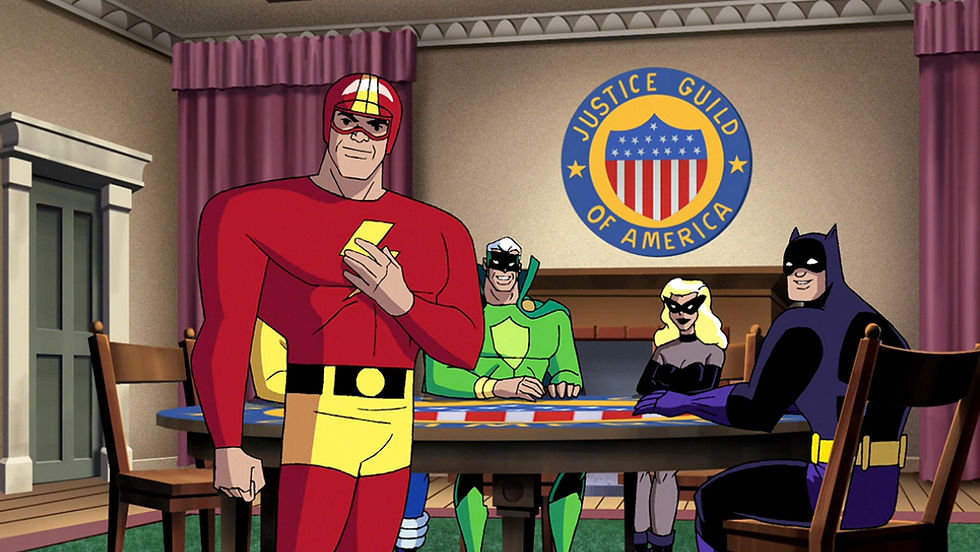
Fortunately, despite their concerns, DC Comics still saw merit in the script, as revealed by Fogel in the aforementioned DVD commentary for “Legends, Part Two.” During the narration, he revealed how “I talked to a lot of people at DC during this time and, you know, they actually really liked the story. They wanted it to be told because they understood what we were trying to do” (qtd. in “Commentary,” 00:02:46-00:02:56). This information was echoed by director and Producer Dan Riba during the March 19, 2024 installment of the Justice League Revisited podcast (Eisenberg and Enstall, 00:12:07-00:12:09), and he also revealed that Levitz was the one who suggested the following solution: “Well, why don’t you just sort of Watchmen the thing like Alan Moore did?” (qtd. in Eisenberg and Enstall, 00:12:40-00:12:44). Timm would further elaborate on this compromise in the aforementioned December 19, 2001 interview with Anime Superhero (formerly Toon Zone):
Paul saw our point and quickly agreed to a compromise: we’d change the names and designs just enough to make them not quite the JSA but still get the point across. They’re now the superheroes of “Earth Two-and-a-Half,” if you will … kinda similar to what Alan Moore was doing in his Supreme run.
We went back and forth on names for our pseudo-JSA: “Justice Battalion,” “Justice Squadron,” etc. before settling on “Justice Guild” as sounding closest to the original, while making it different enough to keep the folks at DC Comics happy. It did give us a few hairy moments, as all this stuff was happening at literally the eleventh hour. We were actually on the phone with the legal department, awaiting clearances on our new JGA characters’ names, at the voice recording session. We started recording not knowing what some of the characters’ names were going to be! (qtd. in Harvey, “Bruce”)
In particular, the “eleventh hour character-naming crisis” came up frequently in subsequent interviews, as voice actor Corey Burton (voice of Dr. Blizzard) recalled how “[a]ll of us weren’t sure if we were going to keep the names we had. Though I believe [one character] actually got to keep his original name” (qtd. in Yukinori), and Riba offered these words in the aforementioned March 19, 2024 installment of the Justice League Revisited podcast:
It worked out great except for how hard it was to name the characters. We knew who we wanted, but we didn’t know like because every time it was like, “Oh, the Scarlet Speedster. No, because that’s the Flash’s name! The Green—uh, the Emerald Guard—no, you can’t! Emerald, you can’t do emerald. You can’t do this. You can’t—oh, my gosh! And so, every name was so hard to come up with (qtd. in Eisenberg and Enstall, 00:12:13-00:13:34).
Fortunately, after creating analogues for the Justice Society team members (and their villains) and figuring out legally acceptable names for them, the rest of the show quickly fell into place, as Timm concluded in his aforementioned interview:
It’s funny how things work out. At first, we were still kinda disappointed that we couldn’t use the “real” JSA, but we’ve come to realize that the story actually works better this way. The “Green Lantern,” “Flash,” and “Black Canary” doppelgängers are fairly close to the originals, but the “Wildcat” clone is almost a Batman / Wildcat hybrid, and the “Atom” character has quite a bit of classic Superman in him as well. So, in effect, we’re not just spoofing / paying homage to the JSA, but also to the Fox-era Silver Age JLA, too. Sweet!
So, I know there’s been a bit of grumbling about DC Comics not letting us “do” the JSA, but you won’t hear any complaints from us. The folks at DC have been an absolute joy to work with. They’ve given us an enormous amount of leeway while letting us play with their toys, stepping in only when it looks like we’re gonna break ‘em. All of us on the Justice League crew have high hopes for “Legends.” If all goes well, it has the potential to be one of our best shows ever. (qtd. in Harvey, “Bruce”)
This sentiment was echoed at the time by Rich Fogel who—in an April 18, 2002 interview with Anime Superhero (formerly Toon Zone)—said that “‘Legends’ is a loving tribute to those larger than life, all in color for a dime, Golden Age superheroes. […] In addition to being a rollicking, nostalgic adventure, ‘Legends’ is a thoughtful examination of what inspires true heroism” (qtd. in Harvey, “Rich”); later adding, in a Comics Continuum interview the following day, how “[w]ild, weird, and more that slightly twisted, ‘Legends’ was a true labor of love. This one is for the inner geek in all of us” (Allstetter, “Justice League’s ‘Legends’”).

Years after its debut, “Legends” is still considered a favorite of both Bruce Timm (“Commentary,” 00:00:12-00:00:14) and James Tucker (“Inside,” 00:06:00-00:06:23), though Timm is certainly capable of looking upon it with a critical eye, such as during the aforementioned DVD commentary for “Legends, Part Two”:
This is our one, big alternate universe story that season. As I’ve said before, we gave ourselves that limitation—we can do one time travel story, and one alternate universe story every season. If that. And this was a good one to do. A lot of fans don’t like this episode, though, strangely enough. They think it’s goofy; they don’t understand it. They don’t understand what the, you know, they think we’re parodying the old Adam West show or something, which is strange.
[…] It’s interesting because a lot of people think that this is a parody, and it isn’t really. If you read old Golden Age Justice Society comics, they’re very much like this. They’re very arched, but they didn’t—they weren’t doing it, again, they didn’t think it was tongue-in-cheek. They just thought it was—that’s the way you told comics back then. It was a different world. […] Oh, and their dialogue […] too. I mean, it’s—we’re not even lampooning old dialogue; they talk the way characters actually talked in those old Golden Age comics. (qtd. in “Commentary,” 00:19:52-00:20:18, 00:03:03-00:03:21, 00:04:14-00:04:22)
He would later expand on this observation in an interview with RetroVision CD-ROM Magazine:
It’s one of those controversial episodes. Some people just don’t get it; people who just want their superheroes to be dark and serious all the time just don’t get it. It’s not so much [that] we’re lampooning the Justice Society; it’s lampooning old school superheroes in general. It’s literally lampooning every pre-1965 comic book hero. There was definitely a cultural shift when Marvel started making great strides with the college market and stuff. Comic books really started maturing rapidly, and comic books were never the same after that. So, this was our nod to the way things used to be—the innocence of childhood. What I love about it is that the first part is so light and fun, and you get that shocker ending when Hawkgirl finds their graves. Even though we’re still having fun while they’re fighting the wacky villains, once the truth comes out the story just gets deeper, darker, and sadder. By the end, I think it’s really emotional. (qtd. in Gross 14-15)
Looking back, Dan Riba stood in agreement with Timm, saying how “[i]t’s really powerful because, at first, you know, they’re kind of a joke and, by the end of the episode when they sacrifice themselves, you get really choked up” (qtd. in Eisenberg and Enstall, 00:20:13-00:20:21).

Commentary
As I have discussed in previous essays, the Justice League creative team—seeking to avoid some of the darker, cynical, and more adult themes that were prevalent on Batman Beyond—decided during production of Season One to tone down such content for their new animated series (Jankiewicz 33). As a result, longtime fans of the DC Animated Universe (DCAU) can no doubt detect a difference in early episodes. Don’t get me wrong—the shows are still well-written and entertaining, but they often lack the depth, intensity, and maturity that can be more easily found on Batman: The Animated Series (BTAS), early episodes of Superman: The Animated Series (STAS), some episodes of The New Batman Adventures (TNBA), Season Two of Justice League, and Justice League Unlimited (JLU). Over time, the creative team recognized this problem, with Bruce Timm acknowledging in an April 2003 interview that “when we took out the dark edge, we didn’t really replace it with anything comparable. Again, we were trying to make the show maybe a little bit more family-friendly, but it just got a little bit bland” (qtd. in MacDonald). Fortunately, the shift back towards more challenging, mature storytelling began here. Indeed, “Legends” is the first high concept episode of Justice League, and its elevator pitch is as follows: “what if we take the classic JLA / JSA team-ups of the Silver Age, and then filter them through the works of Alan Moore, Pleasantville, and The Twilight Zone?”

Above, left to right: the covers of Justice League of America #21 (August 1963), Justice League of America #56 (September 1967), Justice League of America #148 (November 1977), and Justice League of America #197 (December 1981).
While American physicist Hugh Everett III is credited with developing the initial quantum mechanics, comic book writer Gardner Fox was the one who first popularized the concept of a “multiverse” following the publication of The Flash #123 (September 1961) in a story titled “The Flash of Two Worlds!” And after introducing DC Comics to parallel Earths—including an “Earth-2” that conveniently held the original, Golden Age heroes that populated their pre-1956 stories—suddenly the company was awash in interdimensional travelogues featuring their heroes regularly jumping universes to team up with different heroes, fight different villains, or just to hang out with versions of themselves that were World War II vets, supervillains, or even funny, talking animals. And while it is true that this would later become a confusing tangle that would require extreme measures to sort out, this was simply an established storytelling trope in the Silver and Bronze Ages of Comics … and one that the creative team of Justice League wanted to pay homage to, as Bruce Timm discussed in the aforementioned RetroVision CD-ROM Magazine:
At the time we did the show, DC was going full blast with their Justice Society relaunch and, of course, since that Crisis on Infinite Earths miniseries, there are no parallel dimensions in the DC Universe, although I think that’s getting muddy now. At the time, both groups exist on the same Earth, and we thought, “That doesn’t really give you the contrast.” We really wanted to at least honor the tradition of the fact that you would have Earth-1 GL and Earth-2 GL and the Flash from both worlds teaming up, and you would get some contrast and interest out of that. So, we toyed with a bunch of ideas, and nothing was really jelling. James Tucker and I were both in Korea working on the first episode, and during a little bit of our downtime in Korea we started talking about the story. (qtd. in Gross 14)
(NOTE: While I cannot confirm any dates at this time, I suspect that the RetroVision CD-ROM Magazine interviews were done sometime in 2004. Also, the DC Comics’ multiverse officially returned to continuity in Infinite Crisis #6 [May 2006].)
Later, in the aforementioned DVD commentary for “Legends, Part Two,” the following exchange between Bruce Timm, James Tucker, and Rich Fogel picked up where Timm left off above:
BRUCE TIMM: And so, we just started talking about this, and we just started throwing ideas around, and we had a pretty good idea of what the story was going to be. We didn’t have it all worked out, but we had the ending, and what’s interesting about it is that we’d actually even come up with a twist that the Justice Society’s world had been destroyed in a nuclear war, and we said, “Ahh, that’s really dark; we’re not going to go that dark with this series, so we won’t do that, so we won’t even pitch that to Rich.”
So, we got back to the States; we kind of pitched in the idea for the story. He liked it, and we didn’t tell him the nuclear war aspect of the story, and then when Andrew Kreisberg took his pass on it in outline, he ended up putting the—
JAMES TUCKER: Oh, that’s right.
RICH FOGEL: He and I discussed it, so we were on the same page.
BRUCE TIMM: Okay. So, it’s funny. So, we ended up—at that point, it’s like, “Okay, that’s too good; if we’re all thinking of the same thing, then we kind of have to go with that.” […] When DC Comics got the outline for this, they said, “You can’t do that to the Justice Society,” and it was kind of touch and go there for a while. We didn’t know if we were going to be able to do this story. We didn’t know—I mean, there were so many things that we would have had to have changed in this storyline to actually be able to use the Justice Society; we didn’t think it was even worth doing it at that point. (qtd. in “Commentary,” 00:01:06-00:02:31)
And, later still, in the aforementioned March 19, 2024 installment of the Justice League Revisited podcast, Dan Riba elaborated on DC’s concerns regarding the script:
They loved the script; they loved the outline. They just went, “Wow, this is awesome, but we can’t let you do it” because […] we can’t introduce them in an animated series—the first time anyone’s going to see them—and then say they were dead. We just can’t do that.” And then it was Levitz who kind of went, “Well, why don’t you just sort of Watchmen the thing like Alan Moore did?” When they couldn’t let him do the Charlton characters, and he created the Watchmen as ciphers for them? So, why don’t we just have ciphers for characters, and what it ended up doing was not only creating a cipher for the Justice Society, but it also played in a more innocent time; they almost feel like Super Friends. So, for people who weren’t familiar with the Justice [Society], they were like, “Okay, we’re watching a parody of Super Friends.” And it worked on that level too. (qtd. in Eisenberg and Enstall, 00:12:07-00:13:12)
So, to recap, DC Comics was critical of the “Legends” script not because it poked fun at the goody-goody, older heroes, but because the script called for them to die during a nuclear war decades in the past, making the present-day characters encountered by the Justice League mere phantoms. Fortunately, as stated above, DC Comics Publisher Paul Levitz allowed them to move forward with the script as long as the Justice Society characters were altered into analogue characters, similar to the works of Alan Moore (Eisenberg and Enstall, 00:12:40-00:12:44; Harvey, “Bruce”).

One of the most celebrated comic book writers of all time, some of Alan Moore’s greatest works involved a sort of subterfuge, telling stories about iconic characters that could never be told with the originals by creating archetypical equivalents to take their place. As stated above, when he initially attempted to pitch the series that would become Watchmen, his original intent was to use the superheroes from Charlton Comics, who had been recently acquired by DC Comics. However, when DC protested, the solution became to insert alternates that resembled the original characters (Jensen); it is worth noting that the series became so celebrated that these characters would soon overshadow the originals in popularity. Later, following a very public falling out with DC Comics (Itzkoff), Alan Moore found his way to Image Comics in 1993, where he wrote 1963, a six-issue miniseries that served as an homage to the Silver Age of Marvel Comics, featuring ciphers of Spider-Man (The Fury), the Hulk (N-Man), and the Fantastic Four (Mystery Incorporated), among others. Finally, even though he could not return to Superman proper, he was still able to tell one of the finest Superman stories of the modern era by utilizing Supreme, a Rob Liefeld ectype also created for Image Comics, to take the Man of Steel’s place. So, in order to make their story a reality, the Justice League creative team needed to emulate the tactics of Moore.
With their alternate, “classic” superhero team established (for details, see “Stray Observations” here), the creative team shifted to worldbuilding, specifically the milieu of Seaboard City, a community better resembling Mayberry than Metropolis. Comparable to the kind of post-World War II, small town aesthetic seen in television shows like Leave It to Beaver (1957-1963) and The Donna Reed Show (1958-1966), the setting also drew significant influences from the 1998 feature film Pleasantville. A morality tale featuring a pair of siblings that find themselves trapped in a 1950s family sitcom, the story—much like “Legends” itself—emphasized the culture clash between old and new, as well as the cracks that can form in nostalgia’s seemingly flawless façade. In the aforementioned DVD commentary for “Legends, Part Two,” Bruce Timm discussed the film’s influence on the story:
There was a movie that came out about a year before this called Pleasantville, which I think I … what I like [about] the idea of Pleasantville is everybody has, like, this nostalgic fondness for the way things used to be, and they think the world used to be really sweet and innocent. And then, it’s like, “Well, yeah, in a way that’s true, but then there was also really bad things about the world back then that are better now,” so it’s all about how kind of nostalgia can be, you know, misplaced. […] That’s really what this episode is really all about. It’s not even specifically about the Justice Society—it’s really contrasting the way we remember the world and the way, you know, the world is. (qtd. in “Commentary,” 00:03:22-00:03:55)
Dan Riba also referenced the movie in interviews, describing Seaboard City as “an idealized environment, a Mayberry meets Pleasantville kind of thing. It had to feel like it was the late 1950s or early 1960s, but the television version of that era” (Rossen 50).

With the town established and its heroes on duty, all the episode needed was a villain, and I don’t mean the dinner theater rogues from the Injustice Guild. For “Legends,” the creative team dusted off the classic, Justice Society villain Brain Wave and transformed him into Ray Thompson, a tragic survivor of a nuclear holocaust who utilizes his reality-warping powers to relive the Justice Guild adventures of his youth. In describing his origins, Timm revealed that the character is “a kind of combination” of influential genre author Ray Bradbury and comic book icon Roy Thomas (qtd. in “Commentary,” 00:06:38-00:06:41), who served as writer and editor for both Marvel and DC for decades and, along the way, created multiple characters and storylines for both. Described by Timm as “probably the world’s biggest Justice Society fan” (qtd. in “Commentary,” 00:06:43-00:06:45), Thomas notably adapted the Justice Society and other Golden Age heroes for the All-Star Squadron series (1981-1987), as well as spin-offs such as Infinity, Inc. (1984-1988) and The Young All-Stars (1987-1989). In the aforementioned RetroVision CD-ROM Magazine interview, Timm elaborated upon Roy Thomas’ influence on the story:

Above, left to right: utilizing the potential of the human race, Rick Jones creates duplicates of Marvel’s Golden Age champions to fight Ronan the Accuser and his Kree troops; from Avengers #97 (March 1972). Images courtesy of Marvel Comics and the Walt Disney Company.
This story owes everything to Roy Thomas. It’s really weird. Roy Thomas, being the huge Justice Society fan [that] he is, is our direct inspiration for the Ray Thompson character in the story. It started with this idea, what do we do with the Justice Society? There was an Avengers story with the Kree / Skrull War and, at the climax of it, young Rick Jones somehow gets telepathic, paranormal abilities, and he conjures up his Golden Age comic book heroes; he brings them to life to fight the bad guys. I somehow remembered that little bit and came up with the idea, what if the “Justice Society” exists in another universe where they are, in fact, ghosts; that they’ve been killed, and this young comic book fan has used his enhanced mental powers to resurrect them. So, that’s where I got the very basics of the story, and that little germ is completely indebted to Roy Thomas. James and I both hit on the same idea at the same time: if the Justice Society was [Green Lantern’s] childhood heroes, when he finds out they’re ghosts, and the Justice Society has to basically sacrifice itself and die again, we knew we would have a very strong, heart-breaking finale. So, we loved that idea.
The more we started talking this show, the more we thought the guy who resurrects the Justice Society being their version of Snapper Carr, who was a sidekick to the Justice League back in the day. So, the story just started to snowball and then, at a certain point, remembering the Roy Thomas connection gave me the idea for the ghost Justice Society. It totally made sense that if this was an alternate universe where Roy Thomas was one of the last survivors of a nuclear war and somehow got amazing mental powers, that’s exactly what Roy Thomas would do. He would resurrect his childhood heroes, the Justice Society. This is exactly the kind of in-joke story that Roy Thomas himself has done throughout his entire comic book history. It’s a big loop. (qtd. in Gross 14)
To voice the formidable villain, the creative team chose noted stage and screen actor Neil Patrick Harris, who is best known for his television roles—such as the title character on Doogie Howser, M.D. (1989-1993) and Barney Stinson on How I Met Your Mother (2005-2014)—and his appearances in films such as Starship Troopers (1997), Gone Girl (2014), and the Harold & Kumar series (2004-2011). In reference to his pulling double time as both the innocent boy and mutated monster versions of the character, Dan Riba championed his performance, saying how “he was so wonderful because he had that, you know, that young, Doogie Howser voice; and he was able to turn it into [MENACING SOUNDS]. It was awesome” (qtd. in Eisenberg and Enstall, 00:26:22-00:26:30). And, considering how the villain is essentially a super-powered child manipulating the reality around him, that leads us to the episode’s connection to The Twilight Zone (1959-1964).
While it has never been directly stated by the Justice League creative team, the crux of the episode is obviously an homage to “It’s a Good Life,” the 1953 short story written by Jerome Bixby that would later be famously adapted as an episode of the classic anthology series. Originally airing on November 3, 1961, the story features a six-year-old boy named Anthony Fremont who possesses god-like powers, including telepathy and the ability to manipulate reality. Isolating his hometown of Peaksville, Ohio from the rest of existence, he lords over everyone like a king, and they must all think good thoughts around him, lest he become displeased and wish them away to “the cornfield.” Ranked by TV Guide as number 31 of the 100 greatest episodes of television of all time (“100” 666), it is difficult not to recognize the parallels between Anthony Fremont and Ray Thompson, considering how the latter reset Seaboard City prior to its destruction, recreated the Justice Guild of America from his memories, and forced the survivors to endlessly cosplay as participants in his superheroes’ adventures. It is only through the League’s arrival and the “JLA / JSA team-up” that Thompson’s reign was challenged, allowing the ghosts of the Justice Guild to break free and defeat their creator.
Before “Legends,” the Justice League scripts, while good, were not great, as they tended to be one-note retreads of standard superhero formulas: alien invasions, plots to discredit an established hero, incursions from Atlantis, supervillain team-ups, and so on. Even Timm recognized this, admitting how the show had “a little too much reliance on ‘been there, done that’ clichés” (qtd. in MacDonald), leading to a desire to elevate the proceedings for Season Two and beyond. And this episode, while not perfect, was the starting point—the moment where the creative team attempted to reach past the familiar and aspire to take their characters, narratives, and the series itself to the next level.
This is Part 1 of a two-part episode review. To read Part 2 of the review of “Legends,” please click here.
Works Cited
Allstetter, Rob. “Bruce Timm Talks Justice League: Part Two.” Comics Continuum. 25 Apr. 2001. <http://comicscontinuum.com/stories/0104/25/timmindex.htm>. Accessed 19 Nov. 2022.
---. “Justice League Animated Update.” Comics Continuum. 10 May 2001. <http://www.comicscontinuum.com/stories/0105/10/index.htm>. Accessed 18 Dec. 2022.
---. “Justice League Animated Update.” Comics Continuum. 27 Sept. 2001. <http://www.comicscontinuum.com/stories/0109/27/index.htm>. Accessed 22 Dec. 2022.
---. “Justice League’s ‘Fury.’” Comics Continuum. 6 Apr. 2002. <http://www.comicscontinuum.com/stories/0204/06/index.htm>. Accessed 31 Dec. 2022.
---. Justice League’s ‘Legends.’” Comics Continuum. 19 Apr. 2002. <http://www.comicscontinuum.com/stories/0204/19/index.htm>. Accessed 31 Dec. 2022.
---. “Justice League Update.” Comics Continuum. 4 Mar. 2002. <http://www.comicscontinuum.com/stories/0203/04/index.htm>. Accessed 31 Dec. 2022.
---. “Justice League Update.” Comics Continuum. 26 Mar. 2002. <http://www.comicscontinuum.com/stories/0203/26/index.htm>. Accessed 31 Dec. 2022.
Alter, Ethan. “David Naughton Revisits His Classic Dr. Pepper Ads That Featured Mickey Rooney and Jimmie Walker: ‘You Never Know Who’s a Pepper Out There.’” Yahoo! 8 Feb. 2022. <https://www.yahoo.com/entertainment/david-naughton-dr-pepper-be-a-pepper-commercials-192301618.html>. Accessed 26 Aug. 2026.
Bixby, Jerome. “It’s a Good Life.” STAR Science Fiction Stories, No. 2. Edited by Frederik Pohl. Internet Archive. 13 Feb. 2024. <https://archive.org/details/starscienceficti0000unse/mode/2up>. Accessed 6 Sept. 2026: 66-85. PDF file.
“Commentary on ‘Legends—Part Two.’” Justice League: Season One. Warner Bros. Animation, 2006.
Cotton, Mike. “Leading the ‘League.’” Wizard: The Guide to Comics. Aug. 2001: 80-81. Print.
Eisenberg, Susan and James Enstall, hosts. “Legends.” Justice League Revisited, featuring Phil LaMarr, Jennifer Hale, and Dan Riba. Apple Podcasts, 19 Mar. 2024. <https://podcasts.apple.com/us/podcast/legends-with-phil-lamarr-jennifer-hale-and-dan/id1709910091?i=1000649702984>. Accessed 30 Jul. 2026.
Gough, Bob. “Interview with Roy Thomas.” Mile High Comics. Mile High Comics, Inc. n.d. <https://www.milehighcomics.com/interviews/roythomas.html>. Accessed 7 Sept. 2026.
Gross, Edward. “Justice League Episode Guide.” RetroVision CD-ROM Magazine. M&R Multimedia, Inc. n.d.: 8-27. PDF file.
Harvey, Jim. “Bruce Timm Talks Justice League: ‘JGA.’” Anime Superhero. 19 Dec. 2001. <https://animesuperhero.com/forums/threads/bruce-timm-talks-justice-league-jga.2873701/>. Accessed 25 Dec. 2022.
---. “Justice League’s ‘Atom.’” Anime Superhero. 24 Dec. 2001. <https://animesuperhero.com/forums/threads/justice-leagues-atom.2877071/>. Accessed 23 Dec. 2022.
---. “Rich Fogel Talks ‘Legends.’” Anime Superhero. 18 Apr. 2002. <https://animesuperhero.com/forums/threads/rich-fogel-talks-legends.2982301/>. Accessed 24 Dec. 2022.
“Inside Justice League.” Justice League: Season One. Warner Bros. Animation, 2006.
Itzkoff, Dave. “The Vendetta Behind ‘V for Vendetta.’” Internet Archive. 3 Apr. 2014. <https://web.archive.org/web/20131113224600/http://www.nytimes.com/2006/03/12/movies/12itzk.html>. Accessed 11 Aug. 2026.
Jankiewicz, Pat. “Justice League: Superman, Batman & Their Super Friends Get Animated for the 21st Century.” Starlog. Jan. 2002: 28-33. Print.
Jensen, Jeff. “Watchmen: An Oral History.” Entertainment Weekly. People, Inc. 21 Oct. 2005. <https://ew.com/books/2005/10/21/watchmen-oral-history/>. Accessed 11 Aug. 2026.
Johnson, Dan. “Beware His Power, John Stewart’s Might: An Interview with Denny O’Neil and Phil LaMarr.” Back Issue! Jan. 2005: 32-38. Print.
kyerkes98. “JLanimated. com Interview # 3: James Tucker!” Internet Archive. 25 Nov. 2005. <https://web.archive.org/web/20051125225030/http://www.batbeyond.com/forum/viewtopic.php?t=7696>. Accessed 17 Jan. 2023.
MacDonald, Heidi. “Timm on the League’s New Attitude.” Internet Archive. 23 Apr. 2003. <https://web.archive.org/web/20060623022635/http://www.comicon.com/cgi-bin/ultimatebb.cgi?ubb=get_topic;f=36;t=000941;p=1>. Accessed 3 Jan. 2023.
“100 Greatest Episodes of All Time.” TV Guide Guide to TV. Internet Archive. 1 Jan. 2012. <https://archive.org/details/isbn_9780760756348/mode/2up>. Accessed 18 Aug. 2026: 666-667. PDF file.
Pleasantville. Directed by Gary Ross. Performances by Tobey Maguire, Reese Witherspoon, Jeff Daniels, Joan Allen, and William H. Macy. New Line Cinema. 1998.
Rossen, Jake. “An Extraordinary League.” ToyFare: The Toy Magazine. Nov. 2005: 46-64. Print.
Serwin, Andy. “Smells Like Teen Spirit.” Wizard: The Guide to Comics. Oct. 2001: 83. Print.
Thomas, Roy and Carla Conway. “So I Took the Subway and There Was Shelly Mayer…” Alter Ego. ToMorrows Publishing. n.d. <https://twomorrows.com/alterego/articles/01hasen.html>. Accessed 22 Aug. 2026.
Yukinori, Xum. “An Interview with Corey Burton.” Internet Archive. 26 Dec. 2002. <https://web.archive.org/web/20021226224153/http://www.comics2film.com/ProjectFrame.php?f_id=30&f_page=6>. Accessed 23 Nov. 2022.
Images—unless otherwise indicated—courtesy of Warner Bros. Discovery, Warner Bros. Home Entertainment, Warner Bros. Animation, DC Comics, Image Comics, Marvel Comics, the Walt Disney Company, America’s Best Comics, 20th Century Television, Holyoke Publishing, Stephen J. Cannell Productions, Marvel Productions, Paramount Skydance, Paramount Television, and Lucasfilm, Ltd. YouTube video courtesy of Rotten Tomatoes Classic Trailers, The Twilight Zone, James Bond 007, Shout! Studios, The Dolls of Horror, UgGrugg, Jacob Dombroski, robwett1, Adult Swim Europe, and Watchtower Database channels.


Comments