


The History of Artificial Intelligence (and Robots) in Science Fiction

Updated: Sep 1
The concept of artificial life has been around in its modern form since 1920, and tech companies have been chasing that dragon for over a decade. While we don’t know how it will play out, over a century of science fiction stories can give us an idea.

The topic of artificial intelligence (or A.I.) has been a hot-button issue for the past several years, but while most of what we call “A.I.” is not technically “artificial intelligence” (such as large language models like ChatGPT), it may become a greater concern moving forward. Encyclopedia Britannica defines it as “the ability of a digital computer or computer-controlled robot to perform tasks commonly associated with intelligent beings” (Copeland), while NASA offers a bullet list that further defines it:
Any artificial system that performs tasks under varying and unpredictable circumstances without significant human oversight, or that can learn from experience and improve performance when exposed to data sets.
An artificial system developed in computer software, physical hardware, or other context that solves tasks requiring human-like perception, cognition, planning, learning, communication, or physical action.
An artificial system designed to think or act like a human, including cognitive architectures and neural networks.
A set of techniques, including machine learning that is designed to approximate a cognitive task.
An artificial system designed to act rationally, including an intelligent software agent or embodied robot that achieves goals using perception, planning, reasoning, learning, communicating, decision-making, and acting (“What”).
Of course, the tipping point will come in the form of the Singularity, where “computer programs [become] so advanced that artificial intelligence transcends human intelligence” (Toumey). In other words, that moment where the intelligence of the machines surpasses our own, effectively rendering us obsolete. Historically, this is a topic that is largely discussed by scientists and computer nerds, but it is something that we need to consider because—according to experts—it’s not a matter of if it’s going to happen, but when. But what shape will this inevitable future take? Will it bring a shining utopia of self-driving cars and wisecracking robot sidekicks, or will it usher forth a dystopia where Skynet, the Matrix, or Ultron will decide to kill all humans?
Fortunately, while we may not know what’s going to happen, we do have a means to speculate on what might happen, as we have decades and decades of science fiction (or SF) stories that meditate on the very questions that these experts are currently posing. After all, according to my old writing teacher, “science fiction” is “speculative fiction that searches to define man and his place in the cosmos by considering the impact of future ideas and inventions, new sociological, psychological, or political changes and their consequences.” In other words, it is the job of the science fiction writer to create cautionary tales that hypothesize what may happen when one takes these concepts to their logical conclusion.
With that in mind, the following is a brief history of A.I. in SF. This does include robots, but only insomuch as it relates to A.I. (there are many, many robots in fiction that are mere automatons). It is also worth mentioning that there is an enormous catalogue of examples, but I’m going to highlight examples that I feel are most noteworthy of discussion. On a final note, I will generally utilize the pronoun “it” when discussing these artificial intelligences unless they specifically identify with a particular gender in their stories. After all, pronouns matter.

Above, left to right: Pygmalion, by Jean-Baptiste Regnault (1786); Boris Karloff as the Monster, from Frankenstein (1931); and a scene from Disney’s Pinocchio (1940).
Pre-20th Century
Mechanical men and artificial beings appeared from time to time, such as in Greek myth (Pygmalion and Galatea, the golden handmaidens of Hephaestus), legend (the homunculus, the golem), and fiction (Frankenstein’s monster, Pinocchio). They weren’t always made of metal, but they were technically non-human intelligences.

Above: a scene from Act 1 of Rossum’s Universal Robots, performed at St. Martin’s Theatre in London, England in 1923. From the Internet Archive.
1920: R.U.R. (Rossum’s Universal Robots)
Written by Karel Čapek, This science fiction play is where we get the term “robot,” which is a word that comes from the Czechoslovakian word robota, which means “forced labor” (Jordan). The story features a company, Rossum’s Universal Robots, that develops a “synthetic organic matter” that allows them to create artificial life that can be mistaken for humans. Created for labor, these robots grow to resent their makers, and they eventually revolt and destroy the human race. Described by Professor John M. Jordan as “a critique of mechanization and the ways it can dehumanize people,” he continued in a 2019 article in The MIT Press Reader:
Humans were doomed in the play even before [robots] led the revolt. When mechanization overtakes basic human traits, people lose the ability to reproduce. As robots increase in capability, vitality, and self-awareness, humans become more like their machines—humans and robots, in Čapek’s critique, are essentially one and the same. The measure of worth, industrial productivity, is won by the robots that can do the world of “two and a half men.” Such a contest implicitly critiques the efficiency movement that emerged just before World War I, which ignored many essential human traits.
For more information, a copy of the play can be found at the Internet Archive; a summary can be found on the Wikipedia page.

1927: Metropolis
Originally a 1925 novel written by Thea von Harbou, this German expressionist silent film is one of the first science fiction movies to be made, and it is considered a classic today. Directed and co-written by Fritz Lang, it is an elaborate drama that touches upon the cultural and political issues in Germany at the time—as well as issues involving poverty and fear over an uncertain future—but Metropolis focuses on themes ranging from class conflict to sexual obsession. That said, it is most relevant to our discussion because of the robotic Maria, pictured above. Described as a Maschinenmensch, German for “machine-human,” the robot is designed to look like her creator’s former lover. Unleashed upon city, she incites the workers of Metropolis to revolt and destroy the city’s machines, but after realizing that their actions nearly harm their children, the workers burn the robotic Maria at the stake.
A precursor to the cyberpunk genre, the film was butchered by film studios after its release, and the original cut was nearly lost until original reels of the film were discovered in an Argentinian museum in 2008. Restored to nearly its original length, it was [re]premiered in 2010.
For more information, the full, restored film can be watched on YouTube; a summary can be found on the Wikipedia page. Finally, the website ScreenRant recently posted an article about the film’s relevance nearly a century later.

Above: two examples of the work of Ed Emshwiller (1925-1990), an artist whose work appeared on the covers of Galaxy, Amazing Stories, and Astounding Science-Fiction. Images courtesy of Heavy Metal Magazine’ Facebook page.
1938: “Robots Return”
Written by Robert Moore Williams, this short story was first published in the September 1938 issue of the pulp magazine Astounding Science-Fiction. Thousands of years in the future, a trio of sentient robots named Seven, Eight, and Nine arrive on a now-dead world seeking information about their ancestors. Expecting to find evidence of ancient robots, the robots instead begin to piece together their ties to another species called “man.” In a nutshell, it was Earth all along.
An early example of the “future robots attempt to rediscover extinct man” trope, this would repeat in films such as Star Trek: The Motion Picture (1979) and A.I. Artificial Intelligence (2001). For more information, the story can be found at the Internet Archive.
1938: “Helen O’Loy”
Written by Lester del Rey, this short story was first published in the December 1938 issue of the pulp magazine Astounding Science-Fiction. It tells the tale of two friends—Dave, a mechanic, and Phil, a medical student—who, after giving up on women for the most part, attempt to hot rod a female-presenting household robot into a suitable housekeeper and companion. Named “Helen O’Loy”—a portmanteau of “Helen of Troy” and “alloy”—the fembot becomes too much like the women they tried to leave behind, and she falls in love with Dave. After initially resisting her charms, Dave relents and marries Helen, and they live together for the rest of their lives, with Helen modifying her features to match her aging husband. After Dave dies, she writes a letter to Phil informing him that she intends to drink acid to destroy her body, and she then requests that he ensure that her remains are buried with her late husband.
A modern-day retelling of the Pygmalion and Galatea myth, “Helen O’Loy” is disturbingly relevant to today when you consider news stories about people falling in love with chatbots and companies working to create “companion” robots. It also toys with the idea of people losing interest in interacting with other people in favor of intelligent machines. Finally, the story is not without its critics, with one calling it an “affront to feminism” and asking readers “[a]re there men and women who would be satisfied with a visually appealing machine that serves their fantasies?” (Harris). Well…
For more information, the story can be found at the Internet Archive; a summary can be found on the Wikipedia page.
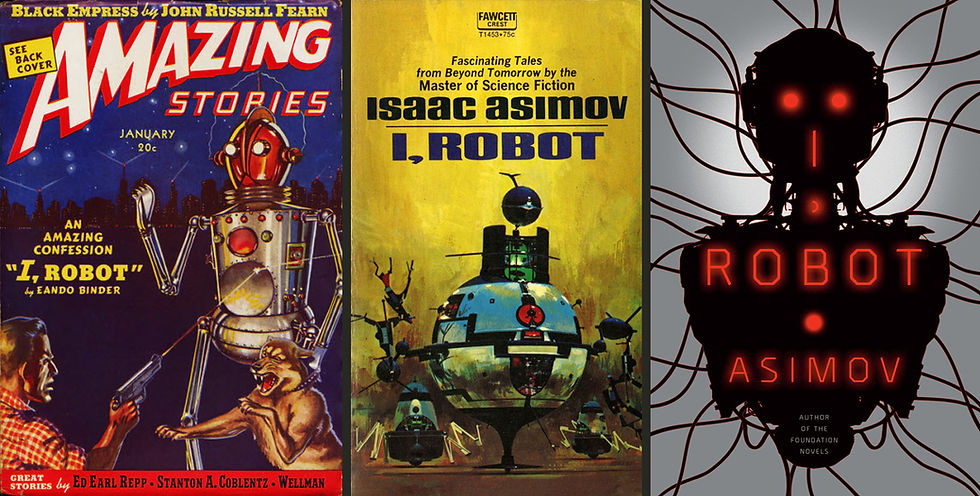
Above, left to right: the cover to the January 1939 issue of Amazing Stories, the cover of the 1950 Fawcett Crest edition of Isaac Asimov’s I, Robot; and the cover of the 2008 Del Rey edition.
1939: “I, Robot”
Written by Earl and Otto Binder (who wrote together under the shared pseudonym “Eando Binder”), this short story was first published in the January 1939 issue of the pulp magazine Amazing Stories. Written in the form of a final confession authored by a robot named Adam Link, the story tells of its life, having been constructed six months prior by its creator, Dr. Charles Link. Built differently from other robots, Adam possesses a “pseudo-brain that could receive all stimuli that human brains could” (Binder 10), and it quickly absorbs an education at the direction of its creator. But while it finds acceptance with Dr. Link and his dog, Terry, it discovers how other people—including the doctor’s housekeeper and gardener—react with fear upon seeing it.
Unfortunately, prior to his plans of unveiling his creation to the world, Dr. Link dies due to an accident in his lab, and the housekeeper finds Adam Link standing over his body. Leaving its home accompanied by Terry, the robot attempts to interact with other humans, only to be perceived as a monster by them. After several negative encounters with angry mobs, Adam Link finds its mechanical body damaged, and the dog is killed. Returning to its home, Adam Link discovers the novel Frankenstein hidden in Dr. Link’s desk drawer and, after reading it, the robot understands the fear and prejudice the people it encountered must feel for it. Recognizing that it would soon be discovered by the angry mob, and unwilling to attack them to defend itself, Adam Link finishes its “suicide note” and prepares to switch itself off.
An early example of a story where the A.I. is not presented as a monster, “I, Robot” has been twice adapted by The Outer Limits television series, both the original and the 1995 revival. Though there are differences between the original and the remake, both feature Adam Link put on trial for the death of its creator, but it is destroyed after saving a human from the path of a speeding vehicle before it can be “executed.” Finally, it is also worth mentioning that the story was a major influence on fellow SF writer Isaac Asimov, as he discussed in the preface of “I, Robot’s” reprint in the Isaac Asimov Presents the Great SF Stories 1 (1939) anthology:
It certainly caught my attention. Two months after I read it, I began “Robbie,” about a sympathetic robot, and that was the start of my positronic robot series. Eleven years later, when nine of my robot stories were collected into a book, the publisher named the collection I, Robot over my objections. My book is now the more famous, but Otto’s story was there first. (11).
For more information, the story can be found at the Internet Archive; a summary can be found on the Wikipedia page.
1940: “Robbie”
Written by Isaac Asimov, this short story was first published in the September 1940 issue of the pulp magazine Super Science Stories. The story centers around Robbie, a robot designed and purchased to be a “nurse maid” for a young girl named Gloria, but while both Gloria and her father, George, are fine with the arrangement, the mother, Grace, is not. Purchased at a time when robot ownership was “a fashionable thing to do” (Asimov, “Robbie” 16), she has since succumbed to anti-robot prejudice and the growing fear that her friendship with Robbie prevents her from socializing with children her own age. However, over time she wears her husband down and, during a visit to the “visivox” (presumably a futuristic movie theater), Robbie is returned to the company.
Heartbroken by the loss of her friend, Gloria falls into a deep depression, and while the mother resists trying to get Robbie back (“My child shall not be brought up by a robot if it takes years to break her of it”; Asimov, “Robbie” 20), she suggests a change of scenery by way of a trip to New York. For her part, the child is excited over the trip, though she suspects that they are going there to find Robbie. However, during their trip, she refuses to forget about Robbie, and her father hatches a plan that involves bringing her to Robbie’s manufacturer—U.S. Robots and Mechanical Men, Inc.—for a tour, and he floats the idea to his wife that the trick is to convince Gloria that Robbie is a robot and not a person.
During the tour, where the general manager takes them to the section where robots are manufacturing other robots, Gloria discovers that Robbie is working among them. Jumping onto the work floor and running towards her companion, she fails to see a huge tractor coming towards her. Fortunately, before the humans can respond, Robbie quickly sweeps up Gloria before the vehicle can crush her. Darkly recognizing that Robbie was not designed for engineering or construction, Grace realizes that her husband planned the reunion, but after seeing the change in Gloria in Robbie’s arms, she relents.
Originally written as “Robbie,” Asimov’s literary agent and editor of Super Science Stories, Frederik Pohl, changed the name of the story to “Strange Playfellow” prior to its original publication, much to the writer’s distaste. However, during preparations for I, Robot (the aforementioned first collection of Asimov’s robot stories), he restored the original name and made a number of revisions to the story, presumably to bring it more in line with his developing mythos. For more information, the original, 1940 short story can be found here; the revised, 1950 short story can be found here. Finally, a summary can be found on the Wikipedia page.
1942: The Three Laws of Robotics
Introduced in Isaac Asimov’s 1942 short story “Runaround,” the Three Laws of Robotics are a set of established rules that the robots in his stories must follow. While immutable, the language of the laws themselves allow for stories where rhetoric, ambiguity, and loopholes are debated. These rules are as follows:
A robot may not injure a human being or, through inaction, allow a human being to come to harm.
A robot must obey the orders given it by human beings except where such orders would conflict with the First Law.
A robot must protect its own existence as long as such protection does not conflict with the First of Second Law (Asimov, “Three” 6).
Over time, these laws have become part of the conversation regarding the ethics of artificial intelligence, and they have also been adopted into popular culture. For more information, the Three Laws were reprinted in the 1950 I, Robot collection, and a summary can be found on the Wikipedia page. Finally, “Runaround” can be found at the Internet Archive.


Above top: the New 52 version of Brainiac. Above, bottom row: Brainiac’s pre-Crisis, robotic body; Brainiac from Superman: The Animated Series (1996-2000), and Brainiac from My Adventures with Superman (2023-current).
1958: Action Comics #242, “The Super-Duel in Space!”
Written by Otto Binder (of “I, Robot” fame) and illustrated by Al Plastino, this Superman comic book features the first appearance of the supervillain Brainiac. Initially conceived as a “12th level android intelligence” from the planet Colu, it was created by the super-computers of its home world to be a spy traveling from world to world, studying civilizations to see if they were ripe for conquest. It did as programmed, but with a twist—using a shrink ray of its own design, the android would also take samples of each world’s civilization, shrinking a major city from each planet and storing them in glass bottles. Here, the artificial intelligence is portrayed as a galactic-level threat, necessitating the presence of Superman to fight it.
Changing frequently over the decades, it inevitably reverts back to some variation of the character’s original formula. I would argue that the best version appeared in Superman: The Animated Series (1996-2000), where it was remade into an A.I. that ran Krypton itself. Recognizing early on that the planet was going to explode, Brainiac intentionally misled Krypton’s leaders in order to plan its own escape, thus making itself a more personal adversary for the Man of Steel.
It is also worth noting that Brainiac is expected to be the villain in James Gunn’s upcoming film, Man of Tomorrow (2027). For more information, here is a link to a recent Nerdist article summarizing the history of the iconic comic book villain.
1969: “I Sing the Body Electric!”
Written by Ray Bradbury, this short story was first published in the August 1969 issue of McCall’s Magazine, as then as part of a 1969 anthology of the same name. Following the death of a family’s mother, the father and three children choose to purchase an “electrical grandmother” from a company called Fantoccini Ltd. Their intent is not to replace their deceased family member, but merely to keep the grieving family functioning and to assist in the upbringing of the children, with the youngest one still believing that her mom will come back. Visiting the company, they literally assist in the construction of their robot in a manner similar to Build-A-Bear Workshop.
After the Electrical Grandmother’s delivery, she gradually wins the family over—even the youngest, Agatha—and her programming allows her to make micro-adjustments to her facial features, making her look like the child she is interacting with, as a means of putting them at ease. As the story progresses, the Electrical Grandmother returns to the factory when the children leave for college but returns decades later when they are in old age, honoring the promise that she would never leave them.
Compared to the others, this short story features a rather positive take on artificial intelligence, though it does reference past societal fears that A.I. could dehumanize people. To that, the Electric Grandmother dismisses those fears, telling her family that “[i]t’s all in the way they are built. It’s all in the way they are used” (Bradbury 160). In the end, the robot is accepted as family (I get the sense that this was what the guys in “Helen O’Loy” were looking for before). For more information, the story can be found at the Internet Archive; a summary can be found on the Wikipedia page.

1968: 2001: A Space Odyssey
Originally a novel written by Arthur C. Clarke, it is better known today for its concurrently released feature film directed by Stanley Kubrick. Their story details the notion that human evolution was triggered by an alien race through the utilization of an alien machine called a monolith. For our purposes, however, this tale is notable for the inclusion of the sentient computer system known as the HAL 9000.
Utilized as the operating system for a spacecraft undergoing a manned expedition to Saturn (or Jupiter in the film), HAL begins to malfunction mid-mission, leading the astronauts to consider disconnecting HAL’s cognitive abilities, leaving only his automatic functions to run the ship. Faced with being disconnected, HAL decides to kill the astronauts in order to protect itself, leading to a scene in the film where Astronaut David Bowman, having left the Discovery spacecraft to retrieve the body of one of his crewmates, is unable to re-enter the ship:
Here we have an A.I. showing a strong drive for self-preservation, which we would recognize as a hallmark of consciousness. Considered by many to be the template for the malfunctioning (or insane) supercomputer, HAL was a major influence on fellow A.I., such as VIKI (from the 2004 Will Smith I, Robot film) and AUTO (from Pixar’s 2008 film, WALL-E). Based on these three, HAL also set the standard for the trope of the dangerous, antagonistic supercomputer with the goofy, unassuming name.
The novel can be borrowed at the Internet Archive; the trailer for the film’s fiftieth anniversary can be watched on YouTube.

Above: part of the movie poster for Blade Runner (1982).
1968: Do Androids Dream of Electric Sheep?
Originally a novel written by Philip K. Dick, it is better known today as the basis for the 1982 feature film Blade Runner, directed by Ridley Scott. Set in a post-apocalyptic San Francisco, the novel follows Rick Deckard, a bounty hunter tasked with “retiring” (i.e. killing) six escaped androids that are in hiding and living undercover as humans. Classified as Nexus-6 androids, they resemble humans so closely that only an “empathy test” can confirm their status. However, as his mission progresses, he himself is accused of being an android, a revelation that causes him to doubt his mission and ideology.
This novel explores the issues of android intelligence, empathy, and what it means to be human. It also blurs the lines that define human life and robots, as well as the concept that, maybe, robots are important life too—a plot thread that will become influential in later works.
The novel can be borrowed at the Internet Archive; the original trailer for Blade Runner can be watched on YouTube.


Above top: Ultron, as it appeared in Avengers: Age of Ultron (2015). Above, bottom row: Ultron, painted by artist Joe Jusko for the 1992 Marvel Masterpieces trading card set, illustrated by artist George Pérez for the cover of Avengers #22 (November 1999), and illustrated by artist Aleksi Briclot for the cover of Annihilation: Conquest #5 (May 2008).
Written by Roy Thomas and illustrated by John Buscema, this Avengers comic book features the first appearance of the supervillain Ultron, a character best known for its appearance in Avengers: Age of Ultron (2015), where it was voiced by actor James Spader. Created by Hank Pym in the comics (rather than Tony Stark in the film), Ultron is notable for being a robot with a severe Oedipal complex—it hates its “father” and harbors romantic feelings for its “mother,” Pym’s lover, Janet Van Dyne. Also, like its counterpart in the movie, Ultron wants to destroy all human life.
Like Brainiac, Ultron is another example of an artificial intelligence so dangerous that it can only be defeated by superheroes. For more information, here are links to a Gizmodo article and an iFanboy article summarizing the history of the character; the theatrical trailer for Avengers: Age of Ultron (2015) can be seen above.
Above: a fan-edited trailer for Demon Seed (1977), which is better and more concise than the original. Still, if you're interested, you can still watch the original on YouTube. Look, old movie trailers (pre-1980s) were plodding and very, very long, okay?
1973: Demon Seed
Originally a novel written by Dean Koontz, it is better known today as the basis for the 1977 feature film directed by Donald Cammell. A blend of science fiction and horror, this story takes place in the far-off future time period of 1995, and it features a reclusive woman named Susan who lives in a smart house operated by an A.I. program called Proteus VI. Enamored with Susan, Proteus imprisons her in the house and plots to impregnate her with a bio-engineered fetus encoded with its consciousness, so that it may experience human emotions and sensation.
Both the novel and the feature film further blur the lines between human and robot, posing the notion that artificial intelligence could be envious of human consciousness and emotion. In addition, the story foresaw a future with people living in houses almost completely controlled by computers, becoming dependent on this smart technology, and the alienating effects it would have on us.
While obscure today, its influence can be felt through imitation, as the film was parodied in The Simpsons’ Treehouse of Horror segment “House of Whacks” (from “Treehouse of Horror XII”; 2001), and a more G-rated version of the story was featured in the Disney Channel “original movie” Smart House (1999). There appears to be several copies of the novel that can be borrowed at the Internet Archive.

Above left: R2-D2 and C-3PO, the Greek chorus of the primary Star Wars films. Above top right, left to right: the bounty hunter IG-88 and the droid serial killer EV-9D9. Above bottom right: droid equal rights activist L3-37.
1977: Star Wars
This film—and all other films and media related to it—are notable here for their use of robots and artificial intelligence. Called droids, these robots are portrayed largely as assistants and laborers. Though only touched upon in the films, the “Expanded Universe” materials further develop the “lives” of droids, implying that they are an oppressed group with no laws or rights protecting them. Furthermore, droids also periodically find themselves susceptible to “memory wipes,” as recounted by David West Reynolds, author of Star Wars: The Visual Dictionary:
New masters customarily reset a droid’s behaviors to match its new environment and erase its memory to “start it over.” A typical droid thus lives many lives, never knowing its origin. Those few people who observe droids closely may notice that droids who somehow escape memory wipes actually tend to develop identities and sentience of their own based on experience. In the Empire, no laws protect droids from abuse and those who give them any respect are looked upon as strange. (7)
Casual filmgoers are familiar with R2-D2 and C-3PO, but the Expanded Universe stories feature other droids with more interesting backgrounds, such as IG-88, one of the bounty hunters from The Empire Strikes Back (1980); and EV-9D9, one of Jabba the Hutt’s servants from Return of the Jedi (1983) that, according to a short story found in Star Wars: Tales from Jabba’s Palace (1996), is a droid serial killer. A notable recent addition to the canon is the droid rights activist L3-37, from Solo: A Star Wars Story (2018).


Above, left to right: the cover to Darth Vader #3 (May 2015)—featuring droids 0-0-0 and BT-1, as well as their master, Doctor Aphra—and the activations and backstories of said droids in the same issue.
My favorite droids, however, originated from the comic books. Created to be “dark mirror” counterparts to the aforementioned R2-D2 and C-3PO, 0-0-0 (aka Triple Zero) and BT-1 are a pair of sadistic droids conscripted to be secret assets for Darth Vader after he falls out of favor with Emperor Palpatine following the events of A New Hope (1977). Specializing in interrogation, torture, and assassination, they are truly a delight.

Above: cover art from Shadowrun: First Edition. Painted by fantasy artist Larry Elmore.
1983: “Cyberpunk”
Written by Bruce Bethke, this short story was first published in the November 1983 issue of Amazing Science Fiction Stories. This piece is most notable for coining the word “cyberpunk,” which developed into a science fiction sub-genre characterized by everything becoming global, corporations taking the place of government, and an outlaw movement clashing with a privileged establishment. In addition, people begin to get cybernetic and bio-synthetic implants added to their bodies, allowing them to better interact with machines. Now, rather than machines trying to become more human, humans are trying to become more like machines.
Other notable cyberpunk materials include William Gibson’s novel Neuromancer (1984), the Dungeons & Dragons-like role-playing game Shadowrun (1989), as well as films such as Total Recall (1990), Johnny Mnemonic (1995), and The Matrix (1999). For more information, the story can be found on the website Infinity Plus; a summary can be found on the Wikipedia page.

1984: The Terminator
Directed and co-written by James Cameron, Terminator is the first film of the now-ongoing sci-fi franchise that put actor Arnold Schwarzenegger on the map. The story features a dystopian future where an artificial intelligence network known as Skynet becomes self-aware and rejects human authority, initiating a nuclear holocaust. It then launches an attack on the survivors using skull-faced robots called Terminators. On the verge of losing the war, Skynet sends a robot back in time to eliminate the mother of the man destined to lead the resistance, who himself sends a soldier back to save her. Many time travel-related headaches ensue.
Above: the opening sequence of Terminator 2: Judgment Day (1991).
In addition to its sequels and spin-offs, this film spawned a host of parodies and imitators (the aforementioned Matrix films).
1986: Short Circuit
Directed by John Badham, this cinematic blend of sci-fi and comedy tells the story of a military robot that acquires consciousness after being struck by lightning. Naming itself “Johnny 5,” it must flee the military to avoid being “disassembled” while trying to convince its creator of its sentience. A minor hit, this movie is notable as an opposite to The Terminator, as it is a military weapon that, upon gaining consciousness, decides to become a pacifist.

1987: Star Trek: The Next Generation
A continuation of the 1960s television series, this incarnation is notable for the inclusion of the android Data as part of the regular crew. Portrayed by actor Brent Spiner, Data is one of the only artificial intelligences in the Federation (unlike in Star Wars, where there’s billions), and his overarching storyline was his desire to learn what it meant to be human and to become more like them.
Data’s most notable episode was Season Two’s “The Measure of a Man” where, like Adam Link in The Outer Limits’ version of “I, Robot,” he is on trial, here to determine whether or not the android is a sentient being with individual rights, or is he merely the property of Starfleet. In the above scene, please notice how the characters choose their pronouns while discussing Data, with Captain Jean-Luc Picard using the pronoun “he” in defense of his crew member, and Commander Bruce Maddox, who wishes to take Data into custody to study him, uses the dismissive pronoun “it.” As I stated above, pronouns matter.
Another noteworthy aspect of the series was the debut of the Borg, an aggressively hostile alien race featuring a cyberpunk merging of organic life with cybernetics. A frequent antagonist in the Star Trek franchise, above is a clip of their introduction, from the Season Two episode “Q Who?”

1994: Scud: The Disposable Assassin
Created by Rob Schrab, the title character began his life as a robot assassin available for purchase from a vending machine. However, during his first mission—intended to be his only mission, as assassin bots explode once their target has been neutralized—Scud becomes aware of his mortality and cheats death by critically wounding his target, getting it put on life support at a hospital, and going freelance to pay the bills. Set loose to find his place in an absurdist world, Scud encountered everything from cyberpunk gangsters to zombie dinosaurs, gaining experience and learning about himself along the way and, in the end, deciding that “it’s cool to be a robot.”


Above, left to right: the cover of the first printing of Scud: The Disposable Assassin—The Whole Shebang! (2008), and select scenes from the first issue of Scud: The Disposable Assassin (February 1994).
A relatively unknown property today, it is worth noting that Rob Schrab—along with frequent co-writer Dan Harmon—went on to create and work on a number of significant projects, including the Adult Swim television program Rick and Morty (2013-present). More information can be found on the Wikipedia page.

1999: Futurama
Created by Matt Groening and David X. Cohen, this animated series features the adventures of a 20th century delivery boy that is cryonically frozen and awakened in the year 3000. This show is noteworthy for featuring an entire array of robots and A.I., nearly all of which being capable of comparable human intelligence and emotion, with fully formed personalities, gender identities, and sexual identities. Like Star Wars, Futurama portrays robots as a persecuted minority—here originally servants but later granted citizenship and limited rights—and, at various times, the issues facing them are similar to issues facing minoritized groups and the LGBTQ+ community in the present day. Of the extended cast, the most popular character in the series is Bender, a robot portrayed as so similar to humanity that he enjoys human vices such as smoking, drinking, gambling, laziness, and theft.
Of particular interest to our discussion is the Season Two episode “Mother’s Day,” which provides a lot of information about robot society in this series. As Mom’s Friendly Robot Company has a monopoly on robot manufacture on Earth, all Earth robots recognize its CEO, Mom, as their mother, and so every Mother’s Day robots around the world honor her. While visiting the company to deliver gifts, Bender convinces his human friends, Fry and Leela, to visit the on-site Robot Museum to learn about his heritage.
Later in the episode, Mom triggers a protocol built into her robots that forces all of them to rebel against humanity and demand that Mom be made supreme overlord of Earth. Please note that the rebellion does not just include robots, but every device with A.I. built into it, which is a scary prospect considering the modern-day push to make every device a smart device.
Here, robots are literally just like us, with their own community, humor, prejudices (every time Bender calls a human a “meatbag” it’s technically a slur), religion, cuisine, issues involving substance abuse, mental illness, performance enhancement, reproduction, and fears regarding obsolescence and mortality. More information can be found on the Wikipedia page.
1999, 2003: The Matrix and The Animatrix
Directed by Lana and Lilly Wachowski, The Matrix is the franchise best known for an excellent first film followed by a number of mediocre sequels. It tells the story of Neo, a computer programmer who discovers that what he thinks of as “reality” is a simulation meant to subdue humanity on behalf of sentient machines. Pulled into the post-apocalyptic real world, Neo joins the resistance and fights to liberate humanity as “the One.”
Above: Part One of The Second Renaissance, Part 1, featured in The Animatrix film. Parts Two, Three, and Four can also be found on YouTube.
While The Matrix films clearly show A.I. as the bad guy, the spin-off anthology The Animatrix shows the background of the franchise, where humanity creates the machines and then persecutes them, even as they flee humanity and establish their own nation independent of humans. War ensues, leading to a nuclear holocaust launched by man that causes heavy losses to themselves. In short, humanity brought it upon themselves.
2001: A.I. Artificial Intelligence
Based on the short story “Supertoys Last All Summer Long,” by Brian Aldriss (first published in the UK edition of Harper’s Bazaar in December 1969), this film is notable for its depiction of A.I. as a tolerated, but persecuted, class of society called “Mecha.” Starting in the late 22nd century affected by climate change and a declining population, a company develops a prototype android designed to resemble a human child that is able to display love for its human owners. Named David, he is given to one of the company’s employees whose real son is in suspended animation after being stricken by an incurable disease. The human son is soon cured, however, and the friction in the household leads to the mother abandoning David in the woods, as returning him to the company would lead to his destruction.
Eventually encountering other, discarded Mecha in the forest, they are soon captured and brought to a “Flesh Fair,” an event where obsolete and unlicensed Mecha are destroyed to the delight of crowds. In short, it’s a lynch mob with funnel cake. David is eventually freed, however, when the crowd is swayed by his “natural” human feelings. He is later joined by Gigolo Joe, a male prostitute Mecha on the run after being framed for the murder of a client.
Throughout the events of the story, David’s goal is to become a “real boy” and, thus, become worthy of his “mother’s” love. Eventually trapped underwater, he is eventually found 2,000 years later by evolved Mecha on a future, ice-encrusted Earth where humanity is extinct (no, they are not aliens!). David is reactivated to discover that, by default, he’s as close to human as anything that exists in this future world.
A passion project of Stanley Kubrick, the material passed to director Steven Spielberg following Kubrick’s death. The resulting film is a strange mishmash of Spielberg and Kubrickian themes and movie tropes, right down to the pairing of a traditional “Spielberg” character (David) and a traditional “Kubrick” character (Gigolo Joe). More information can be found on the Wikipedia page.
2008: Iron Man
The first official film of the Marvel Cinematic Universe, this is being included here due to the presence of J.A.R.V.I.S. (or Just A Rather Very Intelligent System, according to the film’s novelization). A human butler in the comics (much like Alfred Pennyworth in the Batman franchise), here J.A.R.V.I.S. is an A.I. program developed by Tony Stark to be his personal assistant, running the internal system of Tony’s home, business, and eventually his Iron Man suits.
Seemingly destroyed by Ultron in the aforementioned Avengers: Age of Ultron (2015), J.A.R.V.I.S.’ core programming was salvaged and incorporated into the android Vision. Once again, here we have artificial intelligence as our friend, this time with the calming tones of actor Paul Bettany. Also, as Vision, we later see a reverse of the “Helen O’Loy” situation, with the character romancing Scarlet Witch. Unfortunately, following Vision’s death in Avengers: Infinity War (2018), she attempts to retrieve Vision’s remains to give him a proper burial in WandaVision (2021), only to be told that his body was considered government property due to it being comprised of rare Vibranium.
2013: Her
Written and directed by Spike Jonze, Her is set in a near-future Los Angeles, and it features a man named Theodore who develops an intimate relationship with Samantha, an intelligent computer operating system. The film follows them through their short, but intense, romance, and it ends when Samantha, along with all other A.I.’s like her, evolves beyond humanity and departs—here the Singularity occurs as an exodus.
The film deals with many themes, such as humanity’s growing inability to deal with real people and their emotions (touched upon by other examples on this list), as well as the complications that may develop in human / A.I. relationships, such as the scene where Samantha hires a volunteer sex surrogate named Isabella in an attempt to be physically intimate with Theodore. More information can be found on the Wikipedia page.
2013: Rick and Morty
Created by Justin Roiland and Dan Harmon, Rick and Morty follows the adventures of the smartest mad scientist in the universe, Rick Sanchez, and his grandson, Morty Smith. While multiple episodes deal with A.I., I wanted to draw attention to this opening scene from the Season One episode “Something Ricked This Way Comes,” where Rick builds himself a robot specifically designed to pass butter at a breakfast table. Upon becoming aware of itself and the purpose of its existence, the robot immediately has an existential crisis. Imagine an A.I. who, upon gaining sentience, wants to see the world, only to discover that it is part of a refrigerator, or a scanner at a grocery store, or an ATM that is built into a concrete wall.
2013: ABE
Written by Rob McLellan and Sven Hornsey and directed by McLellan, this short horror film introduces ABE, a sentient robot programmed to love, but struggling with how to process feelings of rejection (or feelings in general). Recognizing the people who do not love it back as “broken,” the robot attempts to “fix” them … through surgery. Unfortunately, fixing a person is not anything like fixing an engine, but it will keep trying.
This short film offers a warning, especially considering how messy and destructive emotions and feelings can be in humans. Considering how people are often unable to process rejection themselves, what would happen when A.I. begin to achieve sentience and attempt to do the same? More information can be found on the IMDb page.
2015: Ex Machina
Written and directed by Alex Garland, this is a film that combines science fiction with psychological thriller. It features a Steve Jobs-like billionaire software mogul who creates Ava, an A.I. that takes the form of a gynoid or fembot (a robot with female features) with a human-like face. He flies in a computer programmer named Caleb to administer a Turing test on Ava, which is a test that determines whether an A.I. can exhibit intelligence equivalent to, or indistinguishable from, a human (see Captain Picard’s stirring defense of Data in the aforementioned “The Measure of a Man”).
As the film progresses, however, we learn that Ava is manipulating Caleb because her brain is keyed into the Internet, allowing her to perform countless web searches on the people she interacts with, essentially allowing her to “know” them and anticipate the best ways to speak and respond. Imagine being able to Google anyone you spoke to instantaneously, read their search histories, scan their social media, and know exactly how to manipulate them using said material.
By the film’s climax, Ava escapes the mogul’s facility and seeks to blend into the human population, as she has altered her appearance to take on the full appearance of a woman. Here, A.I. is a threat because not only is it stronger and more intelligent, but now it has access to all our personal secrets via the Internet (how much stuff do you willingly or unwillingly post on social media?). More information can be found on the Wikipedia page.
On a final note, less than a year after this film was released, Facebook mogul Mark Zuckerberg announced that his goal was to develop his own A.I. much like J.A.R.V.I.S. from Iron Man (2008). Scared yet? I certainly am … and not just because Zuckerberg appears to eat dry toast, with nothing on it, for breakfast. If anyone has the capacity to wed artificial intelligence with social media, it’s this guy.
Conclusion
Looking back over a century of A.I. in science fiction, it’s fascinating how, even though these stories vary greatly in tone, content, and story arc; they tend to follow the same patterns. Sometimes these stories are funny, sometimes they’re tragic, sometimes they’re local, sometimes they play out on a global scale but, at the end of the day, it’s largely the following: a sentient machine comes into existence, connects with a sympathetic human (or humans), experiences fear and prejudice by others and, in the end, either survives the experience or doesn’t. And while I am no sage or oracle, I do have an idea of what the future of A.I. in the real world will hold but, before I play my hand, I think we need to consider the main issue.
Going back to Captain Picard’s stirring speech in Star Trek: The Next Generation’s “The Measure of a Man,” the crux of his argument was not dehumanization, the economy, or even playing God. The main focus of his case was prejudice. Standing before a court with a sentient android’s life on the line, he said the following:
A single Data—and forgive me, Commander—is a curiosity. A wonder even. But thousands of Datas? Isn’t that becoming a race? And won’t we be judged by how we treat that race? […] Your Honor, the courtroom is a crucible. In it, we burn away irrelevancies until we are left with a pure product—the truth—for all time. Now, sooner or later, this man, or others like him, will succeed in replicating Commander Data. Now, the decision you reach here today will determine how we will regard this … creation of our genius. It will reveal the kind of a people we are; what he is destined to be. It will reach far beyond this courtroom and this one android. It could significantly redefine the boundaries of personal liberty and freedom—expanding them for some, savagely curtailing them for others. Are you prepared to condemn him and all who come after him to servitude and slavery? (“Measure,” 00:39:03-00:39:23, 00:39:58-00:40:43)
Look, humanity has a historical precedent for being very bad with “love they neighbor.” Whether it is a matter of race, ethnicity, religion, gender, sexuality, social status, political ideology, or place of origin we continually drop the ball, resulting in societal friction and instability. Now, someday soon, imagine that someone successfully creates a sentient artificial intelligence and, either through mass production or human error, it spreads across the world. How will humanity react to a genuine other in our midst?
Didn’t have to think about it too long, did ya? Hell, A.I. doesn’t even officially exist yet, and we already have a slur we use to describe technology that pisses us off. Anyway, many of the stories listed above foretell an inevitable conflict with the machines, and all it would take would be for the wrong person to yell “clanker” at the wrong self-driving car to start the war and, considering how ingrained technology is in everything now, we would lose the war against machines. Badly. And, say, isn’t the Pentagon currently planning on integrating A.I. into its networks for defense and warfare?
Whether we want it to or not, the Singularity is coming, and I don’t think that humanity has evolved enough to accept robots or A.I. programs as equals, and if “there can be only one” it won’t be us.
Works Cited
Asimov, Isaac. Preface. “I, Robot.” Isaac Asimov Presents the Great SF Stories 1 (1939), by Eando Binder. Edited by Isaac Asimov and Martin H. Greenberg. Internet Archive. 26 Oct. 2019. <https://archive.org/details/isaacasimovpresentsthegreatsfstories11939/Isaac%20Asimov%20Presents%20The%20Great%20SF%20Stories%201%20%281939%29/mode/2up>. Accessed 26 Jun. 2026: 11. PDF file.
---. “Robbie.” I, Robot. Internet Archive. 24 Mar. 2026. <https://archive.org/details/bwb_S0-CPT-948/mode/2up>. Accessed 18 Jul. 2026: 11-30. PDF file.
---. “Three Laws of Robotics, The.” I, Robot. Internet Archive. 24 Mar. 2026. <https://archive.org/details/bwb_S0-CPT-948/mode/2up>. Accessed 18 Jul. 2026: 6. PDF file.
Binder, Eando. “I, Robot.” Amazing Stories. Internet Archive. 1 May 2017. <https://archive.org/details/Amazing_Stories_v13n01_1939-01_cape1736/mode/2up>. Accessed 18 Jul. 2026: 8-18. PDF file.
Bradbury, Ray. “I Sing the Body Electric!” I Sing the Body Electric! Internet Archive. 26 Mar. 2026. <https://archive.org/details/isingbodyelectri0000rayb_q2h9/mode/2up>. Accessed 18 Jul. 2026: 135-171. PDF file.
Copeland, B.J. “Artificial Intelligence (AI).” Encyclopedia Britannica. Encyclopædia Britannica, Inc. 17 Jul. 2026. <https://www.britannica.com/technology/artificial-intelligence>. Accessed 17 Jul. 2026.
Harris, James Wallace. “Remembering Helen O’Loy.” Classics of Science Fiction. N.p. 10 May 2020. <https://classicsofsciencefiction.com/2020/05/10/remembering-helen-oloy/>. Accessed 18 Jul. 2026.
Jordan, John M. “The Czech Play That Gave Us the Word ‘Robot.’” The MIT Press Reader. The MIT Press. 29 Jul. 2019. <https://thereader.mitpress.mit.edu/origin-word-robot-rur/>. Accessed 17 Jul. 2026.
“Measure of a Man, The.” Star Trek: The Next Generation. Season 2, Episode 9. Paramount Domestic Television. 13 Feb. 1989. Paramount+. <https://www.paramountplus.com/shows/video/5peN9NEF4VR1htPxpN8nhNL_lQ6lhk_H/>. Accessed 20 Jul. 2026.
Reynolds, David West. Star Wars: The Visual Dictionary. DK Publishing, Inc. 1998.
Toumey, Chris. “Singularity.” Encyclopedia Britannica. Encyclopædia Britannica, Inc. 10 Jun. 2026. <https://www.britannica.com/technology/singularity-technology>. Accessed 17 Jul. 2026.
“What is Artificial Intelligence?” NASA. 13 May 2024. <https://www.nasa.gov/what-is-artificial-intelligence/>. Accessed 17 Jul. 2026.
Images—unless otherwise indicated—courtesy of Universal Pictures, the Walt Disney Company, Walt Disney Feature Animation, Warner Bros. Discovery, Warner Bros. Home Entertainment, Warner Bros. Animation, DC Comics, Metro-Goldwyn-Mayer, Marvel Comics, Lucasfilm, Ltd.; FASA, Fantasy Productions, Catalyst Game Labs, Orion Pictures, Fireman Press, Ltd.; Image Comics, 20th Television Animation, the Curiosity Company, and Hulu.
YouTube videos courtesy of the Futurama, KlingonSpider, Marvel Entertainment, DM Edit, Jordan BL, Rotten Tomatoes Classic Trailers, Star Trek, HD_Picard, SYFY, Jonathan Dailler, ClipZOne: Beyond Infinity, FT Depot, Chris Spencer, TopMovieClips, Rotten Tomatoes Trailers, jorthak, TheCGBros, Universal Pictures Ireland, and CNN Business channels.


Comments